Managing Director
Management enquiries
+971 4 338 9999info@alareen.aeChat on WhatsApp Get Quote
Home / Services / Wire Rope Services
Wire-rope termination and socketing support for marine and lifting applications.
SERVICE OVERVIEW
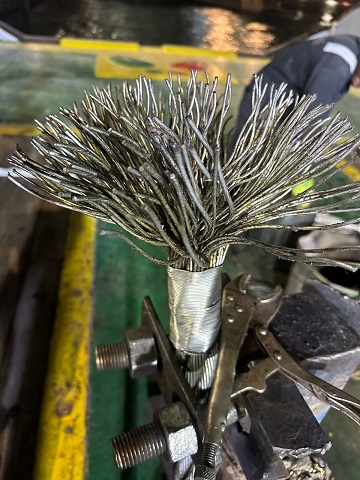
Socketing work is planned against rope construction, socket type, preparation method, resin or spelter system, curing controls and inspection requirements.
Technical datasheets and specification tables appear here only after approved content is entered in the CMS.
WHERE IT WORKS
TECHNICAL QUESTIONS
Start with the duty, design load, geometry, operating cycle, environment and governing project or classification requirement. Product selection must be checked against the approved technical datasheet.
State whether the duty is marine, offshore, port, shipyard, crane, piling, towing, construction or general industrial, because operating modes and acceptance criteria differ.
Confirm construction, assembly arrangement, end connections and any rotation, bending or articulation requirements before matching a configuration.
Review material grade, heat treatment, mechanical properties, coating and compatibility with connected components; appearance alone is not a material verification method.
Use the dimensional convention in the applicable product standard. Nominal size, measured diameter, pitch, throat, pin size and interface dimensions are not interchangeable.
Distinguish working load limit, safe working load, proof load, minimum breaking force and design factor. Never infer an allowable load directly from mass or physical size.
Specify the required certificate type, issuing body, traceability level, test standard and any classification-society endorsement before order confirmation.
Check identification, dimensions, visible damage, corrosion, deformation, coating condition, certificate references and quantity against the approved purchase documents.
Store clean, dry, supported and protected from incompatible chemicals, salt contamination, standing water, crushing and uncontrolled contact between dissimilar metals.
Use suitable lifting points and handling equipment. Do not drag, shock-load, kink, twist or lift an assembly through an unintended component.
Prepare an approved method statement covering equipment, access, load path, connection sequence, exclusion zone, communications and contingency arrangements.
Verify mating dimensions, pin and eye geometry, articulation, alignment, bearing area, material compatibility and the capacity of every component in the load path.
Select coating and preservation for seawater, splash-zone, submerged, coastal or industrial exposure, and include inspection access plus coating repair criteria.
Galvanized and ungalvanized finishes have different friction, dimensional and environmental implications; selection must follow the service condition and approved specification.
Base intervals on duty severity, operating frequency, manufacturer guidance, inspection findings and the applicable maintenance plan rather than a single universal calendar period.
Remove equipment from service when the governing standard or approved procedure limits for wear, deformation, cracking, corrosion, broken elements or damaged identification are reached.
Maintain a link between item marking, batch or serial reference, material/test certificate, inspection record and purchase documentation throughout the service life.
Restrain the load against movement, protect machined and coated surfaces, keep documentation dry and use supports that prevent bending, crushing or abrasion in transit.
Confirm environmental exposure, dynamic duty, fatigue demand, lifting or mooring procedure, certification level and operator requirements specific to the offshore project.
Account for quay geometry, bollards or handling points, vehicle movements, salt exposure, restricted access and simultaneous operations in the work plan.
Verify the equipment is approved for the intended crane, piling or heavy-lifting duty and that interfaces, reeving, bending radius and operating speed are compatible.
Provide seawater, chemical, abrasive, UV, submerged, splash-zone and temperature exposure details so material and protection systems can be evaluated.
Check the approved operating range and any reduction factors for material, coating, lubricant, resin, fibre or termination system at the expected minimum and maximum temperatures.
Use calibrated tools at defined measurement locations and compare readings with baseline dimensions and the rejection limits in the applicable inspection procedure.
Only competent personnel should plan, inspect and perform the work using approved procedures, task-specific PPE, controlled access and verified equipment capacity.
Provide application, quantity, nominal size, construction or type, dimensions, load requirement, end connections, finish, length, certificates, delivery point and required date.
Availability depends on exact size and configuration, quantity, certification, testing, fabrication or termination scope, inspection hold points and destination documentation.
Confirm emirate, site access, unloading method, delivery restrictions, contact person and whether special transport or handling controls apply.
Confirm destination-country customs documents, certificate legalization needs, packing list, origin documentation, transport mode and consignee/importer details.
Send drawings, photographs, equipment details, existing certificates and the governing specification; safety-critical recommendations remain subject to engineering approval.
TECHNICAL SUPPORT