

Home / Products / Anchors & Anchor Chain Systems
ANCHORS & ANCHOR CHAIN SYSTEMS
Anchor D-End Shackles
Marine product supply for vessel, offshore, shipyard and industrial requirements across the UAE & GCC.
Specification SupportType & compatibility
Marine & OffshoreWide applications
UAE & GCCSupply coverage
GLOBAL MARINE SOLUTIONS PARTNER




 01 / 10
Product Overview
Anchor D-End Shackles for Marine Anchor Connections
Al Areen Lifting & Mooring LLC is a UAE/GCC trader, Leading Supplier, Certified Supplier and Largest Stockist of Anchor D-End Shackles. As a No.1 Supplier, we support Best Quality sourcing through correct connection geometry, a compatible complete assembly and the documents required for your order.
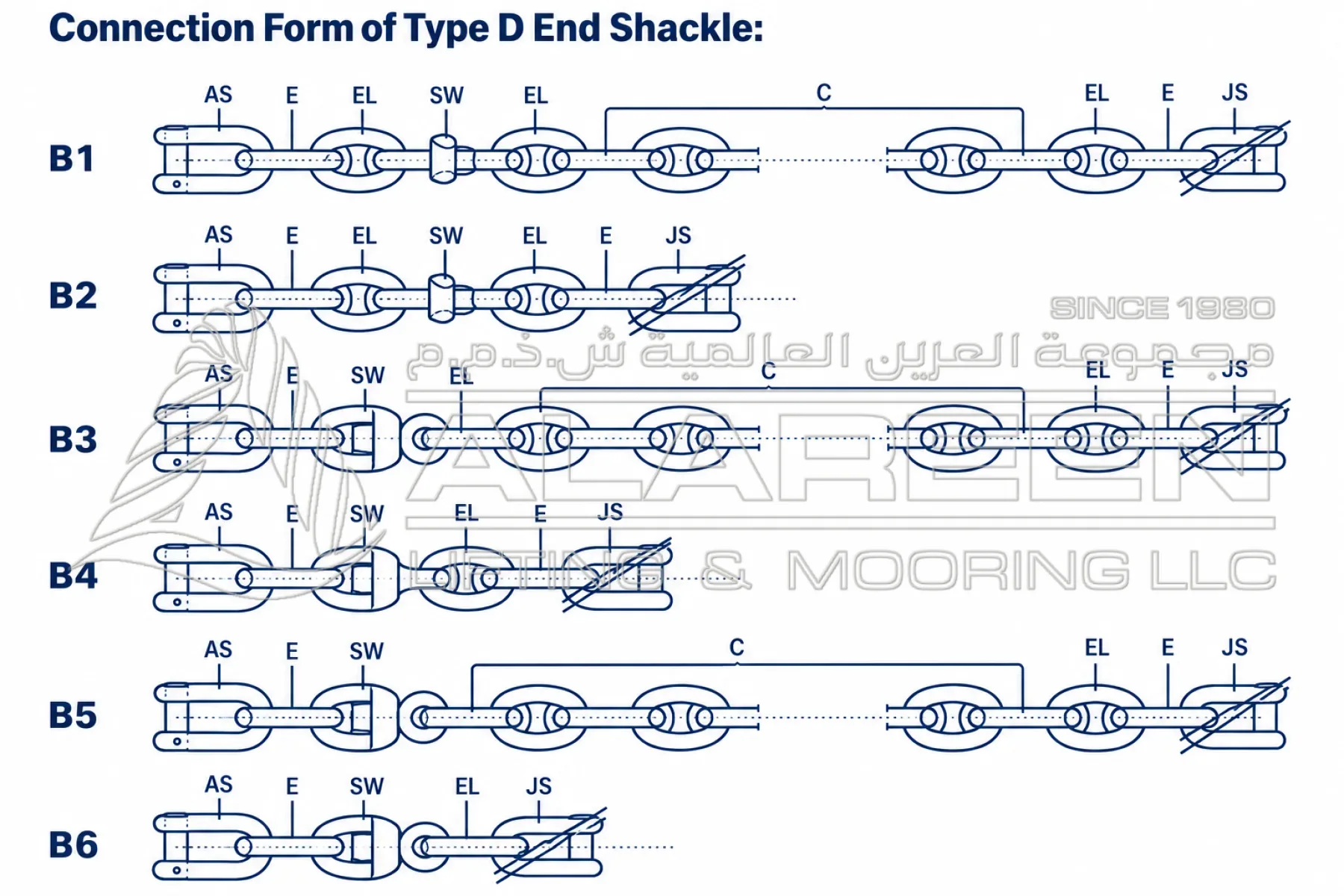
A marine D-end anchor shackle is an end connector in the vessel's anchoring arrangement. It connects the outboard anchor-cable arrangement to the anchor, commonly between an anchor crown shackle and the end link of a swivel forerunner. The approved drawing determines the actual sequence. D-type anchor shackle, anchor D-end shackle and anchor end shackle are recognised descriptions for this product family.
Body, Main Pin and Retaining Components
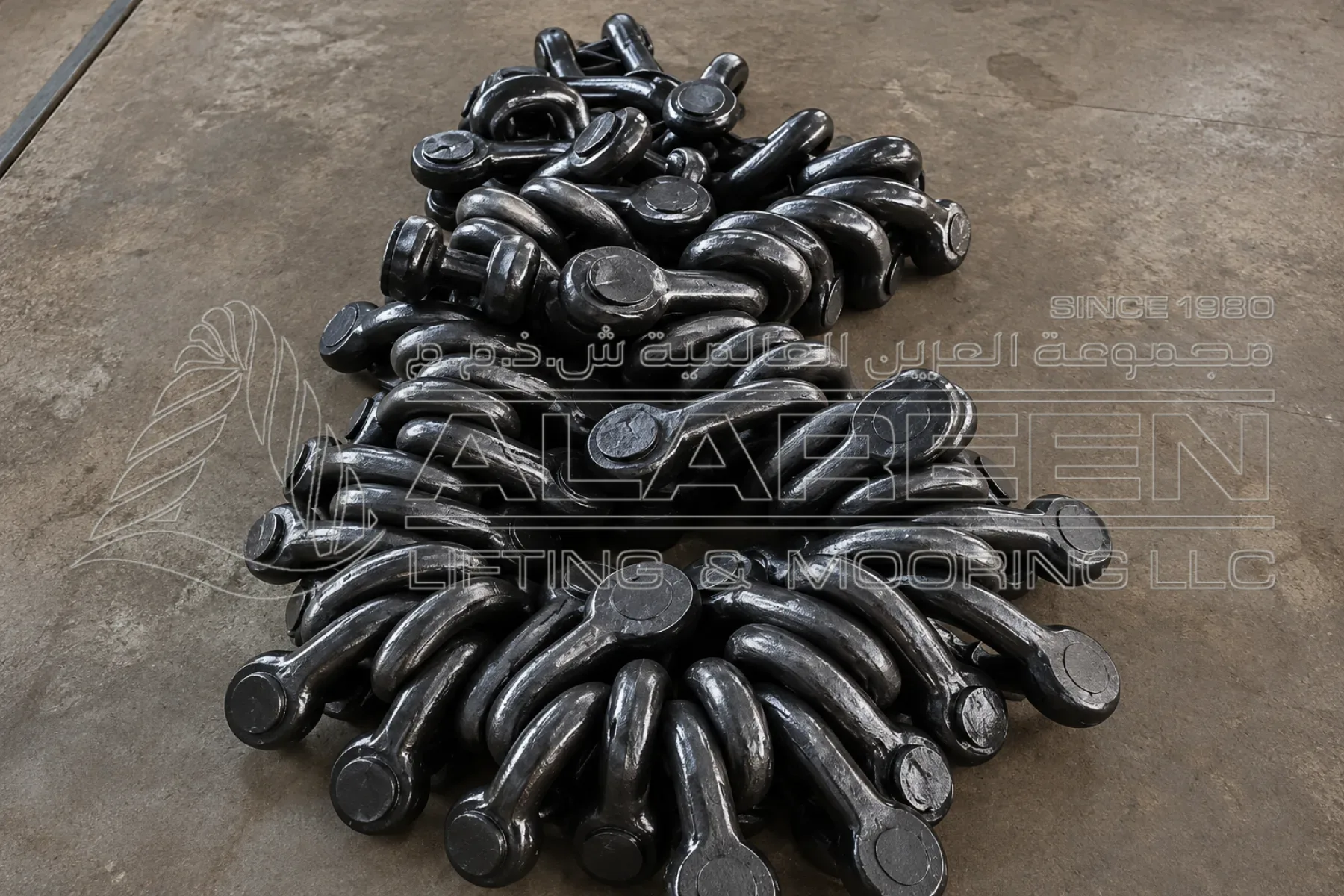
The conventional pattern consists of a shackle body with two eyes or lugs, a removable main pin and the specified pin-retaining components. Some marine D-end patterns have an oval-section main pin. Its section, seating and orientation must match the body and mating connection; a visually similar round pin is not an assumed replacement.
- Body: its opening, crown and eye geometry accommodate the specified anchor and cable components.
- Main pin: closes the body and forms part of the loaded connection. Confirm its section, fit, bearing dimensions and maker's identification.
- Retaining pin: the conventional taper-pin arrangement secures the main pin in its intended position.
- Locking or sealing component: where a lead-sealed retaining recess is specified, use the correct materials and the maker's installation procedure.
The body and main pin transmit load between the mating components. The smaller retaining pin has a separate securing function and cannot substitute for the main pin. Check component completeness and seating together with the required pin retention.
Confirm the Anchor-End Interface
Specify the anchor connection drawing, crown-shackle or shank connection details, and the adjoining end link, swivel or forerunner. Jaw opening, internal length, eye dimensions, main-pin section and bearing fit matter as well as strength. The connection must have the movement required by the design without binding, unintended contact or unacceptable loading against an edge.
Marine anchor-chain catalogues often reference accessories to the nominal diameter of the common chain link. That reference is not necessarily the end shackle's own body diameter or pin size. Give the chain's nominal diameter and the actual connector drawing or measurements; do not order from one unexplained diameter alone.
Check the complete outboard arrangement against hawse-pipe clearance, anchor stowage and the vessel's handling equipment. Replacing an anchor, crown shackle or forerunner can change the required end connector even when the main chain remains the same size.
Grades, Materials and Product Alternatives
Grade 2 and Grade 3 descriptions appear in marine D-end accessory catalogues. Specify the grade required by the vessel's approved anchoring arrangement and verify the offered item. An anchor's mass or holding-power designation alone does not establish the correct shackle size and grade. Offshore mooring grade designations require their own duty and approval assessment.
Steel marine end shackles are supplied with material and manufacturing requirements appropriate to their specified pattern and grade. Confirm the actual material, manufacturing route, treatment and finish in the quotation and records. Painted, galvanised or specialist material variants require separate confirmation; colour or appearance does not identify grade or certification.
A D-type joining shackle joins specified chain lengths and uses its own end-link arrangement. A Kenter joining shackle is a different detachable chain connector. A swivel provides a rotational interface. General lifting D shackles, bow shackles and small-craft connectors are also separate selections. None should be treated as an interchangeable anchor end shackle solely because it is called a shackle or has a similar nominal size.
Pear-shaped connectors and specialised anchor-joining patterns may be alternatives where the complete system is assessed and accepted. Permanent offshore mooring, towing and lifting require equipment selected and documented for those duties; an anchor-end catalogue listing is not a universal approval for them.
Installation, Retention and Inspection
A competent vessel or repair team should secure and support the anchor and cable, remove tension and isolate relevant machinery before opening the connection. Follow the actual maker's instructions for tools, main-pin seating, retaining-pin direction and locking or sealing. Protect personnel from suspended components, pinch points and lead exposure during the work.
After assembly, verify the main pin and its retaining components, the movement of adjoining parts and the approved stowage arrangement. Voyage vibration can affect an insecure pin; the vessel's anchoring and securing procedures should address retention and anchor movement.
Inspection should cover body and pin wear, cracks, corrosion, deformation, damaged eyes or bores, incomplete pin seating and loose, missing or deteriorated retaining components. Use the applicable manufacturer, vessel and classification criteria for limits and intervals. Do not improvise welding, heating, re-machining or pin substitutions on a doubtful assembly.
Documents for the Delivered Shackle
Request the specified material, identification, dimensional and test records, together with any required classification inspection or certificate. Confirm that the documents identify the delivered body and pin or the applicable assembly and production batch. Proof load, breaking strength and lifting WLL or SWL are different parameters and must not be interchanged.
ISO 1704:2022 addresses stud-link anchor-chain components, including end-shackle geometry, and contains provisions on material requirements, loading methods and marking. State the required standard and class basis in the enquiry, then verify the relevant compliance and test records. Naming a standard or describing Al Areen as a Certified Supplier does not establish approval of every offered item.
UAE & GCC Maritime Supply / Service Coverage
Al Areen supports D-end anchor-shackle supply enquiries for customers and vessel operations in and around these maritime hubs. At Port of Fujairah on the Gulf of Oman and Khor Fakkan Port on Sharjah's East Coast, vessel-call or anchorage-related replacement enquiries should identify the existing anchor connection, the required complete shackle or spare, and the receiving agent.
Mussafah Port enquiries can concern anchor-end fittings for identified workboats, marine-contractor craft and support vessels serving Abu Dhabi's industrial area. For Khalifa Port at Taweelah, ship managers can provide the vessel schedule and anchor-cable drawings when requesting a compatible replacement.
Port Rashid (Mina Rashid) enquiries may involve replacing an anchor-end component around a vessel call. Dubai Maritime City repair buyers can request a matched body-and-pin assembly for an existing connection. At Drydocks World Dubai, purchasing for planned anchor or cable work benefits from the approved connection sequence, dimensional checks and required survey documents.
Hamriyah Port and Hamriyah Free Zone enquiries can cover replacement anchor-end assemblies for commercial-vessel and contractor fleets. At Port of Duqm in Oman's Al Wusta Governorate, drydock and repair buyers may need the shackle matched to a retained anchor and renewed forerunner. For Khalifa Bin Salman Port in Hidd, Bahrain, enquiries can combine vessel receiving details with the connector's required grade, fit and documentation.
Supply enquiries also cover the other UAE emirates and wider Saudi Arabian, Omani, Qatari, Bahraini and Kuwaiti markets. Specify the exact port or yard and the vessel or consignee so the quotation addresses the required component and handover.
Request an Anchor End-Shackle Quotation
Use the procurement checklist below for a complete assembly, an identified replacement pin or a coordinated anchor-and-chain fitting package. Al Areen provides Fast UAE & GCC Delivery, 24/7 Customer Support and Stock Availability. Confirm the selected configuration, documents and receiving schedule in the quotation.
Technical Specifications
Request DatasheetAnchor D-End Shackles: Procurement Specification
Provide the existing connection drawing, markings and measurements together. A photograph helps identify the pattern but cannot establish grade, test status or approval.
| Specification input | Information to provide or confirm |
|---|---|
| Duty and approval basis | Vessel or equipment identification, anchor-end duty, approved arrangement, applicable standard and required classification scope. |
| Anchor-side connection | Anchor type and identification; crown-shackle or shank connection drawing, eye opening, thickness, bearing surfaces and permitted movement. |
| Cable-side connection | Retained or replacement end link, swivel or forerunner details, with link/bar dimensions and the complete component sequence. |
| Nominal chain reference | Common-link nominal bar diameter, units and chain grade; distinguish this reference from the shackle body and main-pin dimensions. |
| End-shackle pattern | Maker, drawing or part reference; internal length, jaw opening, body sections, eye/bore geometry and dimensional tolerances. |
| Main pin | Actual pin section, dimensions, seating, retention interface and identification; specify a complete matched pin rather than an unexplained diameter. |
| Retaining and locking arrangement | Required taper/retaining pin and any prescribed sealing or locking component. Confirm all parts supplied and the installation instructions. |
| Grade, material and finish | Required connector grade, material/manufacturing and treatment records where specified, finish and preservation requirements. |
| Clearance and articulation | Anchor stowage, hawse and handling-path requirements; mating-component movement and any proposed changes from the approved design. |
| Tests and certificates | Required material and dimensional records, proof-test documentation, applicable breaking-test evidence and specified class-related documents. |
| Traceability and inspection | Markings linking the delivered assembly to its records, body/pin identification and any specified receiving or nondestructive examination scope. |
| Quantity and logistics | Required quantity, complete assembly or precisely identified spare, destination, vessel schedule, receiving agent and required date. |
Acceptance and Test Terminology
State the required test basis and document scope rather than converting a breaking-load figure into a working rating. Confirm whether test evidence applies to the delivered assembly, the production batch or qualification specimens. Product acceptance includes fit and traceability as well as the specified strength requirements.
Receiving and Storage
At receipt, reconcile the assembly markings, body, main pin and retention components with the order and records. Keep compatible parts together, protect pin and bore surfaces, preserve identification and follow the maker's storage instructions. Inspect condition and completeness before installation after storage.
Applications Across Industry
FAQ
What are Anchor D-End Shackles?+
It is a marine end connector between the outboard anchor-cable arrangement and the anchor. A common arrangement connects the anchor crown shackle to the end link of a swivel forerunner; the approved drawing defines the actual sequence.
Which other names are used for this product?+
D-type anchor shackle, anchor D-end shackle and anchor end shackle are recognised descriptions. Specify the marine anchor-end function and drawing because the name D shackle is also used for different hardware.
How is a D-end anchor shackle different from a lifting D shackle?+
Their design duty, pin arrangement, dimensions and documentary basis can differ. A lifting rating or a similar D shape does not establish suitability for the vessel's anchor-end connection.
What components should a complete conventional assembly contain?+
Confirm the shackle body, compatible main pin, retaining pin and any prescribed locking or sealing component. The exact maker's drawing and instructions determine the complete scope.
What is the difference between the main pin and the retaining pin?+
The main pin closes the body and forms part of the loaded connection. The smaller retaining component secures that pin in position; it is not a replacement for the main load-carrying pin.
Do all D-end anchor shackles use a round pin?+
No. Oval-section main pins are documented in marine D-end patterns. Confirm the actual section, bore fit and orientation from the drawing instead of substituting a similar-looking round pin.
Can I fit a spare pin from a different maker?+
Do not assume interchangeability. Identify the body, pattern, markings and original pin dimensions, then obtain confirmation that the proposed spare meets the required fit, material and approval basis.
Can a crown shackle and a D-end shackle be treated as the same part?+
They have different positions in many anchor assemblies. Identify the anchor's crown connection and the detachable cable-side connector separately; use the approved drawing rather than appearance alone.
Can the shackle connect directly to an anchor shank?+
Some approved arrangements use a direct connection or a different outboard sequence. Confirm the anchor interface, connector geometry, articulation and required documents before selecting it.
What information is needed about the adjoining chain component?+
Provide the actual end link, swivel or forerunner drawing and measurements. Nominal chain diameter alone does not describe every opening, section or bearing interface at the anchor end.
Does the quoted chain diameter equal the end-shackle body diameter?+
Not necessarily. Marine accessory tables may use the common-link nominal diameter as a reference. State that chain size together with the actual shackle body and pin dimensions or drawing.
Which dimensions are most useful in a replacement enquiry?+
Provide the internal length, jaw opening, body sections, eye/bore geometry and main-pin section and dimensions, together with the mating anchor and cable components. Confirm the required tolerances from the specification.
How do I choose Grade 2 or Grade 3?+
Use the vessel's approved anchoring specification and the offered item's records. Catalogue grade options do not replace confirmation of the required connector and its complete mating arrangement.
Does anchor mass alone establish the correct shackle?+
No. Grade, connector geometry, mating openings, required strength and the vessel's approved arrangement must be considered. Submit the anchor identification and connection drawing with the enquiry.
Can a higher grade justify a smaller connector?+
A higher grade does not establish geometric fit or approval. Any reduction or substitution needs assessment of the complete anchor-end arrangement and the applicable requirements.
Is the material always stainless steel or always forged alloy steel?+
The product name does not establish one universal material or manufacturing route. Specify the required material, grade and records for the actual item; specialist variants need their own suitability assessment.
Does black paint or galvanising identify the grade?+
No. Finish is a separate specification parameter. Confirm grade and material from identification and required records, and state the coating or preservation needed for the order.
What is the difference from a D-type joining shackle?+
A joining shackle connects specified chain lengths using its required end-link sequence. An anchor end shackle connects the outboard cable arrangement to the anchor. Their geometry and duties should be identified separately.
Can a Kenter joining shackle replace the D-end anchor connector?+
Not by assumption. A conventional Kenter link serves chain joining; an anchor-specific connector requires its own approved design and mating-interface assessment.
Does a D-end shackle work as a swivel?+
No. A fixed end shackle and a swivel serve different functions. If rotation is required, use the specified swivel or swivel-shackle arrangement and verify its movement in the complete connection.
Can a pear-shaped shackle be substituted?+
Only after assessing the full connection. Its opening, pin, mating links and service basis may differ; obtain the required design and classification acceptance for any change.
Is this automatically suitable for permanent offshore mooring?+
No automatic equivalence follows from an anchor-end listing. Permanent mooring needs assessment of the connector's design duty, cyclic loading, fatigue, grade and approval scope.
Can an anchor end shackle be selected for towing or lifting from its breaking load?+
A catalogue breaking-load figure is not a towing or lifting working rating. Use equipment selected and documented for the intended duty and the actual connection arrangement.
Why must articulation and clearance be checked?+
The anchor and adjoining cable components need the movement permitted by the design. Restricted movement or unintended contact can create an unsuitable load path even where nominal sizes appear compatible.
Can changing the anchor affect the shackle selection?+
Yes. A different anchor connection can change jaw, pin and movement requirements. Check the retained cable, forerunner and stowage arrangement with the new anchor's drawing.
What should happen before the main pin is removed?+
A competent team should plan the work, secure and support the anchor and cable, remove tension and isolate relevant machinery. Follow the vessel procedure and the maker's disassembly instructions.
What must be checked after reassembly?+
Check main-pin seating, the correct retaining and locking components, the required movement of adjoining parts and the approved stowage arrangement. Do not return an incomplete or doubtful connection to service without assessment.
Does every design use the same lead-sealing procedure?+
No universal method should be assumed. Where lead sealing is specified, follow the actual maker's preparation and installation instructions and the applicable work procedure for lead handling.
Why is the taper-pin area important during inspection?+
Pin retention is essential to maintaining the connection. Look for insecure, missing or damaged retaining and sealing components; vibration and movement make correct retention and vessel securing procedures important.
Which defects should trigger further assessment?+
Cracks, deformation, excessive wear or corrosion, damaged eyes or bores, poor main-pin seating and uncertain retention require competent assessment against the applicable acceptance criteria.
Is there one universal wear limit or inspection interval?+
No single percentage or interval should be applied to every end-shackle design and duty. Use the actual maker's guidance together with the vessel and applicable classification requirements.
Can welding, grinding or heating repair a damaged shackle?+
Do not improvise such repairs. They can affect material properties and fit. A repair or modification needs the relevant maker's and applicable approval basis, together with the required subsequent inspection.
Does a reference to ISO 1704:2022 prove that an item is certified?+
No. The standard addresses stud-link chain components and their specified requirements. Compliance, tests and any classification certificate must be verified for the offered and delivered item.
Which certificates and records should be requested?+
Specify the required material, dimensional and test records, identification and traceability, plus any class inspection or certificate scope. Reconcile the documents with the delivered body, pin and assembly markings.
What is the difference between proof load, breaking load and WLL?+
They describe different test or service parameters. Ask for the values and basis required for the specified connector; do not convert anchor-chain strength information into a lifting working limit.
What does Certified Supplier mean for my product enquiry?+
It describes Al Areen's company positioning. The particular shackle still needs the material, test and classification evidence required by your order; no certification scheme or item approval should be inferred.
What helps a Fujairah or Khor Fakkan replacement enquiry?+
Send anchor and connector identification, mating-link details, required complete assembly or spare, vessel schedule and receiving-agent information. These support fit, documentation and handover planning.
What should a GCC drydock or port buyer include in the RFQ?+
Combine the technical drawing and required records with the exact country, port or yard, vessel or consignee, receiving agent and required date. Identify any anchor or forerunner change in the repair scope.
How should a spare body and main pin be stored?+
Keep compatible parts together, protect pin and bore surfaces and identification, and preserve the assembly according to the maker's instructions. Inspect condition and completeness before installation.
Does Stock Availability confirm immediate supply of my exact size and grade?+
Confirm the pattern, size, grade, complete component scope and required documents in the quotation. The company-wide statement does not by itself specify a particular configuration or guaranteed delivery date.
Does Al Areen manufacture these anchor shackles?+
Al Areen Lifting & Mooring LLC acts as a UAE/GCC trader, supplier and stockist. Confirm the offered maker, exact assembly specification and relevant product documents for your order.
Product Overview
Anchor D-End Shackles for Marine Anchor Connections
Al Areen Lifting & Mooring LLC is a UAE/GCC trader, Leading Supplier, Certified Supplier and Largest Stockist of Anchor D-End Shackles. As a No.1 Supplier, we support Best Quality sourcing through correct connection geometry, a compatible complete assembly and the documents required for your order.
A marine D-end anchor shackle is an end connector in the vessel's anchoring arrangement. It connects the outboard anchor-cable arrangement to the anchor, commonly between an anchor crown shackle and the end link of a swivel forerunner. The approved drawing determines the actual sequence. D-type anchor shackle, anchor D-end shackle and anchor end shackle are recognised descriptions for this product family.
Body, Main Pin and Retaining Components
The conventional pattern consists of a shackle body with two eyes or lugs, a removable main pin and the specified pin-retaining components. Some marine D-end patterns have an oval-section main pin. Its section, seating and orientation must match the body and mating connection; a visually similar round pin is not an assumed replacement.
- Body: its opening, crown and eye geometry accommodate the specified anchor and cable components.
- Main pin: closes the body and forms part of the loaded connection. Confirm its section, fit, bearing dimensions and maker's identification.
- Retaining pin: the conventional taper-pin arrangement secures the main pin in its intended position.
- Locking or sealing component: where a lead-sealed retaining recess is specified, use the correct materials and the maker's installation procedure.
The body and main pin transmit load between the mating components. The smaller retaining pin has a separate securing function and cannot substitute for the main pin. Check component completeness and seating together with the required pin retention.
Confirm the Anchor-End Interface
Specify the anchor connection drawing, crown-shackle or shank connection details, and the adjoining end link, swivel or forerunner. Jaw opening, internal length, eye dimensions, main-pin section and bearing fit matter as well as strength. The connection must have the movement required by the design without binding, unintended contact or unacceptable loading against an edge.
Marine anchor-chain catalogues often reference accessories to the nominal diameter of the common chain link. That reference is not necessarily the end shackle's own body diameter or pin size. Give the chain's nominal diameter and the actual connector drawing or measurements; do not order from one unexplained diameter alone.
Check the complete outboard arrangement against hawse-pipe clearance, anchor stowage and the vessel's handling equipment. Replacing an anchor, crown shackle or forerunner can change the required end connector even when the main chain remains the same size.
Grades, Materials and Product Alternatives
Grade 2 and Grade 3 descriptions appear in marine D-end accessory catalogues. Specify the grade required by the vessel's approved anchoring arrangement and verify the offered item. An anchor's mass or holding-power designation alone does not establish the correct shackle size and grade. Offshore mooring grade designations require their own duty and approval assessment.
Steel marine end shackles are supplied with material and manufacturing requirements appropriate to their specified pattern and grade. Confirm the actual material, manufacturing route, treatment and finish in the quotation and records. Painted, galvanised or specialist material variants require separate confirmation; colour or appearance does not identify grade or certification.
A D-type joining shackle joins specified chain lengths and uses its own end-link arrangement. A Kenter joining shackle is a different detachable chain connector. A swivel provides a rotational interface. General lifting D shackles, bow shackles and small-craft connectors are also separate selections. None should be treated as an interchangeable anchor end shackle solely because it is called a shackle or has a similar nominal size.
Pear-shaped connectors and specialised anchor-joining patterns may be alternatives where the complete system is assessed and accepted. Permanent offshore mooring, towing and lifting require equipment selected and documented for those duties; an anchor-end catalogue listing is not a universal approval for them.
Installation, Retention and Inspection
A competent vessel or repair team should secure and support the anchor and cable, remove tension and isolate relevant machinery before opening the connection. Follow the actual maker's instructions for tools, main-pin seating, retaining-pin direction and locking or sealing. Protect personnel from suspended components, pinch points and lead exposure during the work.
After assembly, verify the main pin and its retaining components, the movement of adjoining parts and the approved stowage arrangement. Voyage vibration can affect an insecure pin; the vessel's anchoring and securing procedures should address retention and anchor movement.
Inspection should cover body and pin wear, cracks, corrosion, deformation, damaged eyes or bores, incomplete pin seating and loose, missing or deteriorated retaining components. Use the applicable manufacturer, vessel and classification criteria for limits and intervals. Do not improvise welding, heating, re-machining or pin substitutions on a doubtful assembly.
Documents for the Delivered Shackle
Request the specified material, identification, dimensional and test records, together with any required classification inspection or certificate. Confirm that the documents identify the delivered body and pin or the applicable assembly and production batch. Proof load, breaking strength and lifting WLL or SWL are different parameters and must not be interchanged.
ISO 1704:2022 addresses stud-link anchor-chain components, including end-shackle geometry, and contains provisions on material requirements, loading methods and marking. State the required standard and class basis in the enquiry, then verify the relevant compliance and test records. Naming a standard or describing Al Areen as a Certified Supplier does not establish approval of every offered item.
UAE & GCC Maritime Supply / Service Coverage
Al Areen supports D-end anchor-shackle supply enquiries for customers and vessel operations in and around these maritime hubs. At Port of Fujairah on the Gulf of Oman and Khor Fakkan Port on Sharjah's East Coast, vessel-call or anchorage-related replacement enquiries should identify the existing anchor connection, the required complete shackle or spare, and the receiving agent.
Mussafah Port enquiries can concern anchor-end fittings for identified workboats, marine-contractor craft and support vessels serving Abu Dhabi's industrial area. For Khalifa Port at Taweelah, ship managers can provide the vessel schedule and anchor-cable drawings when requesting a compatible replacement.
Port Rashid (Mina Rashid) enquiries may involve replacing an anchor-end component around a vessel call. Dubai Maritime City repair buyers can request a matched body-and-pin assembly for an existing connection. At Drydocks World Dubai, purchasing for planned anchor or cable work benefits from the approved connection sequence, dimensional checks and required survey documents.
Hamriyah Port and Hamriyah Free Zone enquiries can cover replacement anchor-end assemblies for commercial-vessel and contractor fleets. At Port of Duqm in Oman's Al Wusta Governorate, drydock and repair buyers may need the shackle matched to a retained anchor and renewed forerunner. For Khalifa Bin Salman Port in Hidd, Bahrain, enquiries can combine vessel receiving details with the connector's required grade, fit and documentation.
Supply enquiries also cover the other UAE emirates and wider Saudi Arabian, Omani, Qatari, Bahraini and Kuwaiti markets. Specify the exact port or yard and the vessel or consignee so the quotation addresses the required component and handover.
Request an Anchor End-Shackle Quotation
Use the procurement checklist below for a complete assembly, an identified replacement pin or a coordinated anchor-and-chain fitting package. Al Areen provides Fast UAE & GCC Delivery, 24/7 Customer Support and Stock Availability. Confirm the selected configuration, documents and receiving schedule in the quotation.
01 / 10
Technical Specifications
Request DatasheetAnchor D-End Shackles: Procurement Specification
Provide the existing connection drawing, markings and measurements together. A photograph helps identify the pattern but cannot establish grade, test status or approval.
| Specification input | Information to provide or confirm |
|---|---|
| Duty and approval basis | Vessel or equipment identification, anchor-end duty, approved arrangement, applicable standard and required classification scope. |
| Anchor-side connection | Anchor type and identification; crown-shackle or shank connection drawing, eye opening, thickness, bearing surfaces and permitted movement. |
| Cable-side connection | Retained or replacement end link, swivel or forerunner details, with link/bar dimensions and the complete component sequence. |
| Nominal chain reference | Common-link nominal bar diameter, units and chain grade; distinguish this reference from the shackle body and main-pin dimensions. |
| End-shackle pattern | Maker, drawing or part reference; internal length, jaw opening, body sections, eye/bore geometry and dimensional tolerances. |
| Main pin | Actual pin section, dimensions, seating, retention interface and identification; specify a complete matched pin rather than an unexplained diameter. |
| Retaining and locking arrangement | Required taper/retaining pin and any prescribed sealing or locking component. Confirm all parts supplied and the installation instructions. |
| Grade, material and finish | Required connector grade, material/manufacturing and treatment records where specified, finish and preservation requirements. |
| Clearance and articulation | Anchor stowage, hawse and handling-path requirements; mating-component movement and any proposed changes from the approved design. |
| Tests and certificates | Required material and dimensional records, proof-test documentation, applicable breaking-test evidence and specified class-related documents. |
| Traceability and inspection | Markings linking the delivered assembly to its records, body/pin identification and any specified receiving or nondestructive examination scope. |
| Quantity and logistics | Required quantity, complete assembly or precisely identified spare, destination, vessel schedule, receiving agent and required date. |
Acceptance and Test Terminology
State the required test basis and document scope rather than converting a breaking-load figure into a working rating. Confirm whether test evidence applies to the delivered assembly, the production batch or qualification specimens. Product acceptance includes fit and traceability as well as the specified strength requirements.
Receiving and Storage
At receipt, reconcile the assembly markings, body, main pin and retention components with the order and records. Keep compatible parts together, protect pin and bore surfaces, preserve identification and follow the maker's storage instructions. Inspect condition and completeness before installation after storage.
Applications Across Industry
FAQ
What are Anchor D-End Shackles?+
It is a marine end connector between the outboard anchor-cable arrangement and the anchor. A common arrangement connects the anchor crown shackle to the end link of a swivel forerunner; the approved drawing defines the actual sequence.
Which other names are used for this product?+
D-type anchor shackle, anchor D-end shackle and anchor end shackle are recognised descriptions. Specify the marine anchor-end function and drawing because the name D shackle is also used for different hardware.
How is a D-end anchor shackle different from a lifting D shackle?+
Their design duty, pin arrangement, dimensions and documentary basis can differ. A lifting rating or a similar D shape does not establish suitability for the vessel's anchor-end connection.
What components should a complete conventional assembly contain?+
Confirm the shackle body, compatible main pin, retaining pin and any prescribed locking or sealing component. The exact maker's drawing and instructions determine the complete scope.
What is the difference between the main pin and the retaining pin?+
The main pin closes the body and forms part of the loaded connection. The smaller retaining component secures that pin in position; it is not a replacement for the main load-carrying pin.
Do all D-end anchor shackles use a round pin?+
No. Oval-section main pins are documented in marine D-end patterns. Confirm the actual section, bore fit and orientation from the drawing instead of substituting a similar-looking round pin.
Can I fit a spare pin from a different maker?+
Do not assume interchangeability. Identify the body, pattern, markings and original pin dimensions, then obtain confirmation that the proposed spare meets the required fit, material and approval basis.
Can a crown shackle and a D-end shackle be treated as the same part?+
They have different positions in many anchor assemblies. Identify the anchor's crown connection and the detachable cable-side connector separately; use the approved drawing rather than appearance alone.
Can the shackle connect directly to an anchor shank?+
Some approved arrangements use a direct connection or a different outboard sequence. Confirm the anchor interface, connector geometry, articulation and required documents before selecting it.
What information is needed about the adjoining chain component?+
Provide the actual end link, swivel or forerunner drawing and measurements. Nominal chain diameter alone does not describe every opening, section or bearing interface at the anchor end.
Does the quoted chain diameter equal the end-shackle body diameter?+
Not necessarily. Marine accessory tables may use the common-link nominal diameter as a reference. State that chain size together with the actual shackle body and pin dimensions or drawing.
Which dimensions are most useful in a replacement enquiry?+
Provide the internal length, jaw opening, body sections, eye/bore geometry and main-pin section and dimensions, together with the mating anchor and cable components. Confirm the required tolerances from the specification.
How do I choose Grade 2 or Grade 3?+
Use the vessel's approved anchoring specification and the offered item's records. Catalogue grade options do not replace confirmation of the required connector and its complete mating arrangement.
Does anchor mass alone establish the correct shackle?+
No. Grade, connector geometry, mating openings, required strength and the vessel's approved arrangement must be considered. Submit the anchor identification and connection drawing with the enquiry.
Can a higher grade justify a smaller connector?+
A higher grade does not establish geometric fit or approval. Any reduction or substitution needs assessment of the complete anchor-end arrangement and the applicable requirements.
Is the material always stainless steel or always forged alloy steel?+
The product name does not establish one universal material or manufacturing route. Specify the required material, grade and records for the actual item; specialist variants need their own suitability assessment.
Does black paint or galvanising identify the grade?+
No. Finish is a separate specification parameter. Confirm grade and material from identification and required records, and state the coating or preservation needed for the order.
What is the difference from a D-type joining shackle?+
A joining shackle connects specified chain lengths using its required end-link sequence. An anchor end shackle connects the outboard cable arrangement to the anchor. Their geometry and duties should be identified separately.
Can a Kenter joining shackle replace the D-end anchor connector?+
Not by assumption. A conventional Kenter link serves chain joining; an anchor-specific connector requires its own approved design and mating-interface assessment.
Does a D-end shackle work as a swivel?+
No. A fixed end shackle and a swivel serve different functions. If rotation is required, use the specified swivel or swivel-shackle arrangement and verify its movement in the complete connection.
Can a pear-shaped shackle be substituted?+
Only after assessing the full connection. Its opening, pin, mating links and service basis may differ; obtain the required design and classification acceptance for any change.
Is this automatically suitable for permanent offshore mooring?+
No automatic equivalence follows from an anchor-end listing. Permanent mooring needs assessment of the connector's design duty, cyclic loading, fatigue, grade and approval scope.
Can an anchor end shackle be selected for towing or lifting from its breaking load?+
A catalogue breaking-load figure is not a towing or lifting working rating. Use equipment selected and documented for the intended duty and the actual connection arrangement.
Why must articulation and clearance be checked?+
The anchor and adjoining cable components need the movement permitted by the design. Restricted movement or unintended contact can create an unsuitable load path even where nominal sizes appear compatible.
Can changing the anchor affect the shackle selection?+
Yes. A different anchor connection can change jaw, pin and movement requirements. Check the retained cable, forerunner and stowage arrangement with the new anchor's drawing.
What should happen before the main pin is removed?+
A competent team should plan the work, secure and support the anchor and cable, remove tension and isolate relevant machinery. Follow the vessel procedure and the maker's disassembly instructions.
What must be checked after reassembly?+
Check main-pin seating, the correct retaining and locking components, the required movement of adjoining parts and the approved stowage arrangement. Do not return an incomplete or doubtful connection to service without assessment.
Does every design use the same lead-sealing procedure?+
No universal method should be assumed. Where lead sealing is specified, follow the actual maker's preparation and installation instructions and the applicable work procedure for lead handling.
Why is the taper-pin area important during inspection?+
Pin retention is essential to maintaining the connection. Look for insecure, missing or damaged retaining and sealing components; vibration and movement make correct retention and vessel securing procedures important.
Which defects should trigger further assessment?+
Cracks, deformation, excessive wear or corrosion, damaged eyes or bores, poor main-pin seating and uncertain retention require competent assessment against the applicable acceptance criteria.
Is there one universal wear limit or inspection interval?+
No single percentage or interval should be applied to every end-shackle design and duty. Use the actual maker's guidance together with the vessel and applicable classification requirements.
Can welding, grinding or heating repair a damaged shackle?+
Do not improvise such repairs. They can affect material properties and fit. A repair or modification needs the relevant maker's and applicable approval basis, together with the required subsequent inspection.
Does a reference to ISO 1704:2022 prove that an item is certified?+
No. The standard addresses stud-link chain components and their specified requirements. Compliance, tests and any classification certificate must be verified for the offered and delivered item.
Which certificates and records should be requested?+
Specify the required material, dimensional and test records, identification and traceability, plus any class inspection or certificate scope. Reconcile the documents with the delivered body, pin and assembly markings.
What is the difference between proof load, breaking load and WLL?+
They describe different test or service parameters. Ask for the values and basis required for the specified connector; do not convert anchor-chain strength information into a lifting working limit.
What does Certified Supplier mean for my product enquiry?+
It describes Al Areen's company positioning. The particular shackle still needs the material, test and classification evidence required by your order; no certification scheme or item approval should be inferred.
What helps a Fujairah or Khor Fakkan replacement enquiry?+
Send anchor and connector identification, mating-link details, required complete assembly or spare, vessel schedule and receiving-agent information. These support fit, documentation and handover planning.
What should a GCC drydock or port buyer include in the RFQ?+
Combine the technical drawing and required records with the exact country, port or yard, vessel or consignee, receiving agent and required date. Identify any anchor or forerunner change in the repair scope.
How should a spare body and main pin be stored?+
Keep compatible parts together, protect pin and bore surfaces and identification, and preserve the assembly according to the maker's instructions. Inspect condition and completeness before installation.
Does Stock Availability confirm immediate supply of my exact size and grade?+
Confirm the pattern, size, grade, complete component scope and required documents in the quotation. The company-wide statement does not by itself specify a particular configuration or guaranteed delivery date.
Does Al Areen manufacture these anchor shackles?+
Al Areen Lifting & Mooring LLC acts as a UAE/GCC trader, supplier and stockist. Confirm the offered maker, exact assembly specification and relevant product documents for your order.
Technical Specifications+
Anchor D-End Shackles: Procurement Specification
Provide the existing connection drawing, markings and measurements together. A photograph helps identify the pattern but cannot establish grade, test status or approval.
| Specification input | Information to provide or confirm |
|---|---|
| Duty and approval basis | Vessel or equipment identification, anchor-end duty, approved arrangement, applicable standard and required classification scope. |
| Anchor-side connection | Anchor type and identification; crown-shackle or shank connection drawing, eye opening, thickness, bearing surfaces and permitted movement. |
| Cable-side connection | Retained or replacement end link, swivel or forerunner details, with link/bar dimensions and the complete component sequence. |
| Nominal chain reference | Common-link nominal bar diameter, units and chain grade; distinguish this reference from the shackle body and main-pin dimensions. |
| End-shackle pattern | Maker, drawing or part reference; internal length, jaw opening, body sections, eye/bore geometry and dimensional tolerances. |
| Main pin | Actual pin section, dimensions, seating, retention interface and identification; specify a complete matched pin rather than an unexplained diameter. |
| Retaining and locking arrangement | Required taper/retaining pin and any prescribed sealing or locking component. Confirm all parts supplied and the installation instructions. |
| Grade, material and finish | Required connector grade, material/manufacturing and treatment records where specified, finish and preservation requirements. |
| Clearance and articulation | Anchor stowage, hawse and handling-path requirements; mating-component movement and any proposed changes from the approved design. |
| Tests and certificates | Required material and dimensional records, proof-test documentation, applicable breaking-test evidence and specified class-related documents. |
| Traceability and inspection | Markings linking the delivered assembly to its records, body/pin identification and any specified receiving or nondestructive examination scope. |
| Quantity and logistics | Required quantity, complete assembly or precisely identified spare, destination, vessel schedule, receiving agent and required date. |
Acceptance and Test Terminology
State the required test basis and document scope rather than converting a breaking-load figure into a working rating. Confirm whether test evidence applies to the delivered assembly, the production batch or qualification specimens. Product acceptance includes fit and traceability as well as the specified strength requirements.
Receiving and Storage
At receipt, reconcile the assembly markings, body, main pin and retention components with the order and records. Keep compatible parts together, protect pin and bore surfaces, preserve identification and follow the maker's storage instructions. Inspect condition and completeness before installation after storage.
Applications Across Industry+
FAQ+
What are Anchor D-End Shackles?+
It is a marine end connector between the outboard anchor-cable arrangement and the anchor. A common arrangement connects the anchor crown shackle to the end link of a swivel forerunner; the approved drawing defines the actual sequence.
Which other names are used for this product?+
D-type anchor shackle, anchor D-end shackle and anchor end shackle are recognised descriptions. Specify the marine anchor-end function and drawing because the name D shackle is also used for different hardware.
How is a D-end anchor shackle different from a lifting D shackle?+
Their design duty, pin arrangement, dimensions and documentary basis can differ. A lifting rating or a similar D shape does not establish suitability for the vessel's anchor-end connection.
What components should a complete conventional assembly contain?+
Confirm the shackle body, compatible main pin, retaining pin and any prescribed locking or sealing component. The exact maker's drawing and instructions determine the complete scope.
What is the difference between the main pin and the retaining pin?+
The main pin closes the body and forms part of the loaded connection. The smaller retaining component secures that pin in position; it is not a replacement for the main load-carrying pin.
Do all D-end anchor shackles use a round pin?+
No. Oval-section main pins are documented in marine D-end patterns. Confirm the actual section, bore fit and orientation from the drawing instead of substituting a similar-looking round pin.
Can I fit a spare pin from a different maker?+
Do not assume interchangeability. Identify the body, pattern, markings and original pin dimensions, then obtain confirmation that the proposed spare meets the required fit, material and approval basis.
Can a crown shackle and a D-end shackle be treated as the same part?+
They have different positions in many anchor assemblies. Identify the anchor's crown connection and the detachable cable-side connector separately; use the approved drawing rather than appearance alone.
Can the shackle connect directly to an anchor shank?+
Some approved arrangements use a direct connection or a different outboard sequence. Confirm the anchor interface, connector geometry, articulation and required documents before selecting it.
What information is needed about the adjoining chain component?+
Provide the actual end link, swivel or forerunner drawing and measurements. Nominal chain diameter alone does not describe every opening, section or bearing interface at the anchor end.
Does the quoted chain diameter equal the end-shackle body diameter?+
Not necessarily. Marine accessory tables may use the common-link nominal diameter as a reference. State that chain size together with the actual shackle body and pin dimensions or drawing.
Which dimensions are most useful in a replacement enquiry?+
Provide the internal length, jaw opening, body sections, eye/bore geometry and main-pin section and dimensions, together with the mating anchor and cable components. Confirm the required tolerances from the specification.
How do I choose Grade 2 or Grade 3?+
Use the vessel's approved anchoring specification and the offered item's records. Catalogue grade options do not replace confirmation of the required connector and its complete mating arrangement.
Does anchor mass alone establish the correct shackle?+
No. Grade, connector geometry, mating openings, required strength and the vessel's approved arrangement must be considered. Submit the anchor identification and connection drawing with the enquiry.
Can a higher grade justify a smaller connector?+
A higher grade does not establish geometric fit or approval. Any reduction or substitution needs assessment of the complete anchor-end arrangement and the applicable requirements.
Is the material always stainless steel or always forged alloy steel?+
The product name does not establish one universal material or manufacturing route. Specify the required material, grade and records for the actual item; specialist variants need their own suitability assessment.
Does black paint or galvanising identify the grade?+
No. Finish is a separate specification parameter. Confirm grade and material from identification and required records, and state the coating or preservation needed for the order.
What is the difference from a D-type joining shackle?+
A joining shackle connects specified chain lengths using its required end-link sequence. An anchor end shackle connects the outboard cable arrangement to the anchor. Their geometry and duties should be identified separately.
Can a Kenter joining shackle replace the D-end anchor connector?+
Not by assumption. A conventional Kenter link serves chain joining; an anchor-specific connector requires its own approved design and mating-interface assessment.
Does a D-end shackle work as a swivel?+
No. A fixed end shackle and a swivel serve different functions. If rotation is required, use the specified swivel or swivel-shackle arrangement and verify its movement in the complete connection.
Can a pear-shaped shackle be substituted?+
Only after assessing the full connection. Its opening, pin, mating links and service basis may differ; obtain the required design and classification acceptance for any change.
Is this automatically suitable for permanent offshore mooring?+
No automatic equivalence follows from an anchor-end listing. Permanent mooring needs assessment of the connector's design duty, cyclic loading, fatigue, grade and approval scope.
Can an anchor end shackle be selected for towing or lifting from its breaking load?+
A catalogue breaking-load figure is not a towing or lifting working rating. Use equipment selected and documented for the intended duty and the actual connection arrangement.
Why must articulation and clearance be checked?+
The anchor and adjoining cable components need the movement permitted by the design. Restricted movement or unintended contact can create an unsuitable load path even where nominal sizes appear compatible.
Can changing the anchor affect the shackle selection?+
Yes. A different anchor connection can change jaw, pin and movement requirements. Check the retained cable, forerunner and stowage arrangement with the new anchor's drawing.
What should happen before the main pin is removed?+
A competent team should plan the work, secure and support the anchor and cable, remove tension and isolate relevant machinery. Follow the vessel procedure and the maker's disassembly instructions.
What must be checked after reassembly?+
Check main-pin seating, the correct retaining and locking components, the required movement of adjoining parts and the approved stowage arrangement. Do not return an incomplete or doubtful connection to service without assessment.
Does every design use the same lead-sealing procedure?+
No universal method should be assumed. Where lead sealing is specified, follow the actual maker's preparation and installation instructions and the applicable work procedure for lead handling.
Why is the taper-pin area important during inspection?+
Pin retention is essential to maintaining the connection. Look for insecure, missing or damaged retaining and sealing components; vibration and movement make correct retention and vessel securing procedures important.
Which defects should trigger further assessment?+
Cracks, deformation, excessive wear or corrosion, damaged eyes or bores, poor main-pin seating and uncertain retention require competent assessment against the applicable acceptance criteria.
Is there one universal wear limit or inspection interval?+
No single percentage or interval should be applied to every end-shackle design and duty. Use the actual maker's guidance together with the vessel and applicable classification requirements.
Can welding, grinding or heating repair a damaged shackle?+
Do not improvise such repairs. They can affect material properties and fit. A repair or modification needs the relevant maker's and applicable approval basis, together with the required subsequent inspection.
Does a reference to ISO 1704:2022 prove that an item is certified?+
No. The standard addresses stud-link chain components and their specified requirements. Compliance, tests and any classification certificate must be verified for the offered and delivered item.
Which certificates and records should be requested?+
Specify the required material, dimensional and test records, identification and traceability, plus any class inspection or certificate scope. Reconcile the documents with the delivered body, pin and assembly markings.
What is the difference between proof load, breaking load and WLL?+
They describe different test or service parameters. Ask for the values and basis required for the specified connector; do not convert anchor-chain strength information into a lifting working limit.
What does Certified Supplier mean for my product enquiry?+
It describes Al Areen's company positioning. The particular shackle still needs the material, test and classification evidence required by your order; no certification scheme or item approval should be inferred.
What helps a Fujairah or Khor Fakkan replacement enquiry?+
Send anchor and connector identification, mating-link details, required complete assembly or spare, vessel schedule and receiving-agent information. These support fit, documentation and handover planning.
What should a GCC drydock or port buyer include in the RFQ?+
Combine the technical drawing and required records with the exact country, port or yard, vessel or consignee, receiving agent and required date. Identify any anchor or forerunner change in the repair scope.
How should a spare body and main pin be stored?+
Keep compatible parts together, protect pin and bore surfaces and identification, and preserve the assembly according to the maker's instructions. Inspect condition and completeness before installation.
Does Stock Availability confirm immediate supply of my exact size and grade?+
Confirm the pattern, size, grade, complete component scope and required documents in the quotation. The company-wide statement does not by itself specify a particular configuration or guaranteed delivery date.
Does Al Areen manufacture these anchor shackles?+
Al Areen Lifting & Mooring LLC acts as a UAE/GCC trader, supplier and stockist. Confirm the offered maker, exact assembly specification and relevant product documents for your order.
Need help selecting the right product?
Our team will help you choose the best solution for your application.