

Home / Products / Anchors & Anchor Chain Systems
ANCHORS & ANCHOR CHAIN SYSTEMS
Kenter Joining Shackles
Marine product supply for vessel, offshore, shipyard and industrial requirements across the UAE & GCC.
Specification SupportType & compatibility
Marine & OffshoreWide applications
UAE & GCCSupply coverage
GLOBAL MARINE SOLUTIONS PARTNER
 01 / 15
Product Overview
Kenter Joining Shackles for Anchor Chain Connections
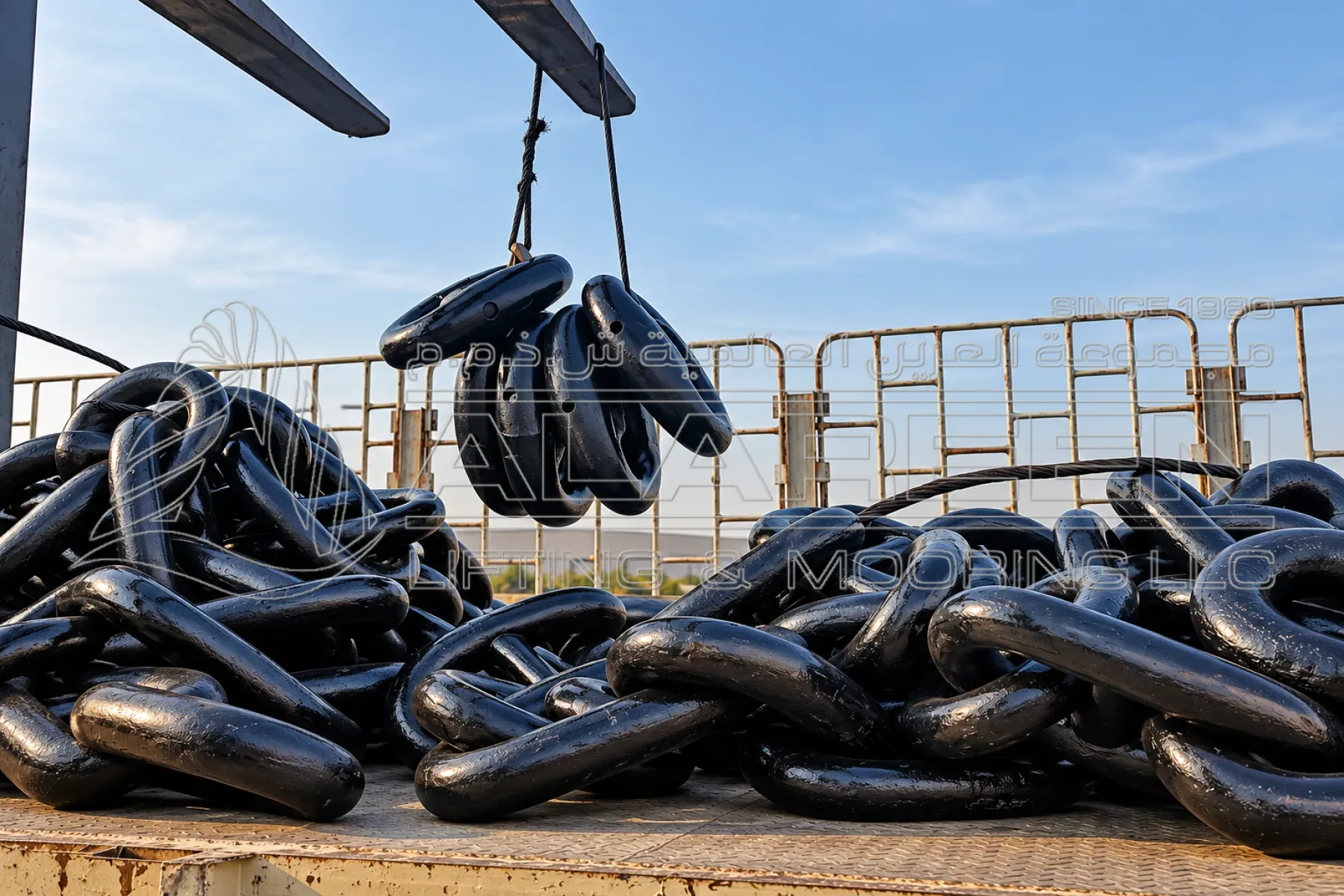
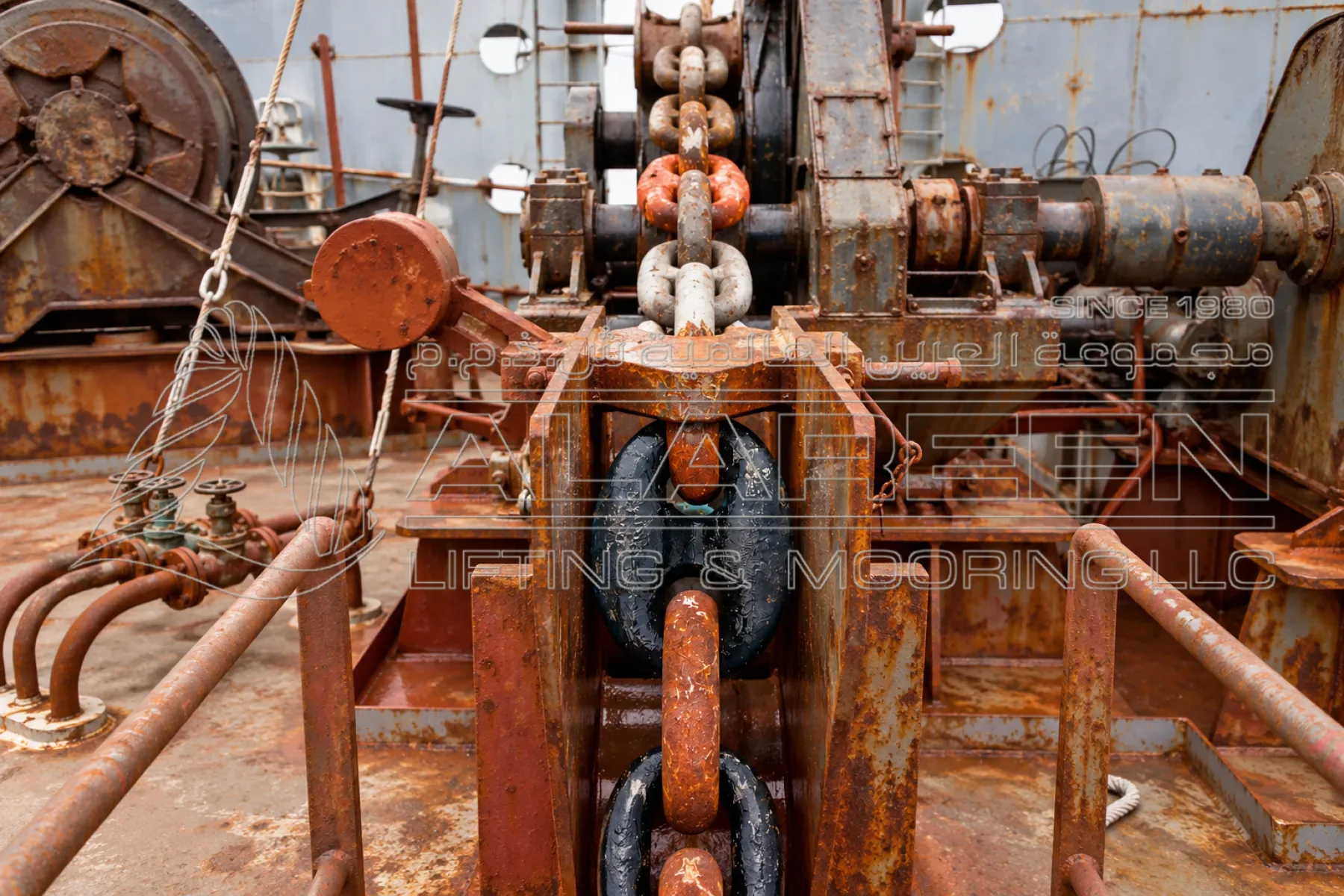
Al Areen Lifting & Mooring LLC is a UAE/GCC trader, Leading Supplier, Certified Supplier and Largest Stockist of Kenter Joining Shackles. As a No.1 Supplier, we support Best Quality sourcing through correct chain matching, complete connector assemblies and the documentation specified for your order.
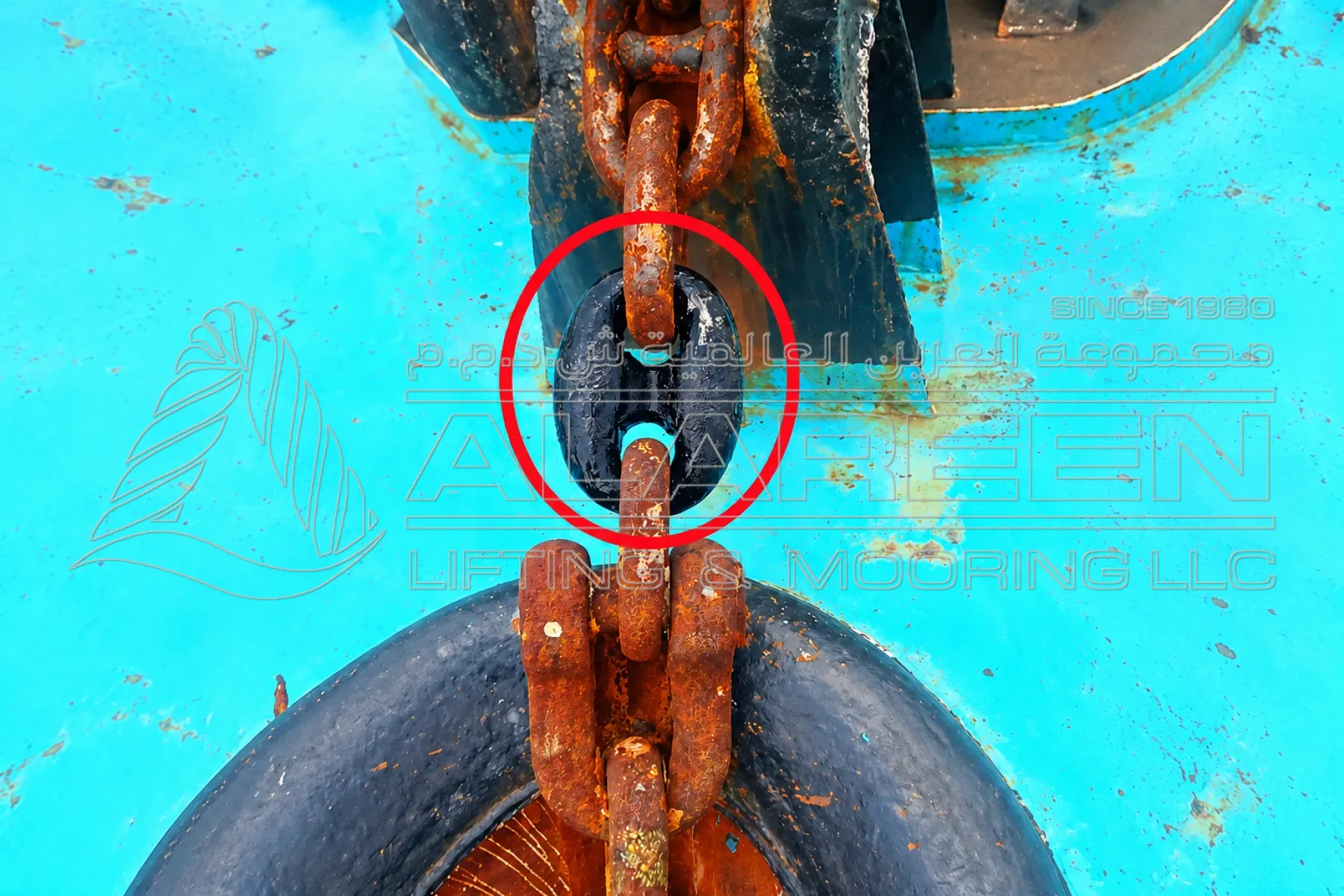
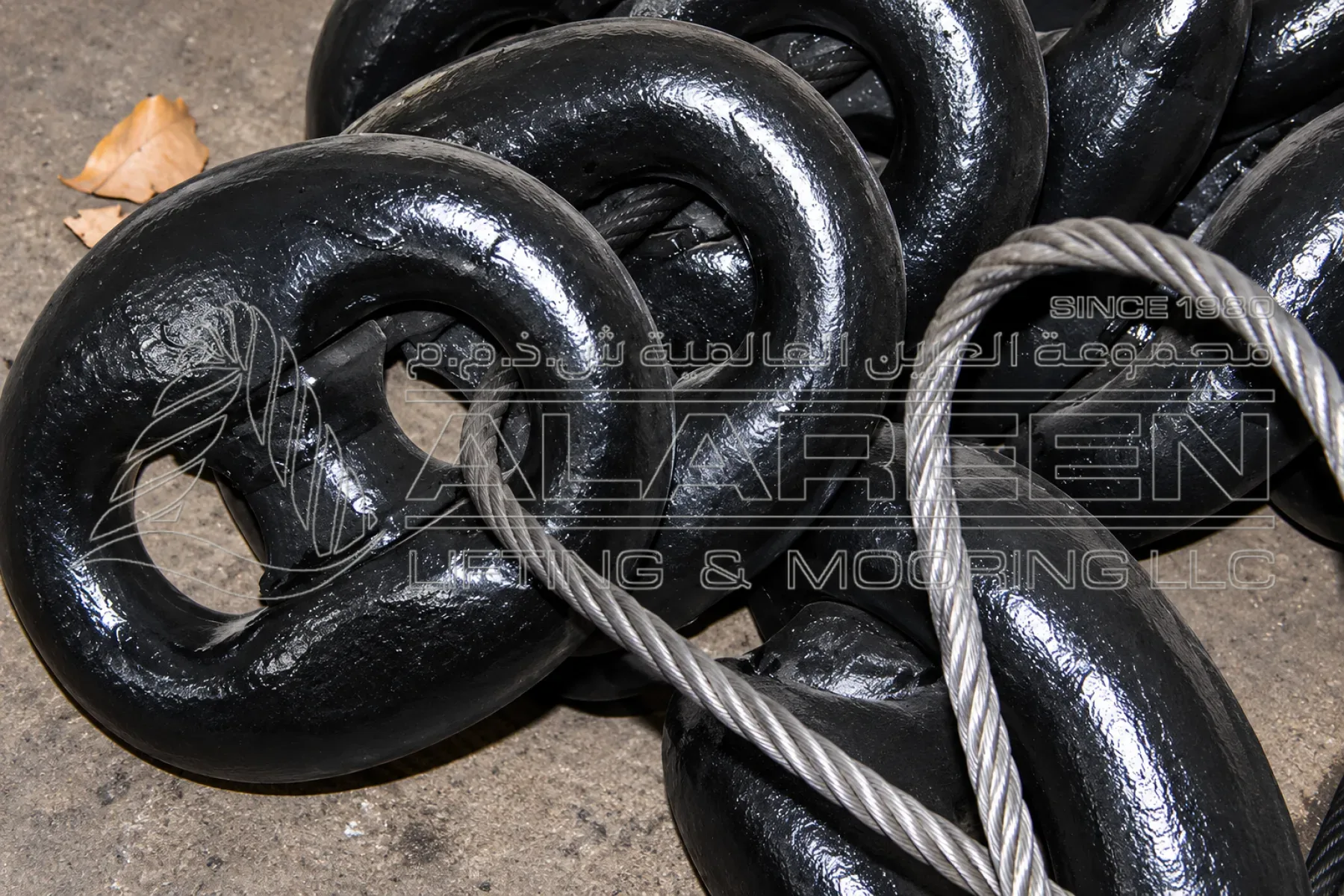
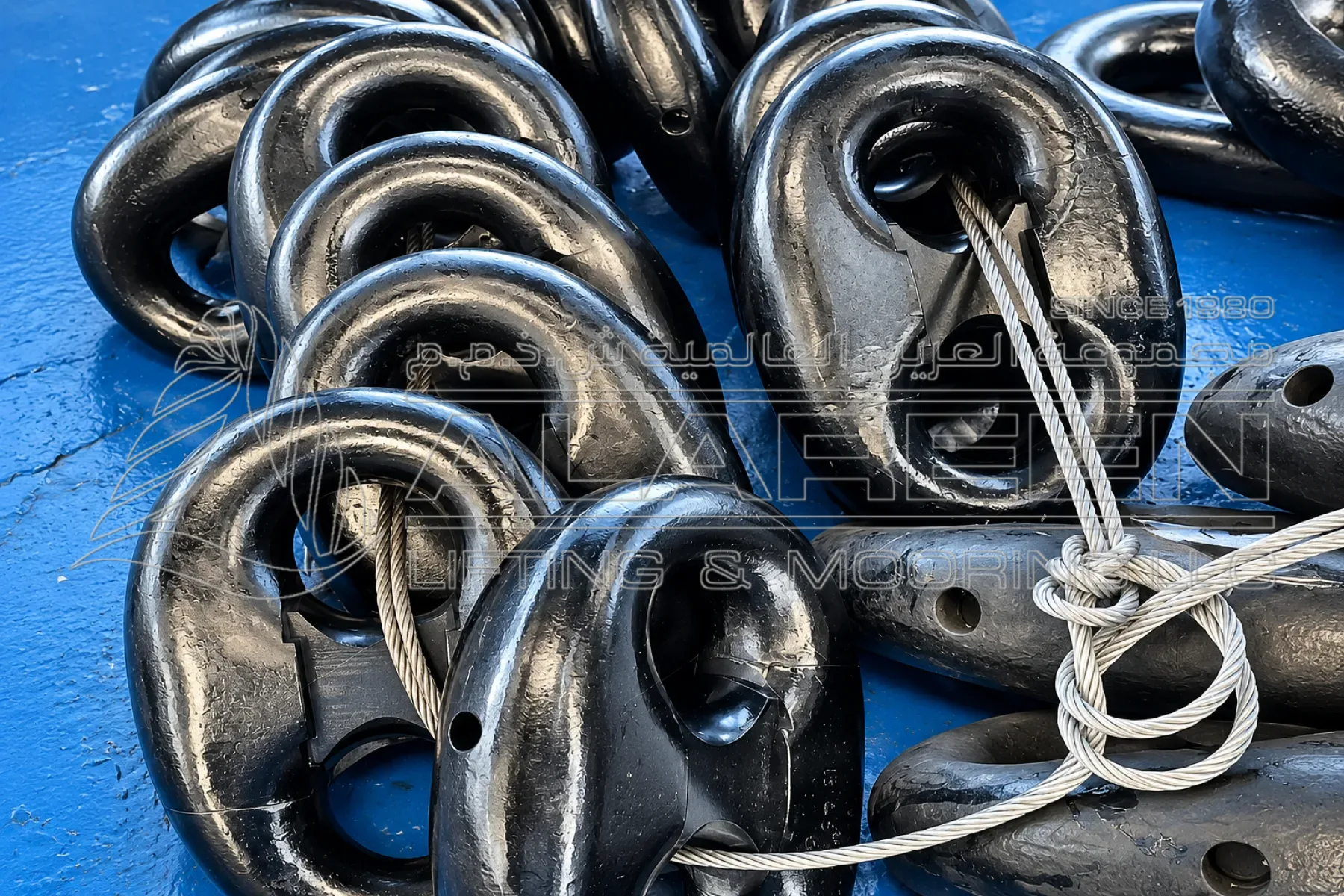
A Kenter joining shackle is a detachable connector used to join compatible lengths of anchor chain, commonly stud-link chain cable. Also called a Kenter joining link or lugless joining shackle, it opens into separate components so the chain ends can be connected without cutting and welding the common links. Selection follows the vessel's anchoring arrangement and the connector drawing.
Construction and Connection Geometry
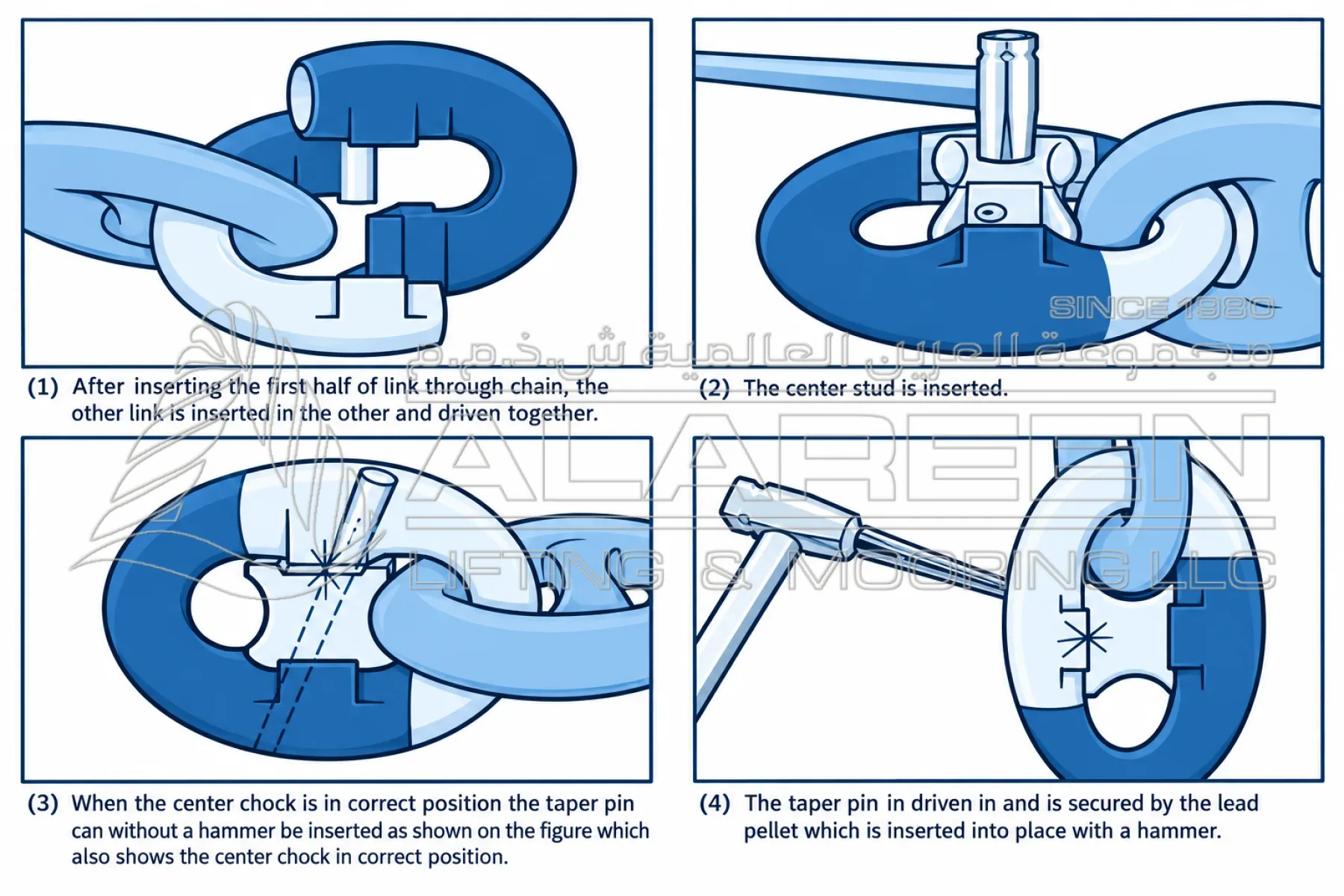
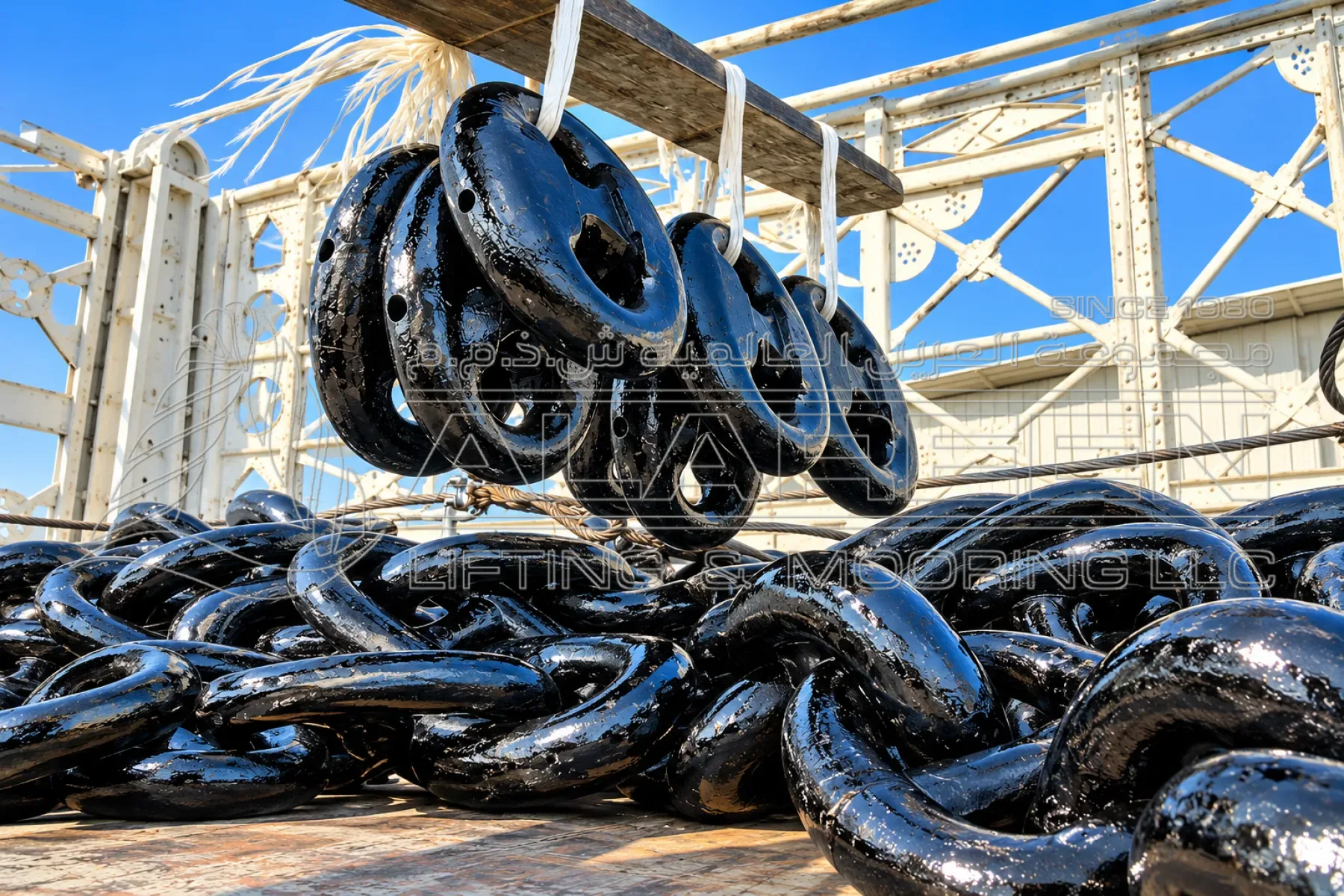
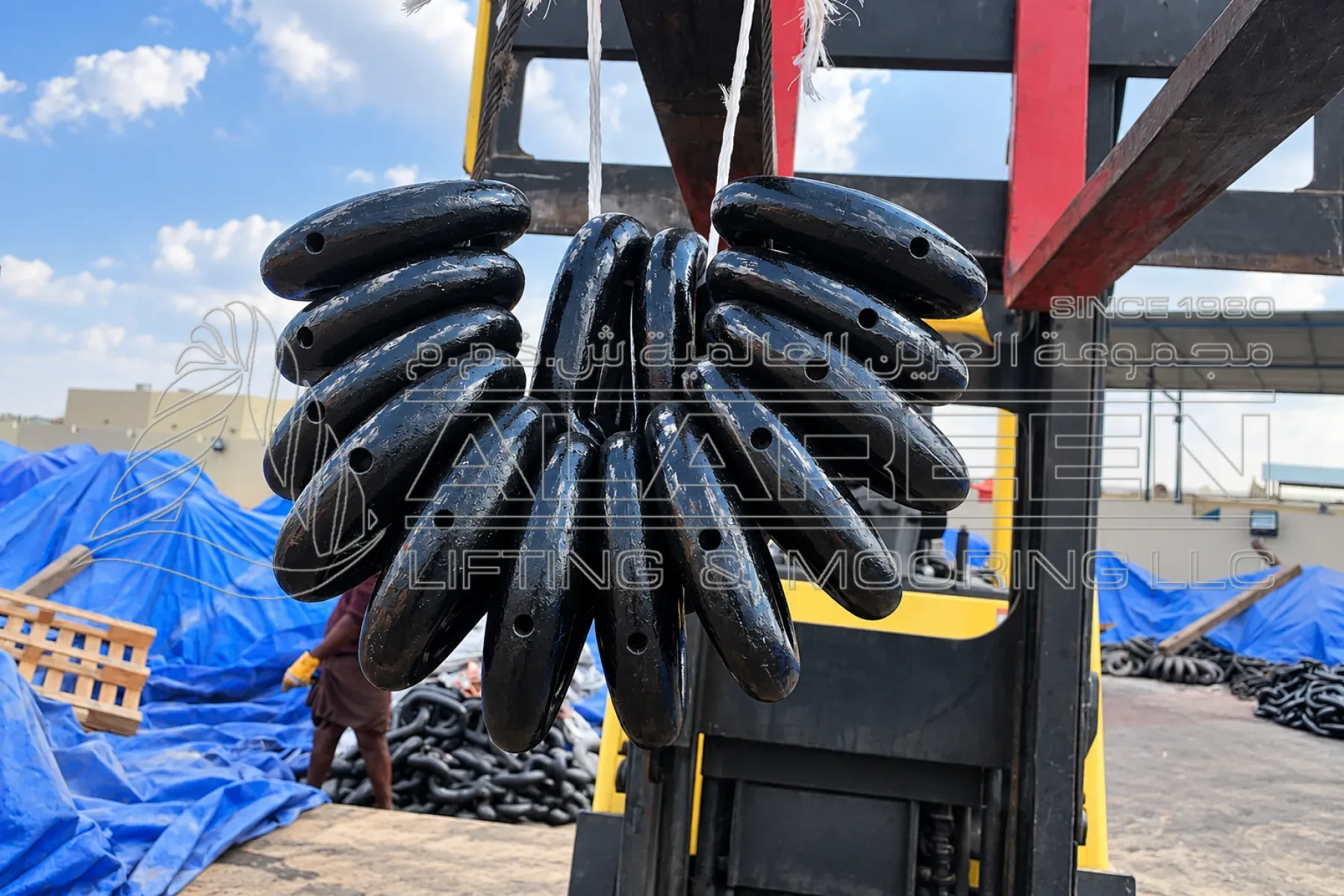
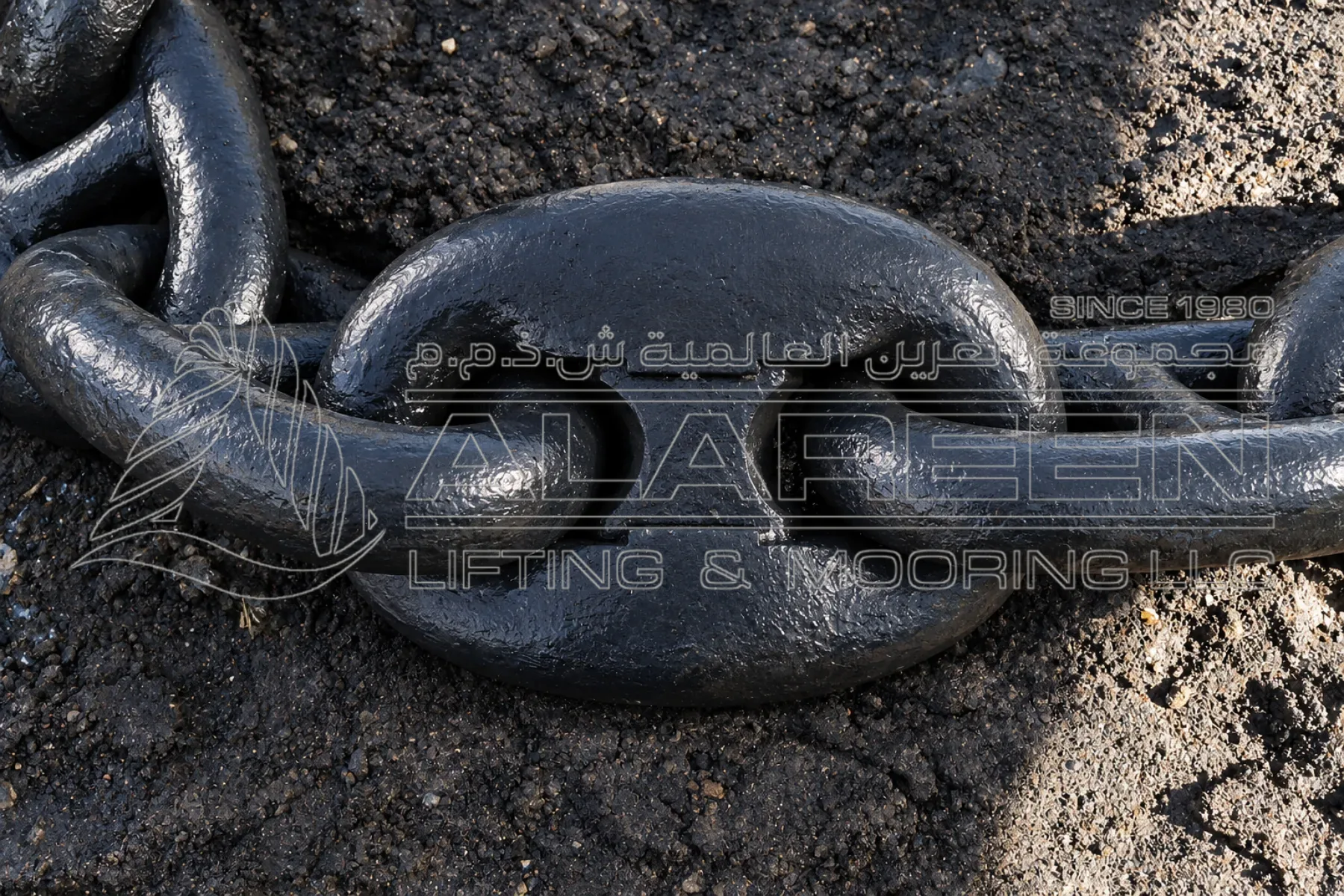
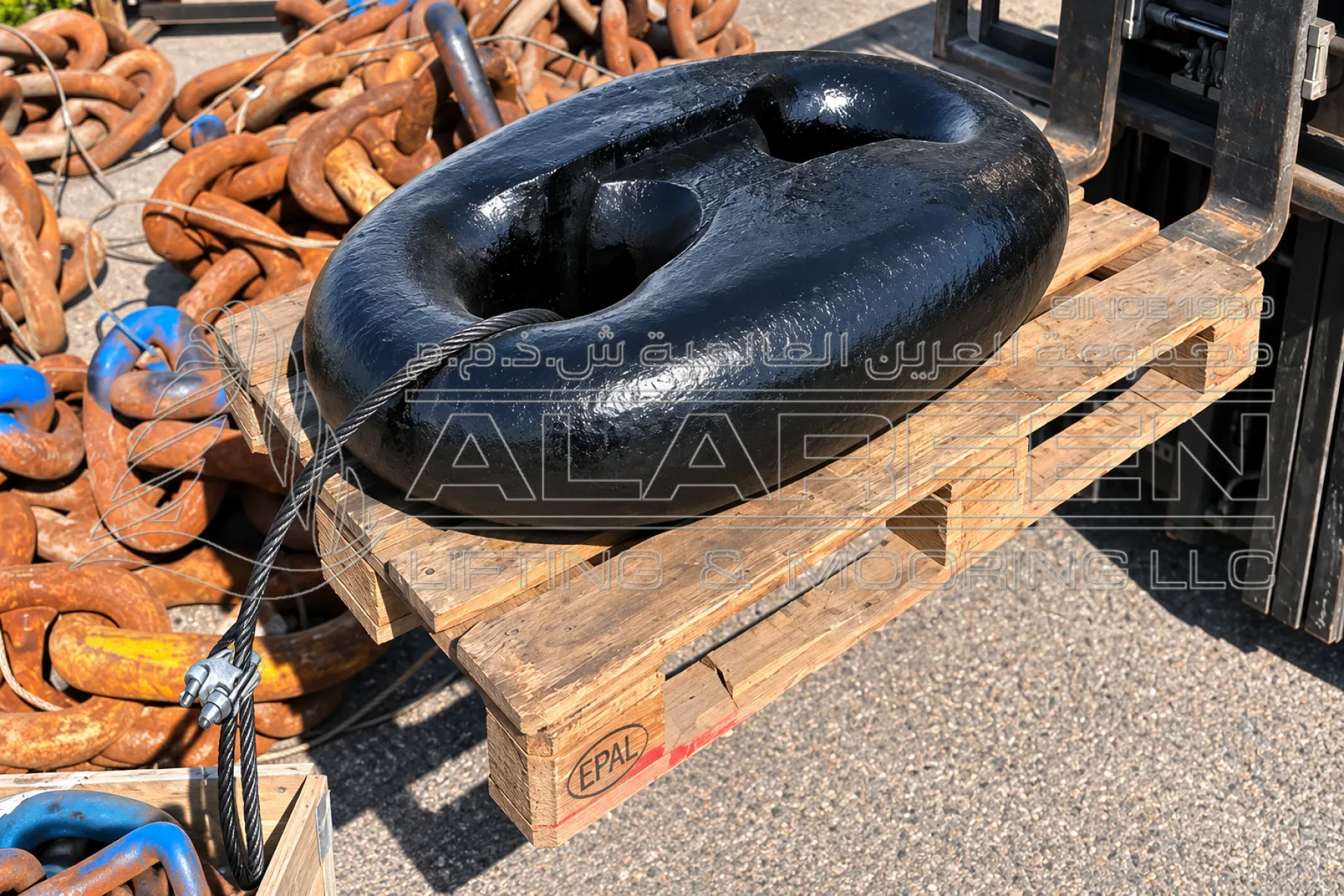
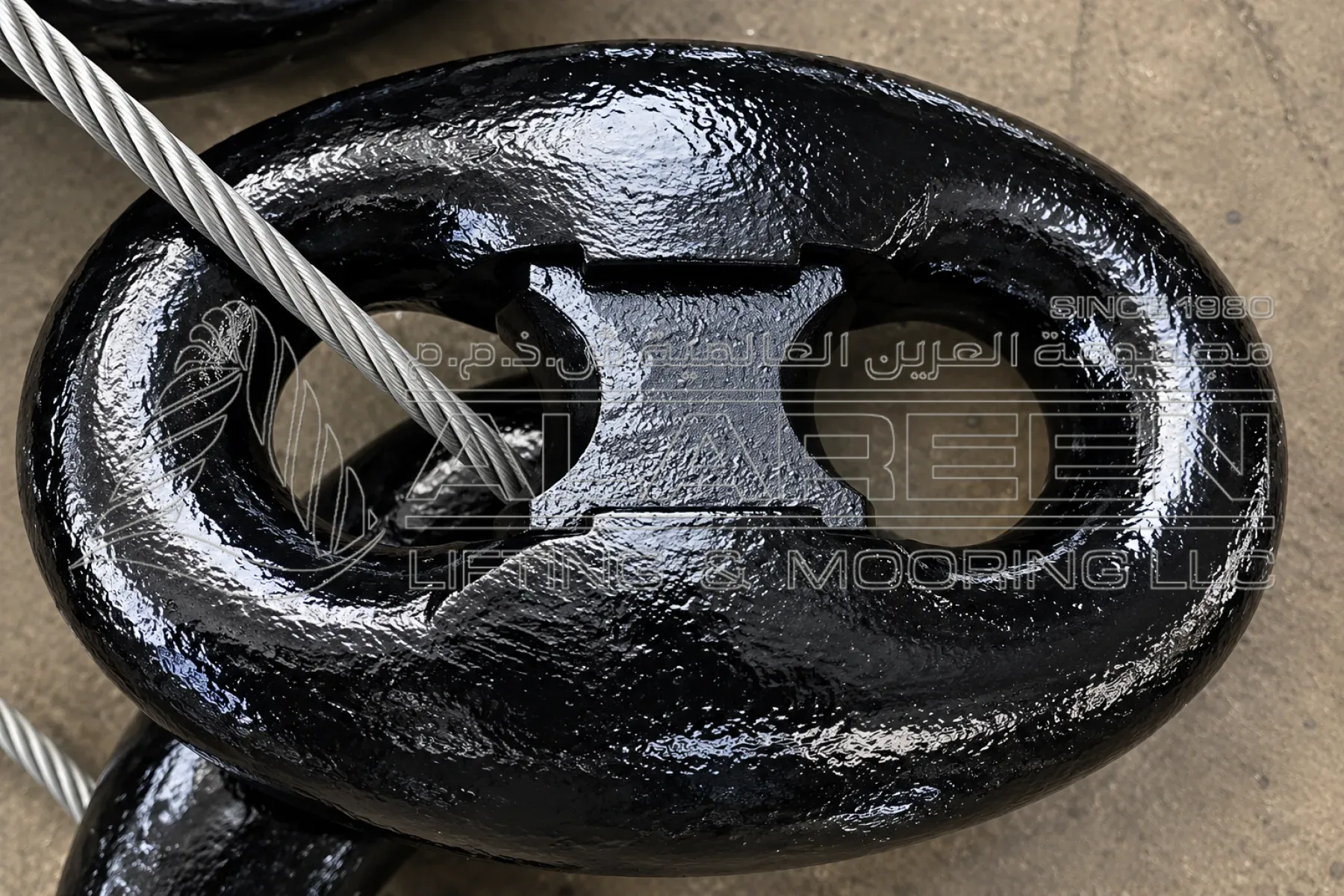
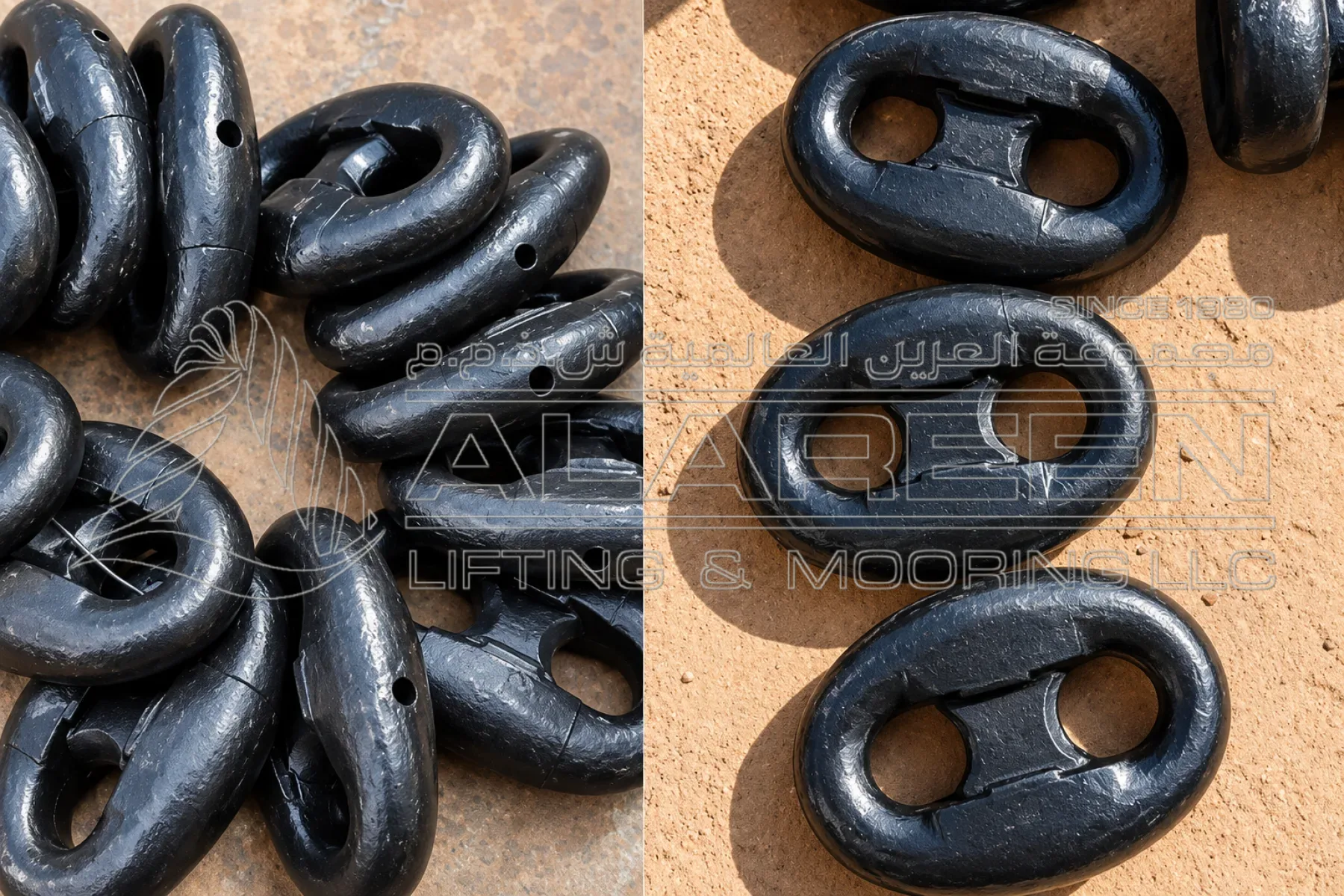
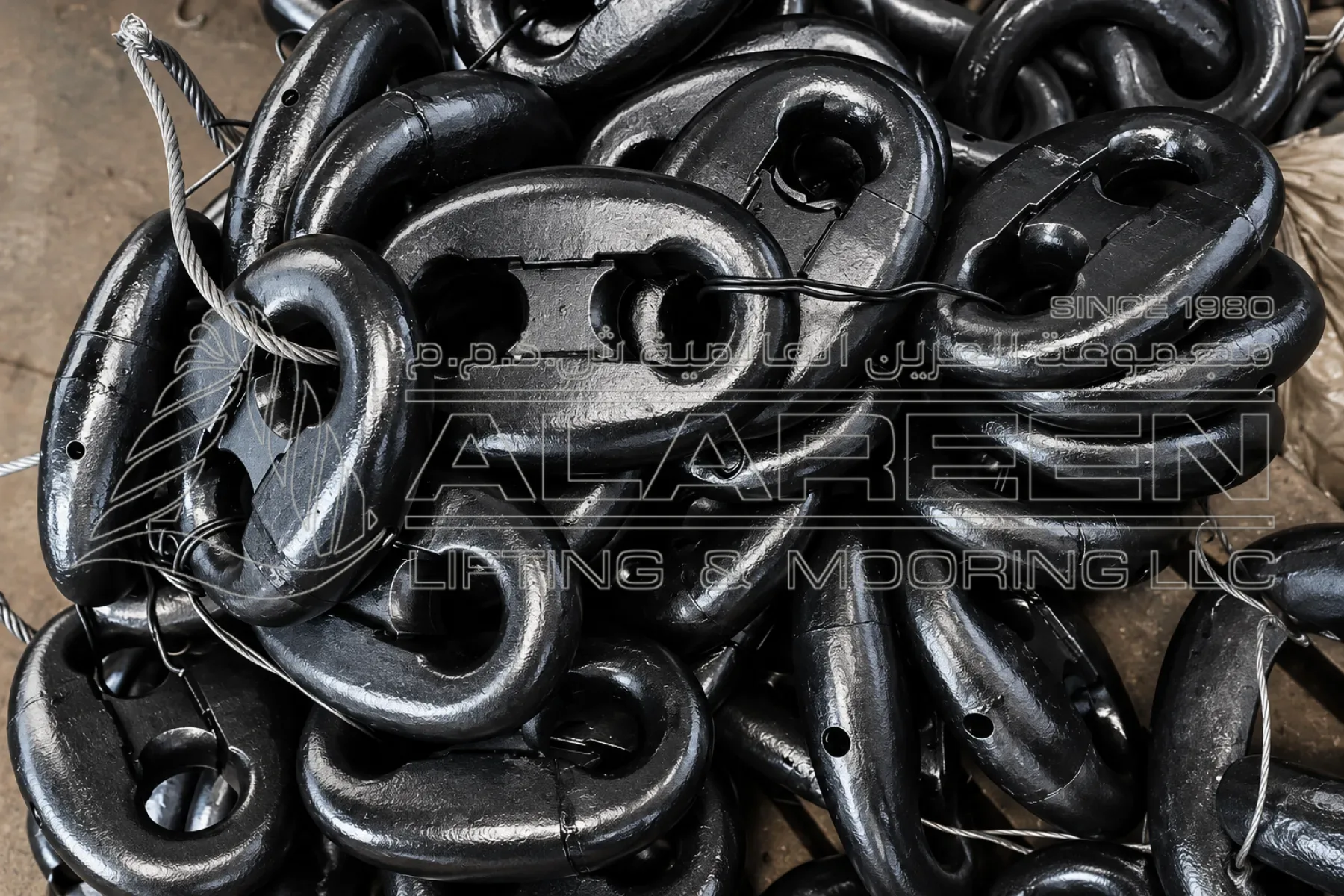
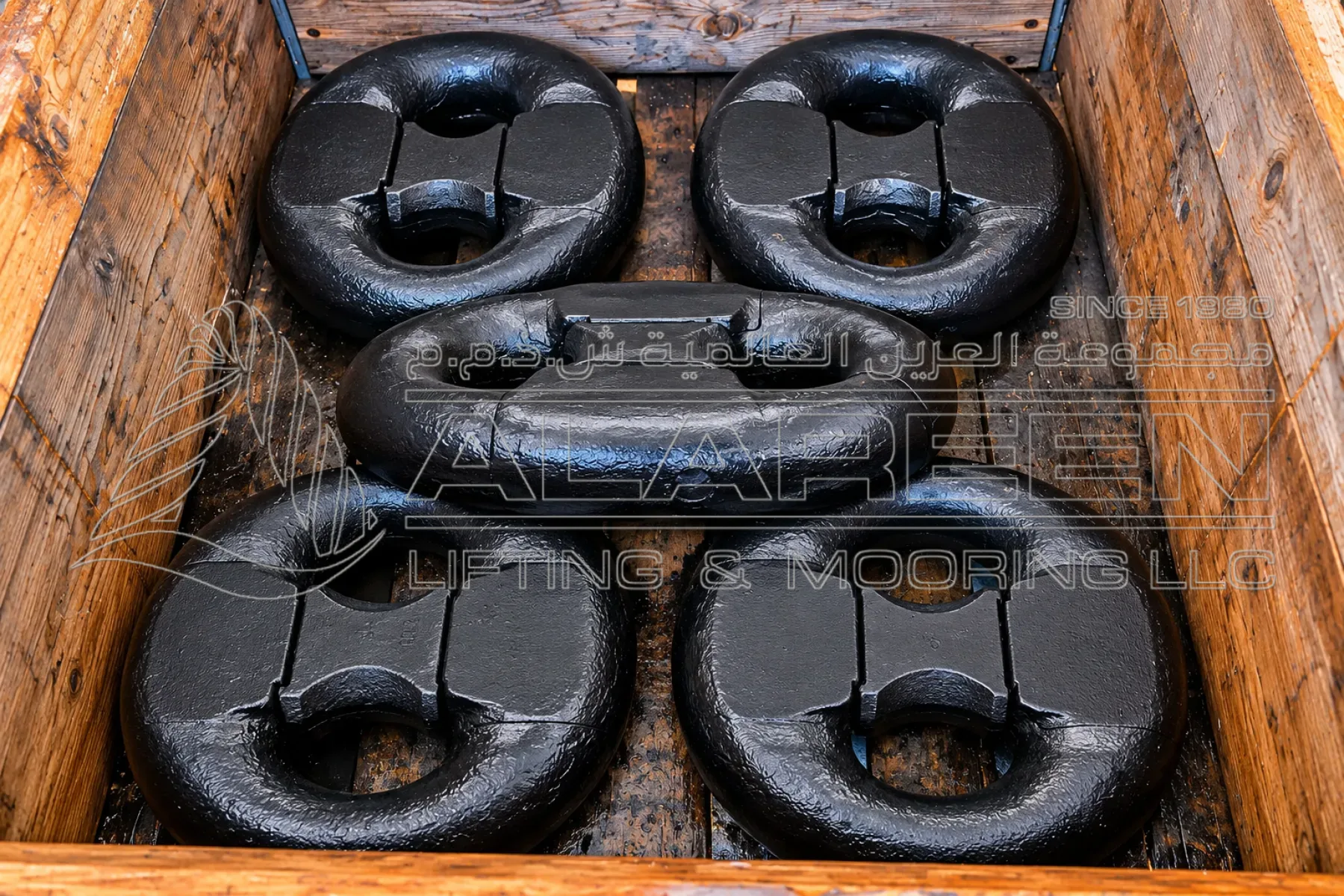
The conventional assembly has two interlocking body halves, a centre stud or chock, a tapered retaining pin and a lead locking plug. The centre component completes the assembly, while the diagonal pin and its locking arrangement secure the assembled parts. Confirm the supplied pattern: the name Kenter alone does not establish dimensions, material or interchangeability.
- Body halves: engage around the specified mating chain links and form the connector body.
- Centre stud or chock: fits between the assembled halves; its seating and alignment must match the manufacturer's design.
- Taper pin: passes through the aligned retaining bore. Its taper direction and seating are specific to the assembly.
- Locking plug: retains the pin using the manufacturer's prescribed method. Confirm that the correct locking components are included.
Tension is transmitted through the assembled connector body and its engagement with the adjoining links. Proper seating and retention are essential to maintaining that assembly. A Kenter link is not a swivel, a chain-diameter reducer or a substitute for every shackle in an anchoring system.
Choosing the Correct Kenter Shackle
Start with the chain's nominal bar diameter, grade and approved connection arrangement. Nominal chain diameter refers to the common link's bar diameter, not the overall width of the chain or the outside width of the Kenter shackle. Confirm these details from identification and records; measuring a worn link alone can misidentify the original size.
Grade U2 and U3 descriptions occur in ship anchor-chain and Kenter accessory catalogues. State the grade required by the vessel specification and verify the offered connector's records. Offshore mooring grades use a separate designation system; a similar-looking connector or a different grade is not automatically an approved replacement.
Kenter joining arrangements commonly connect compatible common links. D-type joining arrangements use their specified enlarged-link and end-link sequence, while anchor shackles connect the chain arrangement to the anchor. Check the actual mating parts rather than assuming these connections are interchangeable.
The connector's complete envelope must suit the chain wheel or wildcat, chain stopper, hawse pipe and handling path. Standard, slim and anchor-specific Kenter patterns need their own drawings and fit checks. Matching nominal diameter does not establish that parts from different patterns or makers can be mixed.
Materials, Finishes and Service Duty
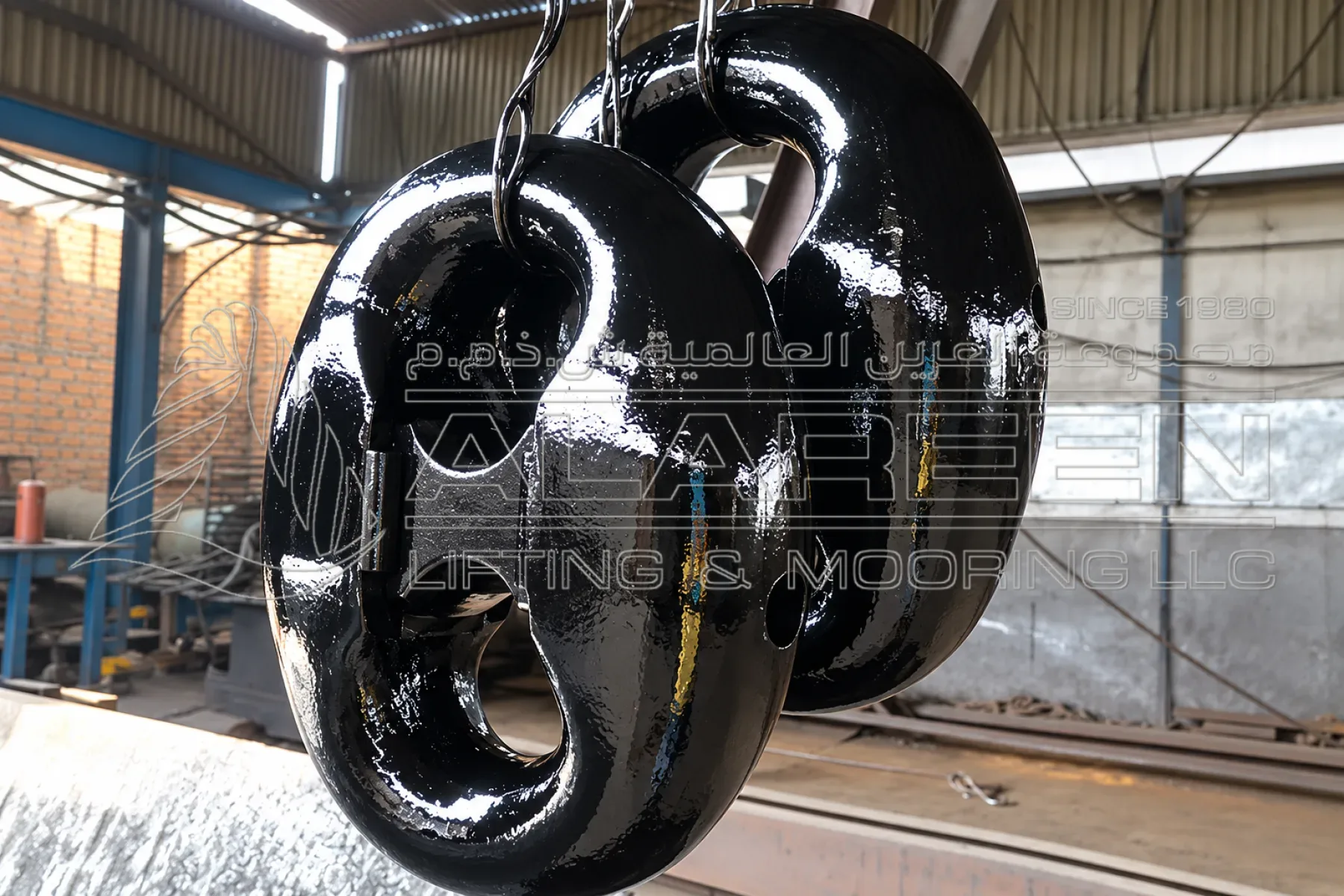
Forged steel Kenter joining shackles are recognised marine components. Specify the required material, grade, manufacturing records and finish for the actual order. Painted, galvanised and specialist material options appearing in a catalogue require separate confirmation of geometry, documentary scope and suitability; appearance is not a material certificate.
The normal procurement context is joining or replacing connections within a vessel's anchor cable. Repair and drydock teams may also require a matched replacement assembly or identified spares. Permanent offshore mooring introduces its own design, cyclic-loading, fatigue and approval requirements. An anchor-cable Kenter shackle should not be selected for that duty solely by diameter or a catalogue breaking-load figure.
Assembly, Inspection and Documentation
A competent vessel or repair team should plan the work, isolate machinery and remove tension before opening a connector. Follow the exact manufacturer's instructions, match component identification, check mating surfaces and use the prescribed tooling, lubrication and pin-locking method. Protect personnel from pinch points and lead fragments, and handle lead according to the applicable work procedure. Do not lift a connector or chain length by its centre stud.
Inspect for cracks, corrosion, wear, distorted engagement surfaces, damaged studs, insecure pins and missing or damaged locking plugs. Check free movement at the adjoining links and fit through the handling equipment. Acceptance limits, inspection intervals and any required nondestructive examination must follow the applicable vessel, manufacturer and classification requirements. A doubtful assembly needs competent assessment before reuse; improvised welding, heating or grinding can change its fit and properties.
Request item identification and traceability together with the material, dimensional, test and classification documents required by the order. The relevant certificate must cover the delivered component and its identification. Supplier status does not replace product documents. ISO 1704:2022 addresses shapes, proportions, dimensions and tolerances of stud-link anchor chains and accessories; reference to it alone does not establish proof testing, material compliance or class approval of a supplied shackle.
UAE & GCC Maritime Supply / Service Coverage
Al Areen supports Kenter joining-shackle supply enquiries for vessel and repair operations in and around the following hubs. For Port of Fujairah on the Gulf of Oman and Khor Fakkan Port on Sharjah's East Coast, enquiries can concern anchor-cable connector replacement during a vessel call or planned anchorage work. Provide the vessel's connection details and receiving arrangements with the request.
At Mussafah Port, enquiries from marine contractors and industrial-area procurement teams may concern connectors for a specified workboat or support-vessel anchor cable. Khalifa Port enquiries can involve purchasing teams arranging compatible replacement fittings around a vessel call at Taweelah.
For Port Rashid (Mina Rashid), buying intent can centre on vessel-call replacement parts and receiving coordination. Dubai Maritime City enquiries can involve repair teams matching an existing connector and its component kit. Drydocks World Dubai purchasing can involve survey-related anchor-chain work, where identification, approved drawings and required test records are especially useful.
Hamriyah Port and Hamriyah Free Zone enquiries can cover anchor-chain connection requirements for commercial vessels and marine-contractor fleets. For Port of Duqm in Oman's Al Wusta Governorate, ship-repair and drydock enquiries can include replacement joining assemblies for an identified chain cable. At Khalifa Bin Salman Port in Hidd, Bahrain, ship managers and marine purchasing teams may need a compatible connector with coordinated vessel receiving.
Coverage also includes enquiries across the other UAE emirates and the wider Saudi Arabian, Omani, Qatari, Bahraini and Kuwaiti maritime markets. State the destination, receiving agent and required date so the quotation can address the actual order and logistics.
Request a Kenter Joining-Shackle Quotation
Send the specification details below for a complete connector, an identified spare or a chain-and-fitting package. Al Areen provides Fast UAE & GCC Delivery, 24/7 Customer Support and Stock Availability. Confirm the requested configuration and receiving schedule in the quotation.
Technical Specifications
Request DatasheetKenter Joining Shackle: Procurement Specification
Use the approved drawing and component records to define the order. Supply measurements, identification photographs and existing documents together; photographs alone cannot establish grade, material or test status.
| Specification input | What to provide or confirm |
|---|---|
| Service and approval basis | Vessel or equipment identification, anchor-cable duty, approved arrangement or replacement specification, and the applicable class requirements. |
| Nominal chain size | Original common-link bar diameter, units, chain identification and relevant dimensional records; do not use overall link width as nominal diameter. |
| Chain and connector grade | Required chain grade and compatible connector grade, supported by the order specification and manufacturer records. |
| Mating links | Common, enlarged or end-link details as applicable, internal openings and bar dimensions, together with the connection drawing. |
| Connector pattern | Standard, slim or another specifically approved pattern; maker, drawing or part reference for a replacement. Identify any proposed change. |
| Machinery clearance | Required overall length, width, body sections and tolerances; chain-wheel, stopper and hawse clearance information where relevant. |
| Assembly scope | Complete matched assembly or an identified spare; confirm inclusion of body halves, centre component, taper pin and specified locking plug. |
| Material and finish | Specified material and heat-treatment requirements where applicable, finish, preservation and any environmental constraints. |
| Testing and documents | Required dimensional checks, material records, proof-test records, relevant breaking-test evidence and any specified class inspection or certificate scope. |
| Identification and traceability | Manufacturer identification, component markings, matched-part references and traceability linking the delivered item to its documents. |
| Quantity and package | Required quantity, connector-only or chain-and-accessory package, identified installation consumables and spare-part requirements. |
| Delivery and receiving | Destination port or yard, vessel schedule, receiving agent, required date and documents needed for handover. |
Test and Load Terminology
A proof-test load, a minimum breaking requirement and a lifting WLL or SWL describe different things. Request the values and test basis applicable to the specified connector; do not derive a lifting capacity from an anchor-chain catalogue. Confirm whether evidence concerns the delivered assembly, its production batch or qualification specimens.
Receiving and Storage
At receipt, reconcile markings, component completeness, visible condition and certificates. Keep matched parts together and protect machined engagement surfaces, retaining bores and identification during storage. Preserve the assembly according to the maker's instructions and inspect it before installation after extended storage.
Applications Across Industry
FAQ
What is a Kenter joining shackle?+
It is a detachable chain connector used to join compatible anchor-chain lengths. Its separable body permits assembly around the specified mating links without cutting and welding the chain.
Are Kenter link and lugless joining shackle the same description?+
Both terms are used for this type of marine joining connector. Confirm the drawing and intended duty because the name alone does not establish the pattern, dimensions or grade.
Why is a Kenter shackle described as three-piece when a pin and plug are also needed?+
Three-piece commonly describes the two body halves and centre stud or chock. The conventional complete assembly also needs its taper pin and locking plug; confirm all components in the quotation.
What secures the assembled connector?+
The centre component, diagonal taper pin and prescribed pin-locking arrangement work with the engaged body halves. Incorrect seating or missing retention can compromise the assembly; follow the exact component instructions.
Can halves from different Kenter shackles be combined?+
Do not assume they can. Use matched parts and their identification; interchangeability requires the maker's confirmation and any approval required by the vessel specification.
Which measurement should I give as chain diameter?+
Give the nominal bar diameter of the common chain link in the specified units. Overall link width and connector width are different dimensions. Confirm the original size from records if the chain is worn.
How do I select a Kenter shackle for U2 or U3 chain?+
Specify the chain grade, nominal diameter and connection drawing. Confirm the offered connector's grade, dimensions and required documentation against the approved anchoring arrangement.
Can a higher-grade connector justify reducing its nominal size?+
A grade change does not establish geometric fit or approval. Any size or grade substitution needs assessment of the complete connection and the vessel's applicable requirements.
Can a standard Kenter joining link connect different chain diameters?+
It is not a generic diameter reducer. A connection between unlike chain sizes needs a separately assessed arrangement rather than an assumed fit through the connector.
Does a Kenter joining shackle remove twist like a swivel?+
No. It is a detachable joining connector. A swivel provides a different rotational interface and must be selected and positioned according to the anchoring arrangement.
What is the difference between a Kenter link and a D-type joining shackle?+
Their geometry and connection sequence differ. A typical Kenter connection joins compatible common links, while a D-type joining arrangement uses its specified enlarged and end links. Check the approved drawing.
Is an anchor shackle interchangeable with a Kenter joining shackle?+
Do not assume interchangeability. An anchor shackle serves the anchor connection, while a joining shackle joins the specified chain arrangement. Their mating openings, movement and approval requirements must be checked.
When would a slim Kenter pattern be considered?+
A slim pattern may be considered where the specified machinery or connection envelope requires it. Obtain its actual dimensions and approval basis; it is not automatically interchangeable with a standard pattern.
What windlass information helps confirm compatibility?+
Provide chain-wheel or wildcat details, the approved chain specification and clearance requirements through the stopper and hawse. The complete connector geometry matters as well as nominal diameter.
Are Kenter shackles always made from the same steel?+
No universal material specification follows from the name. Forged steel products are recognised marine components, but the exact material, grade, treatment and documentary requirements must be confirmed for the offered item.
Does galvanising or black paint prove a connector's grade?+
No. Surface appearance does not establish material grade, heat treatment or test status. Specify the finish and obtain the required identification and records for the actual connector.
Can a mining Kenter connector be used as a marine joining shackle?+
A shared name does not establish suitability. Mining connectors and marine anchor-chain connectors must be assessed against their own duty, geometry and requirements; do not select by resemblance.
Is a ship anchor-cable Kenter shackle suitable for permanent offshore mooring?+
Not automatically. Permanent mooring requires assessment of the design duty, cyclic loading, fatigue and approval basis. Submit the complete mooring specification before selecting a connector.
Can a Kenter joining shackle be used for lifting?+
An anchor-chain connector must not be treated as a lifting shackle solely from its catalogue strength. Lifting requires an item selected, rated and documented for that specific duty.
Does a breaking-load figure mean the same as WLL or SWL?+
No. Breaking strength, proof testing and a lifting working limit are different parameters. Ask for the applicable connector test basis and do not convert one into another without an approved engineering basis.
What should be confirmed when ordering a complete assembly?+
Confirm the matched body halves, centre stud or chock, correct taper pin and specified locking plug, together with identification, instructions and the documents required by the purchase specification.
Can I order only a spare pin or centre stud?+
Identify the original maker, pattern, size, markings and part reference first. Ask the supplier to confirm the spare's compatibility; nominal size alone is insufficient for matching assembly parts.
What must happen before a Kenter shackle is opened?+
A competent team must plan the task, isolate relevant equipment, remove chain tension and support the components. Follow vessel procedures and the connector maker's disassembly instructions.
Should the taper pin be driven out from either end?+
No. Its taper has an intended removal direction. Use the manufacturer's instructions and specified tooling to avoid damaging the bore, body or centre component.
What procedure should be used for the lead locking plug?+
Follow the particular manufacturer's locking and replacement method, including preparation of the recess. Do not assume one maker's plug-installation procedure applies to every pattern. Control lead exposure and flying fragments during the work.
Can a connector be handled by its centre stud?+
Do not use the stud as a lifting point. Use a planned handling method and suitable equipment for the component or chain length, with personnel kept clear of suspended loads and pinch points.
What defects should a repair team look for?+
Look for cracking, corrosion, wear, deformation, damaged engagement surfaces, an insecure centre component or pin, and missing or damaged locking material. Assess doubtful findings before returning the assembly to service.
Is there one universal wear limit or inspection interval?+
No single figure should be applied to every connector and duty. Use the applicable manufacturer, vessel and classification criteria, taking account of service history and inspection findings.
Can a damaged Kenter shackle be repaired by welding or grinding?+
Do not improvise repairs. Welding, heating or removing material can affect geometry and properties. Any repair needs the relevant maker's and applicable classification approval and subsequent inspection requirements.
Does ISO 1704:2022 certify the shackle?+
No. The standard addresses dimensional and geometric requirements for stud-link anchor chains and accessories. Product compliance, test evidence and any classification certification need their own supporting records.
What documentation should accompany a procurement enquiry?+
Provide the required drawing, grade and identification, and specify material, dimensional and test records plus any required class documents. On receipt, reconcile the delivered connector's markings with the documentation.
Does Certified Supplier mean every Kenter shackle has class approval?+
The company description does not replace product-specific evidence. State the required class and certificate scope, then verify the offered assembly's identification and documents before acceptance.
How should spare Kenter joining shackles be stored?+
Keep matched parts together, preserve them according to the maker's instructions and protect machined faces, retaining bores and markings. Check condition and completeness again before installation.
What information helps an urgent Fujairah or Khor Fakkan enquiry?+
Send the original chain size and grade, connector identification, required assembly or spare, vessel schedule and receiving-agent details. These allow the quotation to address fit, documents and the intended handover.
How do drydock replacement enquiries differ from connector-only purchases?+
Drydock work may involve a larger cable inspection or replacement scope. Identify the retained chain, proposed connector pattern, approved arrangement and required survey documents so all mating components can be assessed together.
What should GCC port buyers provide for receiving coordination?+
State the country and exact port or yard, vessel or consignee, receiving agent and required date. Keep those logistics details separate from the technical identification of the connector.
Does Stock Availability confirm that my exact configuration is ready immediately?+
Confirm the required size, grade, pattern, complete component scope and documents in the quotation. The company-wide Stock Availability statement does not by itself identify a particular configuration or delivery date.
Is Al Areen the manufacturer of these Kenter joining shackles?+
Al Areen Lifting & Mooring LLC acts as a UAE/GCC trader, supplier and stockist. Confirm the offered maker and product documentation for the particular order.
Which related components should be checked with the connector?+
Check the adjoining chain links, any enlarged or end links, anchor shackles, swivels and forerunners in the approved arrangement. Also verify the connector's passage through the handling and securing equipment.
Product Overview
Kenter Joining Shackles for Anchor Chain Connections
Al Areen Lifting & Mooring LLC is a UAE/GCC trader, Leading Supplier, Certified Supplier and Largest Stockist of Kenter Joining Shackles. As a No.1 Supplier, we support Best Quality sourcing through correct chain matching, complete connector assemblies and the documentation specified for your order.
A Kenter joining shackle is a detachable connector used to join compatible lengths of anchor chain, commonly stud-link chain cable. Also called a Kenter joining link or lugless joining shackle, it opens into separate components so the chain ends can be connected without cutting and welding the common links. Selection follows the vessel's anchoring arrangement and the connector drawing.
Construction and Connection Geometry
The conventional assembly has two interlocking body halves, a centre stud or chock, a tapered retaining pin and a lead locking plug. The centre component completes the assembly, while the diagonal pin and its locking arrangement secure the assembled parts. Confirm the supplied pattern: the name Kenter alone does not establish dimensions, material or interchangeability.
- Body halves: engage around the specified mating chain links and form the connector body.
- Centre stud or chock: fits between the assembled halves; its seating and alignment must match the manufacturer's design.
- Taper pin: passes through the aligned retaining bore. Its taper direction and seating are specific to the assembly.
- Locking plug: retains the pin using the manufacturer's prescribed method. Confirm that the correct locking components are included.
Tension is transmitted through the assembled connector body and its engagement with the adjoining links. Proper seating and retention are essential to maintaining that assembly. A Kenter link is not a swivel, a chain-diameter reducer or a substitute for every shackle in an anchoring system.
Choosing the Correct Kenter Shackle
Start with the chain's nominal bar diameter, grade and approved connection arrangement. Nominal chain diameter refers to the common link's bar diameter, not the overall width of the chain or the outside width of the Kenter shackle. Confirm these details from identification and records; measuring a worn link alone can misidentify the original size.
Grade U2 and U3 descriptions occur in ship anchor-chain and Kenter accessory catalogues. State the grade required by the vessel specification and verify the offered connector's records. Offshore mooring grades use a separate designation system; a similar-looking connector or a different grade is not automatically an approved replacement.
Kenter joining arrangements commonly connect compatible common links. D-type joining arrangements use their specified enlarged-link and end-link sequence, while anchor shackles connect the chain arrangement to the anchor. Check the actual mating parts rather than assuming these connections are interchangeable.
The connector's complete envelope must suit the chain wheel or wildcat, chain stopper, hawse pipe and handling path. Standard, slim and anchor-specific Kenter patterns need their own drawings and fit checks. Matching nominal diameter does not establish that parts from different patterns or makers can be mixed.
Materials, Finishes and Service Duty
Forged steel Kenter joining shackles are recognised marine components. Specify the required material, grade, manufacturing records and finish for the actual order. Painted, galvanised and specialist material options appearing in a catalogue require separate confirmation of geometry, documentary scope and suitability; appearance is not a material certificate.
The normal procurement context is joining or replacing connections within a vessel's anchor cable. Repair and drydock teams may also require a matched replacement assembly or identified spares. Permanent offshore mooring introduces its own design, cyclic-loading, fatigue and approval requirements. An anchor-cable Kenter shackle should not be selected for that duty solely by diameter or a catalogue breaking-load figure.
Assembly, Inspection and Documentation
A competent vessel or repair team should plan the work, isolate machinery and remove tension before opening a connector. Follow the exact manufacturer's instructions, match component identification, check mating surfaces and use the prescribed tooling, lubrication and pin-locking method. Protect personnel from pinch points and lead fragments, and handle lead according to the applicable work procedure. Do not lift a connector or chain length by its centre stud.
Inspect for cracks, corrosion, wear, distorted engagement surfaces, damaged studs, insecure pins and missing or damaged locking plugs. Check free movement at the adjoining links and fit through the handling equipment. Acceptance limits, inspection intervals and any required nondestructive examination must follow the applicable vessel, manufacturer and classification requirements. A doubtful assembly needs competent assessment before reuse; improvised welding, heating or grinding can change its fit and properties.
Request item identification and traceability together with the material, dimensional, test and classification documents required by the order. The relevant certificate must cover the delivered component and its identification. Supplier status does not replace product documents. ISO 1704:2022 addresses shapes, proportions, dimensions and tolerances of stud-link anchor chains and accessories; reference to it alone does not establish proof testing, material compliance or class approval of a supplied shackle.
UAE & GCC Maritime Supply / Service Coverage
Al Areen supports Kenter joining-shackle supply enquiries for vessel and repair operations in and around the following hubs. For Port of Fujairah on the Gulf of Oman and Khor Fakkan Port on Sharjah's East Coast, enquiries can concern anchor-cable connector replacement during a vessel call or planned anchorage work. Provide the vessel's connection details and receiving arrangements with the request.
At Mussafah Port, enquiries from marine contractors and industrial-area procurement teams may concern connectors for a specified workboat or support-vessel anchor cable. Khalifa Port enquiries can involve purchasing teams arranging compatible replacement fittings around a vessel call at Taweelah.
For Port Rashid (Mina Rashid), buying intent can centre on vessel-call replacement parts and receiving coordination. Dubai Maritime City enquiries can involve repair teams matching an existing connector and its component kit. Drydocks World Dubai purchasing can involve survey-related anchor-chain work, where identification, approved drawings and required test records are especially useful.
Hamriyah Port and Hamriyah Free Zone enquiries can cover anchor-chain connection requirements for commercial vessels and marine-contractor fleets. For Port of Duqm in Oman's Al Wusta Governorate, ship-repair and drydock enquiries can include replacement joining assemblies for an identified chain cable. At Khalifa Bin Salman Port in Hidd, Bahrain, ship managers and marine purchasing teams may need a compatible connector with coordinated vessel receiving.
Coverage also includes enquiries across the other UAE emirates and the wider Saudi Arabian, Omani, Qatari, Bahraini and Kuwaiti maritime markets. State the destination, receiving agent and required date so the quotation can address the actual order and logistics.
Request a Kenter Joining-Shackle Quotation
Send the specification details below for a complete connector, an identified spare or a chain-and-fitting package. Al Areen provides Fast UAE & GCC Delivery, 24/7 Customer Support and Stock Availability. Confirm the requested configuration and receiving schedule in the quotation.
01 / 15
Technical Specifications
Request DatasheetKenter Joining Shackle: Procurement Specification
Use the approved drawing and component records to define the order. Supply measurements, identification photographs and existing documents together; photographs alone cannot establish grade, material or test status.
| Specification input | What to provide or confirm |
|---|---|
| Service and approval basis | Vessel or equipment identification, anchor-cable duty, approved arrangement or replacement specification, and the applicable class requirements. |
| Nominal chain size | Original common-link bar diameter, units, chain identification and relevant dimensional records; do not use overall link width as nominal diameter. |
| Chain and connector grade | Required chain grade and compatible connector grade, supported by the order specification and manufacturer records. |
| Mating links | Common, enlarged or end-link details as applicable, internal openings and bar dimensions, together with the connection drawing. |
| Connector pattern | Standard, slim or another specifically approved pattern; maker, drawing or part reference for a replacement. Identify any proposed change. |
| Machinery clearance | Required overall length, width, body sections and tolerances; chain-wheel, stopper and hawse clearance information where relevant. |
| Assembly scope | Complete matched assembly or an identified spare; confirm inclusion of body halves, centre component, taper pin and specified locking plug. |
| Material and finish | Specified material and heat-treatment requirements where applicable, finish, preservation and any environmental constraints. |
| Testing and documents | Required dimensional checks, material records, proof-test records, relevant breaking-test evidence and any specified class inspection or certificate scope. |
| Identification and traceability | Manufacturer identification, component markings, matched-part references and traceability linking the delivered item to its documents. |
| Quantity and package | Required quantity, connector-only or chain-and-accessory package, identified installation consumables and spare-part requirements. |
| Delivery and receiving | Destination port or yard, vessel schedule, receiving agent, required date and documents needed for handover. |
Test and Load Terminology
A proof-test load, a minimum breaking requirement and a lifting WLL or SWL describe different things. Request the values and test basis applicable to the specified connector; do not derive a lifting capacity from an anchor-chain catalogue. Confirm whether evidence concerns the delivered assembly, its production batch or qualification specimens.
Receiving and Storage
At receipt, reconcile markings, component completeness, visible condition and certificates. Keep matched parts together and protect machined engagement surfaces, retaining bores and identification during storage. Preserve the assembly according to the maker's instructions and inspect it before installation after extended storage.
Applications Across Industry
FAQ
What is a Kenter joining shackle?+
It is a detachable chain connector used to join compatible anchor-chain lengths. Its separable body permits assembly around the specified mating links without cutting and welding the chain.
Are Kenter link and lugless joining shackle the same description?+
Both terms are used for this type of marine joining connector. Confirm the drawing and intended duty because the name alone does not establish the pattern, dimensions or grade.
Why is a Kenter shackle described as three-piece when a pin and plug are also needed?+
Three-piece commonly describes the two body halves and centre stud or chock. The conventional complete assembly also needs its taper pin and locking plug; confirm all components in the quotation.
What secures the assembled connector?+
The centre component, diagonal taper pin and prescribed pin-locking arrangement work with the engaged body halves. Incorrect seating or missing retention can compromise the assembly; follow the exact component instructions.
Can halves from different Kenter shackles be combined?+
Do not assume they can. Use matched parts and their identification; interchangeability requires the maker's confirmation and any approval required by the vessel specification.
Which measurement should I give as chain diameter?+
Give the nominal bar diameter of the common chain link in the specified units. Overall link width and connector width are different dimensions. Confirm the original size from records if the chain is worn.
How do I select a Kenter shackle for U2 or U3 chain?+
Specify the chain grade, nominal diameter and connection drawing. Confirm the offered connector's grade, dimensions and required documentation against the approved anchoring arrangement.
Can a higher-grade connector justify reducing its nominal size?+
A grade change does not establish geometric fit or approval. Any size or grade substitution needs assessment of the complete connection and the vessel's applicable requirements.
Can a standard Kenter joining link connect different chain diameters?+
It is not a generic diameter reducer. A connection between unlike chain sizes needs a separately assessed arrangement rather than an assumed fit through the connector.
Does a Kenter joining shackle remove twist like a swivel?+
No. It is a detachable joining connector. A swivel provides a different rotational interface and must be selected and positioned according to the anchoring arrangement.
What is the difference between a Kenter link and a D-type joining shackle?+
Their geometry and connection sequence differ. A typical Kenter connection joins compatible common links, while a D-type joining arrangement uses its specified enlarged and end links. Check the approved drawing.
Is an anchor shackle interchangeable with a Kenter joining shackle?+
Do not assume interchangeability. An anchor shackle serves the anchor connection, while a joining shackle joins the specified chain arrangement. Their mating openings, movement and approval requirements must be checked.
When would a slim Kenter pattern be considered?+
A slim pattern may be considered where the specified machinery or connection envelope requires it. Obtain its actual dimensions and approval basis; it is not automatically interchangeable with a standard pattern.
What windlass information helps confirm compatibility?+
Provide chain-wheel or wildcat details, the approved chain specification and clearance requirements through the stopper and hawse. The complete connector geometry matters as well as nominal diameter.
Are Kenter shackles always made from the same steel?+
No universal material specification follows from the name. Forged steel products are recognised marine components, but the exact material, grade, treatment and documentary requirements must be confirmed for the offered item.
Does galvanising or black paint prove a connector's grade?+
No. Surface appearance does not establish material grade, heat treatment or test status. Specify the finish and obtain the required identification and records for the actual connector.
Can a mining Kenter connector be used as a marine joining shackle?+
A shared name does not establish suitability. Mining connectors and marine anchor-chain connectors must be assessed against their own duty, geometry and requirements; do not select by resemblance.
Is a ship anchor-cable Kenter shackle suitable for permanent offshore mooring?+
Not automatically. Permanent mooring requires assessment of the design duty, cyclic loading, fatigue and approval basis. Submit the complete mooring specification before selecting a connector.
Can a Kenter joining shackle be used for lifting?+
An anchor-chain connector must not be treated as a lifting shackle solely from its catalogue strength. Lifting requires an item selected, rated and documented for that specific duty.
Does a breaking-load figure mean the same as WLL or SWL?+
No. Breaking strength, proof testing and a lifting working limit are different parameters. Ask for the applicable connector test basis and do not convert one into another without an approved engineering basis.
What should be confirmed when ordering a complete assembly?+
Confirm the matched body halves, centre stud or chock, correct taper pin and specified locking plug, together with identification, instructions and the documents required by the purchase specification.
Can I order only a spare pin or centre stud?+
Identify the original maker, pattern, size, markings and part reference first. Ask the supplier to confirm the spare's compatibility; nominal size alone is insufficient for matching assembly parts.
What must happen before a Kenter shackle is opened?+
A competent team must plan the task, isolate relevant equipment, remove chain tension and support the components. Follow vessel procedures and the connector maker's disassembly instructions.
Should the taper pin be driven out from either end?+
No. Its taper has an intended removal direction. Use the manufacturer's instructions and specified tooling to avoid damaging the bore, body or centre component.
What procedure should be used for the lead locking plug?+
Follow the particular manufacturer's locking and replacement method, including preparation of the recess. Do not assume one maker's plug-installation procedure applies to every pattern. Control lead exposure and flying fragments during the work.
Can a connector be handled by its centre stud?+
Do not use the stud as a lifting point. Use a planned handling method and suitable equipment for the component or chain length, with personnel kept clear of suspended loads and pinch points.
What defects should a repair team look for?+
Look for cracking, corrosion, wear, deformation, damaged engagement surfaces, an insecure centre component or pin, and missing or damaged locking material. Assess doubtful findings before returning the assembly to service.
Is there one universal wear limit or inspection interval?+
No single figure should be applied to every connector and duty. Use the applicable manufacturer, vessel and classification criteria, taking account of service history and inspection findings.
Can a damaged Kenter shackle be repaired by welding or grinding?+
Do not improvise repairs. Welding, heating or removing material can affect geometry and properties. Any repair needs the relevant maker's and applicable classification approval and subsequent inspection requirements.
Does ISO 1704:2022 certify the shackle?+
No. The standard addresses dimensional and geometric requirements for stud-link anchor chains and accessories. Product compliance, test evidence and any classification certification need their own supporting records.
What documentation should accompany a procurement enquiry?+
Provide the required drawing, grade and identification, and specify material, dimensional and test records plus any required class documents. On receipt, reconcile the delivered connector's markings with the documentation.
Does Certified Supplier mean every Kenter shackle has class approval?+
The company description does not replace product-specific evidence. State the required class and certificate scope, then verify the offered assembly's identification and documents before acceptance.
How should spare Kenter joining shackles be stored?+
Keep matched parts together, preserve them according to the maker's instructions and protect machined faces, retaining bores and markings. Check condition and completeness again before installation.
What information helps an urgent Fujairah or Khor Fakkan enquiry?+
Send the original chain size and grade, connector identification, required assembly or spare, vessel schedule and receiving-agent details. These allow the quotation to address fit, documents and the intended handover.
How do drydock replacement enquiries differ from connector-only purchases?+
Drydock work may involve a larger cable inspection or replacement scope. Identify the retained chain, proposed connector pattern, approved arrangement and required survey documents so all mating components can be assessed together.
What should GCC port buyers provide for receiving coordination?+
State the country and exact port or yard, vessel or consignee, receiving agent and required date. Keep those logistics details separate from the technical identification of the connector.
Does Stock Availability confirm that my exact configuration is ready immediately?+
Confirm the required size, grade, pattern, complete component scope and documents in the quotation. The company-wide Stock Availability statement does not by itself identify a particular configuration or delivery date.
Is Al Areen the manufacturer of these Kenter joining shackles?+
Al Areen Lifting & Mooring LLC acts as a UAE/GCC trader, supplier and stockist. Confirm the offered maker and product documentation for the particular order.
Which related components should be checked with the connector?+
Check the adjoining chain links, any enlarged or end links, anchor shackles, swivels and forerunners in the approved arrangement. Also verify the connector's passage through the handling and securing equipment.
Technical Specifications+
Kenter Joining Shackle: Procurement Specification
Use the approved drawing and component records to define the order. Supply measurements, identification photographs and existing documents together; photographs alone cannot establish grade, material or test status.
| Specification input | What to provide or confirm |
|---|---|
| Service and approval basis | Vessel or equipment identification, anchor-cable duty, approved arrangement or replacement specification, and the applicable class requirements. |
| Nominal chain size | Original common-link bar diameter, units, chain identification and relevant dimensional records; do not use overall link width as nominal diameter. |
| Chain and connector grade | Required chain grade and compatible connector grade, supported by the order specification and manufacturer records. |
| Mating links | Common, enlarged or end-link details as applicable, internal openings and bar dimensions, together with the connection drawing. |
| Connector pattern | Standard, slim or another specifically approved pattern; maker, drawing or part reference for a replacement. Identify any proposed change. |
| Machinery clearance | Required overall length, width, body sections and tolerances; chain-wheel, stopper and hawse clearance information where relevant. |
| Assembly scope | Complete matched assembly or an identified spare; confirm inclusion of body halves, centre component, taper pin and specified locking plug. |
| Material and finish | Specified material and heat-treatment requirements where applicable, finish, preservation and any environmental constraints. |
| Testing and documents | Required dimensional checks, material records, proof-test records, relevant breaking-test evidence and any specified class inspection or certificate scope. |
| Identification and traceability | Manufacturer identification, component markings, matched-part references and traceability linking the delivered item to its documents. |
| Quantity and package | Required quantity, connector-only or chain-and-accessory package, identified installation consumables and spare-part requirements. |
| Delivery and receiving | Destination port or yard, vessel schedule, receiving agent, required date and documents needed for handover. |
Test and Load Terminology
A proof-test load, a minimum breaking requirement and a lifting WLL or SWL describe different things. Request the values and test basis applicable to the specified connector; do not derive a lifting capacity from an anchor-chain catalogue. Confirm whether evidence concerns the delivered assembly, its production batch or qualification specimens.
Receiving and Storage
At receipt, reconcile markings, component completeness, visible condition and certificates. Keep matched parts together and protect machined engagement surfaces, retaining bores and identification during storage. Preserve the assembly according to the maker's instructions and inspect it before installation after extended storage.
Applications Across Industry+
FAQ+
What is a Kenter joining shackle?+
It is a detachable chain connector used to join compatible anchor-chain lengths. Its separable body permits assembly around the specified mating links without cutting and welding the chain.
Are Kenter link and lugless joining shackle the same description?+
Both terms are used for this type of marine joining connector. Confirm the drawing and intended duty because the name alone does not establish the pattern, dimensions or grade.
Why is a Kenter shackle described as three-piece when a pin and plug are also needed?+
Three-piece commonly describes the two body halves and centre stud or chock. The conventional complete assembly also needs its taper pin and locking plug; confirm all components in the quotation.
What secures the assembled connector?+
The centre component, diagonal taper pin and prescribed pin-locking arrangement work with the engaged body halves. Incorrect seating or missing retention can compromise the assembly; follow the exact component instructions.
Can halves from different Kenter shackles be combined?+
Do not assume they can. Use matched parts and their identification; interchangeability requires the maker's confirmation and any approval required by the vessel specification.
Which measurement should I give as chain diameter?+
Give the nominal bar diameter of the common chain link in the specified units. Overall link width and connector width are different dimensions. Confirm the original size from records if the chain is worn.
How do I select a Kenter shackle for U2 or U3 chain?+
Specify the chain grade, nominal diameter and connection drawing. Confirm the offered connector's grade, dimensions and required documentation against the approved anchoring arrangement.
Can a higher-grade connector justify reducing its nominal size?+
A grade change does not establish geometric fit or approval. Any size or grade substitution needs assessment of the complete connection and the vessel's applicable requirements.
Can a standard Kenter joining link connect different chain diameters?+
It is not a generic diameter reducer. A connection between unlike chain sizes needs a separately assessed arrangement rather than an assumed fit through the connector.
Does a Kenter joining shackle remove twist like a swivel?+
No. It is a detachable joining connector. A swivel provides a different rotational interface and must be selected and positioned according to the anchoring arrangement.
What is the difference between a Kenter link and a D-type joining shackle?+
Their geometry and connection sequence differ. A typical Kenter connection joins compatible common links, while a D-type joining arrangement uses its specified enlarged and end links. Check the approved drawing.
Is an anchor shackle interchangeable with a Kenter joining shackle?+
Do not assume interchangeability. An anchor shackle serves the anchor connection, while a joining shackle joins the specified chain arrangement. Their mating openings, movement and approval requirements must be checked.
When would a slim Kenter pattern be considered?+
A slim pattern may be considered where the specified machinery or connection envelope requires it. Obtain its actual dimensions and approval basis; it is not automatically interchangeable with a standard pattern.
What windlass information helps confirm compatibility?+
Provide chain-wheel or wildcat details, the approved chain specification and clearance requirements through the stopper and hawse. The complete connector geometry matters as well as nominal diameter.
Are Kenter shackles always made from the same steel?+
No universal material specification follows from the name. Forged steel products are recognised marine components, but the exact material, grade, treatment and documentary requirements must be confirmed for the offered item.
Does galvanising or black paint prove a connector's grade?+
No. Surface appearance does not establish material grade, heat treatment or test status. Specify the finish and obtain the required identification and records for the actual connector.
Can a mining Kenter connector be used as a marine joining shackle?+
A shared name does not establish suitability. Mining connectors and marine anchor-chain connectors must be assessed against their own duty, geometry and requirements; do not select by resemblance.
Is a ship anchor-cable Kenter shackle suitable for permanent offshore mooring?+
Not automatically. Permanent mooring requires assessment of the design duty, cyclic loading, fatigue and approval basis. Submit the complete mooring specification before selecting a connector.
Can a Kenter joining shackle be used for lifting?+
An anchor-chain connector must not be treated as a lifting shackle solely from its catalogue strength. Lifting requires an item selected, rated and documented for that specific duty.
Does a breaking-load figure mean the same as WLL or SWL?+
No. Breaking strength, proof testing and a lifting working limit are different parameters. Ask for the applicable connector test basis and do not convert one into another without an approved engineering basis.
What should be confirmed when ordering a complete assembly?+
Confirm the matched body halves, centre stud or chock, correct taper pin and specified locking plug, together with identification, instructions and the documents required by the purchase specification.
Can I order only a spare pin or centre stud?+
Identify the original maker, pattern, size, markings and part reference first. Ask the supplier to confirm the spare's compatibility; nominal size alone is insufficient for matching assembly parts.
What must happen before a Kenter shackle is opened?+
A competent team must plan the task, isolate relevant equipment, remove chain tension and support the components. Follow vessel procedures and the connector maker's disassembly instructions.
Should the taper pin be driven out from either end?+
No. Its taper has an intended removal direction. Use the manufacturer's instructions and specified tooling to avoid damaging the bore, body or centre component.
What procedure should be used for the lead locking plug?+
Follow the particular manufacturer's locking and replacement method, including preparation of the recess. Do not assume one maker's plug-installation procedure applies to every pattern. Control lead exposure and flying fragments during the work.
Can a connector be handled by its centre stud?+
Do not use the stud as a lifting point. Use a planned handling method and suitable equipment for the component or chain length, with personnel kept clear of suspended loads and pinch points.
What defects should a repair team look for?+
Look for cracking, corrosion, wear, deformation, damaged engagement surfaces, an insecure centre component or pin, and missing or damaged locking material. Assess doubtful findings before returning the assembly to service.
Is there one universal wear limit or inspection interval?+
No single figure should be applied to every connector and duty. Use the applicable manufacturer, vessel and classification criteria, taking account of service history and inspection findings.
Can a damaged Kenter shackle be repaired by welding or grinding?+
Do not improvise repairs. Welding, heating or removing material can affect geometry and properties. Any repair needs the relevant maker's and applicable classification approval and subsequent inspection requirements.
Does ISO 1704:2022 certify the shackle?+
No. The standard addresses dimensional and geometric requirements for stud-link anchor chains and accessories. Product compliance, test evidence and any classification certification need their own supporting records.
What documentation should accompany a procurement enquiry?+
Provide the required drawing, grade and identification, and specify material, dimensional and test records plus any required class documents. On receipt, reconcile the delivered connector's markings with the documentation.
Does Certified Supplier mean every Kenter shackle has class approval?+
The company description does not replace product-specific evidence. State the required class and certificate scope, then verify the offered assembly's identification and documents before acceptance.
How should spare Kenter joining shackles be stored?+
Keep matched parts together, preserve them according to the maker's instructions and protect machined faces, retaining bores and markings. Check condition and completeness again before installation.
What information helps an urgent Fujairah or Khor Fakkan enquiry?+
Send the original chain size and grade, connector identification, required assembly or spare, vessel schedule and receiving-agent details. These allow the quotation to address fit, documents and the intended handover.
How do drydock replacement enquiries differ from connector-only purchases?+
Drydock work may involve a larger cable inspection or replacement scope. Identify the retained chain, proposed connector pattern, approved arrangement and required survey documents so all mating components can be assessed together.
What should GCC port buyers provide for receiving coordination?+
State the country and exact port or yard, vessel or consignee, receiving agent and required date. Keep those logistics details separate from the technical identification of the connector.
Does Stock Availability confirm that my exact configuration is ready immediately?+
Confirm the required size, grade, pattern, complete component scope and documents in the quotation. The company-wide Stock Availability statement does not by itself identify a particular configuration or delivery date.
Is Al Areen the manufacturer of these Kenter joining shackles?+
Al Areen Lifting & Mooring LLC acts as a UAE/GCC trader, supplier and stockist. Confirm the offered maker and product documentation for the particular order.
Which related components should be checked with the connector?+
Check the adjoining chain links, any enlarged or end links, anchor shackles, swivels and forerunners in the approved arrangement. Also verify the connector's passage through the handling and securing equipment.
Need help selecting the right product?
Our team will help you choose the best solution for your application.