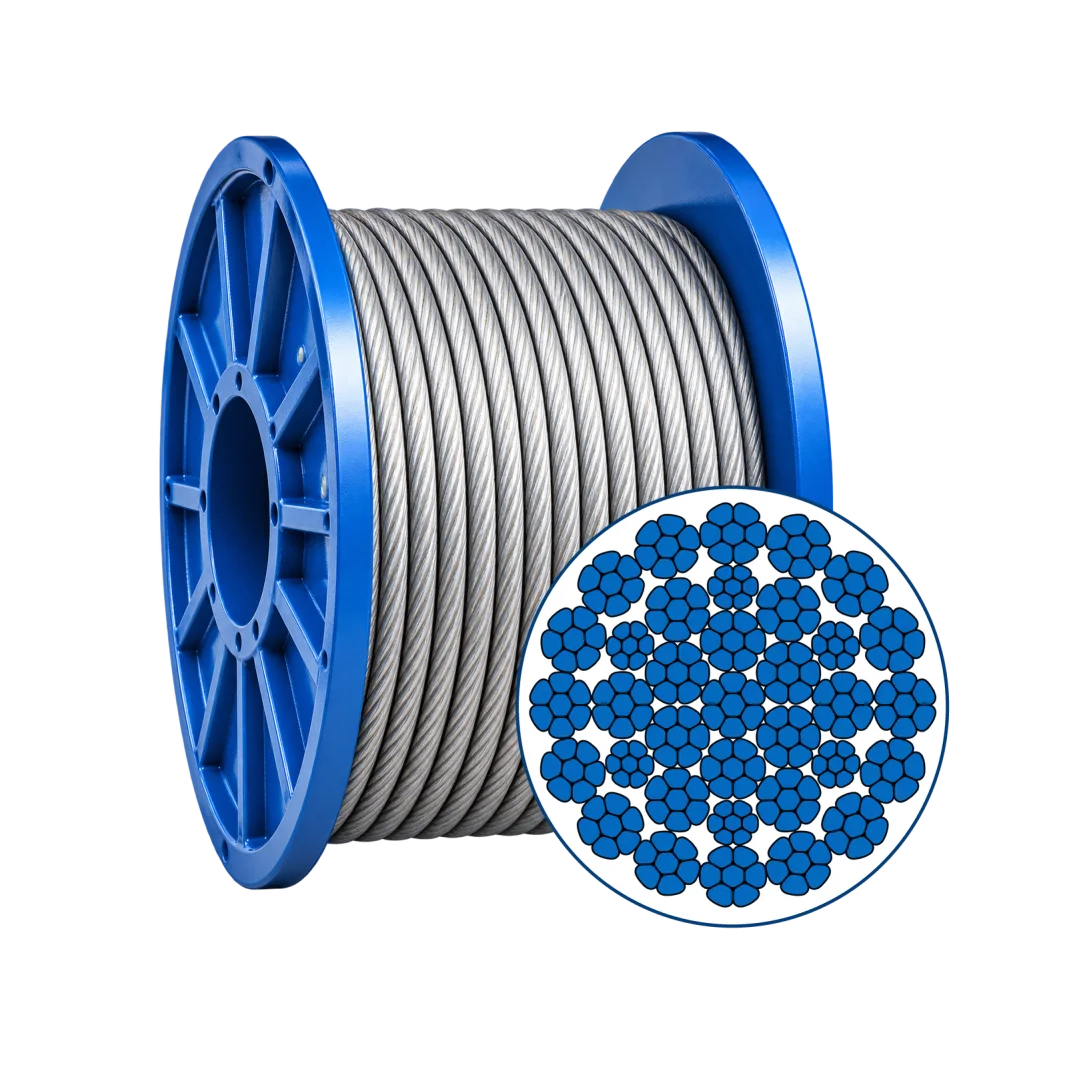
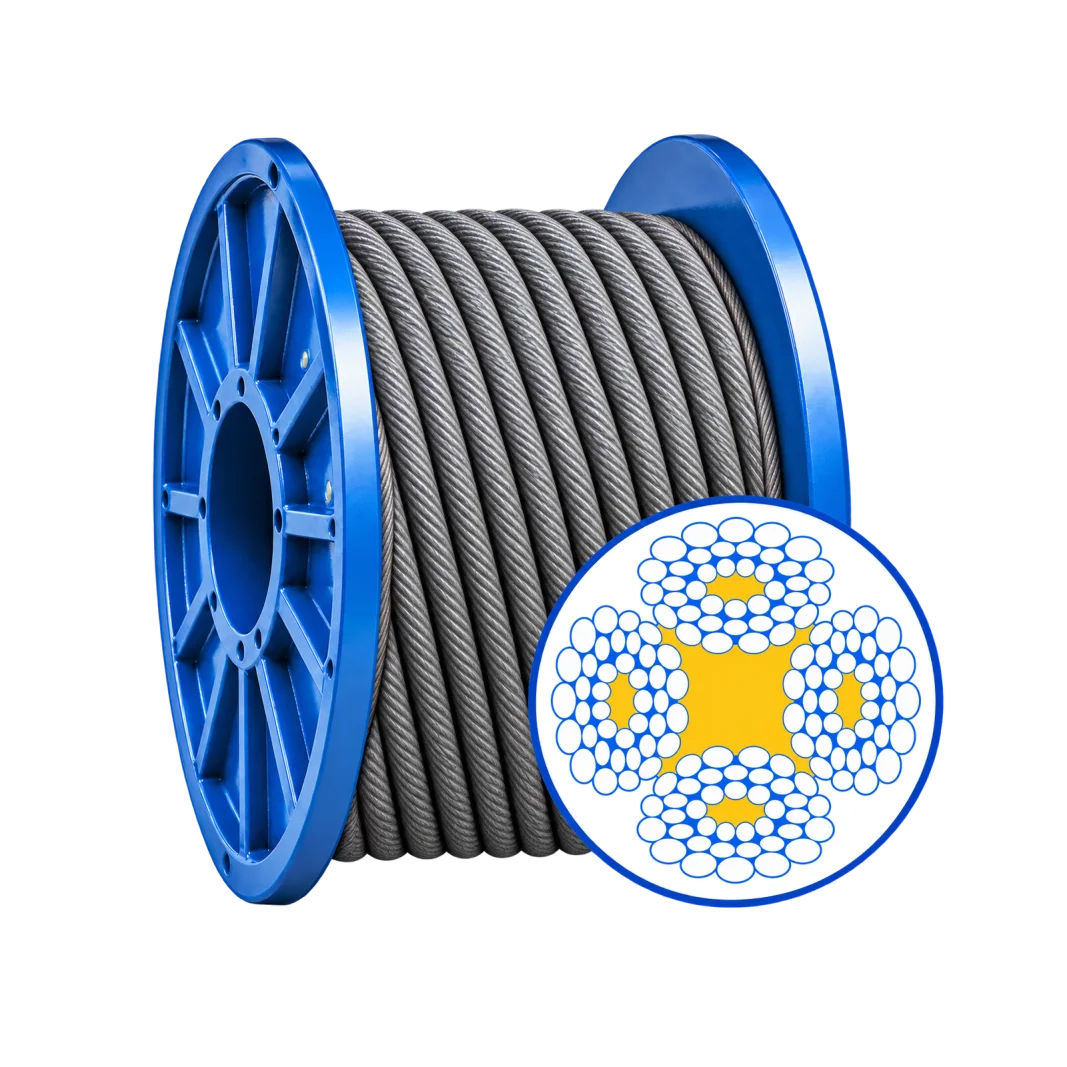
19×7 WSC


 Get Quote
Home / Products / Steel Wire Ropes & Assemblies
STEEL WIRE ROPES & ASSEMBLIES
Marine product supply for vessel, offshore, shipyard and industrial requirements across the UAE & GCC.
GLOBAL MARINE SOLUTIONS PARTNER
Images include an illustrative 6×36 IWRC example. Exact drawings are confirmed against the offered specification.
A crane hoist rope must control the load’s tendency to turn while tolerating bending over sheaves and winding onto a drum. Rotation-resistant ropes use a construction that limits torque or rotation under tension. “Non-rotating” is a common buying term, but it does not mean every rope has identical rotational behaviour or suits every reeving system.
Al Areen Lifting & Mooring LLC supplies and sources steel wire ropes as a UAE/GCC trader, supplier and stockist. Our enquiry range covers 35×7 WSC, 19×7 WSC, 35×K7, 4×K36WS and 4×39 FC. Configuration, documentation and availability are confirmed against the individual requirement.
As a Leading Supplier, Certified Supplier, Largest Stockist and No.1 Supplier in the UAE/GCC, Al Areen Lifting & Mooring LLC focuses on Best Quality sourcing of Rotation-Resistant / Non-Rotating Wire Ropes. We support buyers with construction-specific enquiries and documentation requirements.
The 35×7 family uses multiple strand layers to limit rotation. WSC identifies a wire strand core. This family is considered for crane hoisting where rotational stability and flexibility are required. Specify the exact construction, lay, finish and manufacturer’s minimum breaking force rather than ordering by strand count alone.
19×7 WSC is a recognised hoisting construction used on suitable provision cranes, hose cranes and other approved crane systems. Its rotational behaviour differs from a 35-strand design. For lifeboat falls, selection must follow the launching appliance manufacturer’s specification and the vessel’s applicable requirements.
The K designation identifies compaction. Compacted strands provide a different wire contact geometry from a conventional round-strand rope. Plastic impregnation or an internal plastic layer is a separate specification feature; it must be requested and confirmed when required. A compacted rope is not an automatic replacement for a standard 35×7 rope.
This construction combines four compacted Warrington-Seale strands; the core must be stated separately. Manufacturer literature includes fibre-core variants for demanding hoisting applications. Verify the complete designation, drum duty and swivel restriction for the proposed product. Suspended platform duties require a design specifically accepted for that equipment.
4×39 FC is a different four-strand construction used on compatible marine crane systems. Fibre-core arrangements and strand geometry can vary between named products. Preserve the full manufacturer designation when replacing a rope; 4×39 FC and 4×K36WS should not be treated as interchangeable descriptions.
Start with the crane or hoist manual and the existing rope identification. Review line pull, lifting height, parts of line, drum layering, sheave dimensions and grooves, fleet angle, lay direction and the end connection. A higher breaking force alone does not establish suitability: bending, crushing, spooling and rotational behaviour also matter.
Swivels require particular care. Some low-torque rope designs permit them, while other rotation-resistant products prohibit them. Obtain the exact rope manufacturer’s and equipment manufacturer’s instructions before adding, removing or retaining a swivel.
Keep reels protected from moisture and contamination. Install with controlled pay-off and the specified back tension, without introducing loops, kinks or twist. Follow the manufacturer’s end-securing and cutting instructions; end preparation differs between rope designs. Run in the installed rope as directed by the equipment and rope manufacturers.
Inspection should address broken wires, corrosion, diameter changes, deformation, drum crossover zones and terminations. Internal deterioration can occur without obvious external wear. Apply the relevant rope-specific inspection and discard criteria through a competent person, and record findings.
Request traceable rope identification, a manufacturer’s test certificate and any contractual inspection or class documentation. Check that the documents match the construction, diameter, grade, finish, length and reel or batch supplied.
Al Areen supports supply enquiries for customers and operations in and around the following maritime markets. Rope selection remains specific to the vessel, crane, hoist or launching appliance.
Wider enquiry coverage includes Dubai, Abu Dhabi, Sharjah, Fujairah, Ajman, Umm Al Quwain and Ras Al Khaimah, together with Saudi Arabia, Oman, Qatar, Bahrain and Kuwait. Additional maritime enquiry destinations include Jebel Ali Port, Port Khalid, Saqr Port, Al Jazeera Port and Shipyard, Ajman Port, Ahmed Bin Rashid Port, Sohar Port, Port of Salalah, Duqm drydocks, Jeddah Islamic Port, King Abdulaziz Port, the Jubail and Yanbu port markets, Hamad Port, Ras Laffan Port, Bahrain shipyards, Shuwaikh Port and Shuaiba Port.
Use the procurement details below and attach the equipment manual extract or existing rope certificate where available. State the destination, required date and documentation needs so the enquiry can be assessed accurately. Browse our product catalogue or contact Al Areen with your rope requirement.
Company support: Fast UAE & GCC Delivery · 24/7 Customer Support · Stock Availability. Exact configuration availability and dispatch arrangements are confirmed with the quotation.
Send rotation-resistant wire rope enquiries for operations around Port of Fujairah, Khor Fakkan Port, Mussafah Port, Port Rashid (Mina Rashid), Dubai Maritime City, Hamriyah Port, Khalifa Port and Drydocks World Dubai, as well as Port of Duqm in Oman and Khalifa Bin Salman Port in Bahrain. We also support enquiries across Dubai, Abu Dhabi, Sharjah, Fujairah, Ajman, Umm Al Quwain, Ras Al Khaimah, Saudi Arabia, Oman, Qatar, Bahrain and Kuwait.
| Parameter | Information to provide | Selection purpose |
|---|---|---|
| Construction and core | 35×7 WSC, 19×7 WSC, 35×K7, 4×K36WS or 4×39 FC, with the complete manufacturer designation and core. | Identifies the actual rope design; retain any W, WS, K, P or other suffix. |
| Diameter and length | Nominal diameter, specified tolerance, required working length and end preparation allowance. | Checks the sheave, drum, termination and installation fit. |
| Breaking force and grade | Required minimum breaking force or MBL, rope grade, units and the equipment’s specified design basis. | Allows comparison of the exact manufacturer variant. MBL is not a working load rating. |
| Finish and lubrication | Galvanised or bright finish, operating environment, approved lubricant and any internal plastic feature. | Addresses corrosion exposure and the specified rope design. |
| Lay | Right or left hand; ordinary/regular or Lang’s lay, as specified by the equipment manufacturer. | Checks compatibility with the drum and reeving arrangement. |
| Equipment and duty | Crane/hoist manufacturer, model, rope function, lifting height, parts of line, operating frequency and environment. | Separates main hoist, auxiliary hoist, luffing and other rope duties. |
| Drums and sheaves | Single- or multilayer winding, drum and sheave diameters, groove dimensions, fleet angle and identified wear. | Assesses bending, radial support and spooling requirements. |
| Terminations and swivel | Termination type, size, drawing and manufacturer’s swivel permission or prohibition. | Checks the full load path and controls unintended rotation. |
| Traceability and acceptance | Required test certificate, reel/batch identification, inspection plan, contractual standard and class requirements. | Defines the records and acceptance evidence needed for the supplied item. |
| Supply details | Quantity, reel/coil packaging, destination, required date and delivery contact. | Supports a practical quotation without assuming configuration-specific stock. |
WSC means wire strand core; IWRC means independent wire rope core; FC means fibre core; WS means Warrington-Seale; K denotes compaction. A manufacturer’s W or plastic-related suffix must be interpreted from that product’s data sheet. Core descriptions and branded names should be preserved rather than silently substituted.
EN 12385-4 addresses stranded ropes for general lifting applications. ISO 2408 addresses rope manufacture and acceptance requirements within its scope. ISO 4309 addresses care, maintenance, inspection and discard of crane and hoist ropes. Specify the applicable edition and contractual requirements, and confirm conformity from the supplied documentation. These references do not establish automatic compliance or class approval for every construction listed here.
The rope is designed to limit torque or rotation under tension. Its effectiveness depends on the construction and operating system; the designation does not promise zero rotation in every lift.
Buyers often use both terms for this range. Selection should use the exact manufacturer designation and documented rotational behaviour rather than relying on the marketing term.
Include 35×7 WSC, 19×7 WSC, 35×K7, 4×K36WS or 4×39 FC, together with the required manufacturer designation, diameter, length, core and equipment details.
They use different multistrand arrangements and have different rotational and bending characteristics. A 35-strand rope is not an automatic replacement for a 19×7 rope; obtain equipment-specific acceptance.
WSC identifies a wire strand core. Preserve this core designation when preparing the purchase specification and checking the manufacturer’s certificate.
Do not substitute the abbreviations without confirming the actual construction. WSC and IWRC identify different core descriptions, even where supplier listings use broader steel-core terminology.
K identifies compaction. Compacted strands have a different contact geometry from conventional round strands. Confirm the exact rope data instead of applying a standard 35×7 breaking-force table.
No. An internal plastic layer or plastic impregnation is a separate manufacturer-specific feature. State it explicitly when required and verify it in the product data.
WS means Warrington-Seale, describing the strand construction. The core, compaction and any additional manufacturer suffix must also be identified.
Your enquiry should state the core separately. Fibre-core variants are documented, but a shortened construction name does not establish the core of a particular supplied reel.
No automatic interchangeability should be assumed. Their strand geometry, compaction, core arrangements and operating restrictions can differ. A replacement requires a full specification comparison.
Manufacturer instructions for conventional 19×7 products commonly prohibit swivels. Check the proposed rope’s instructions and the crane specification; do not add a swivel simply because the rope is called rotation-resistant.
Some documented low-torque 35-strand designs allow swivels. Confirm permission for the exact rope, end connection and crane arrangement before installation.
It is product-specific. For example, some 4×K36WS literature advises against swivels. Obtain the exact manufacturer’s written guidance rather than transferring permission from another four-strand product.
MBL alone is insufficient. Verify diameter, construction, grade, lay, rotational behaviour, drum and sheave compatibility, end fittings and the equipment’s design requirements.
No. MBL is a breaking-force parameter. A working load rating belongs to an appropriately designed system or assembly and requires its applicable design basis and operating conditions.
Identify the manufacturer, model and rope function, and provide the manual or existing certificate. Include the reeving, lifting height, drum layering and end connection details.
They affect how the rope interacts with the drum and reeving. Specify right or left hand and ordinary or Lang’s lay according to the equipment’s requirements.
Diameter ratio, groove support and spooling geometry influence bending and rope stability. Inspect the existing components and use the equipment and rope manufacturers’ permitted dimensions.
Yes. The rope must tolerate the particular winding and crushing conditions. Drum crossover zones also need attention during inspection; a suitable construction depends on the actual system.
State the equipment-specified finish and the saltwater, humidity or splash exposure. Confirm galvanised or bright wire and lubrication against the exact manufacturer product.
A documented 19×7 construction may suit certain launching appliances. Use the appliance manufacturer’s required rope and follow the vessel’s applicable inspection, servicing and documentation requirements.
Crane suitability does not establish towing or mooring suitability. Submit that duty separately, with its equipment and load requirements, for construction-specific assessment.
Do not assume this. Platform hoists can require different design features and approvals. Identify the equipment and obtain acceptance for the proposed rope.
Use controlled reel or coil handling that avoids adding twist, loops or kinks. Follow the prescribed pay-off arrangement and installation tension for the rope and equipment.
Follow the exact manufacturer’s securing and cutting instructions. End treatments differ between rope designs; uncontrolled cutting can disturb the strand and core arrangement.
Follow the rope and equipment manufacturers’ procedure for bedding in, including any reduced-speed or light-load cycles. Confirm correct winding and condition before normal service.
Keep them supported and protected from ground moisture, weather and contamination. Retain the identification and check condition and lubrication before installation.
Examine broken wires, corrosion, diameter changes, deformation, terminations and relevant drum or sheave contact zones. Use the applicable inspection procedure and record the findings.
Yes. Rotation-resistant ropes can deteriorate internally. A competent person should assess suspected internal damage using suitable methods and the manufacturer’s guidance.
We review your requirement with the manufacturer before confirming the proposed supply.