

Home / Products / Anchors & Anchor Chain Systems
ANCHORS & ANCHOR CHAIN SYSTEMS
Stockless / Hall Type Anchors
Marine product supply for vessel, offshore, shipyard and industrial requirements across the UAE & GCC.
Specification SupportType & compatibility
Marine & OffshoreWide applications
UAE & GCCSupply coverage
GLOBAL MARINE SOLUTIONS PARTNER


 01 / 10
Product Overview
Hall-type stockless anchors for vessel anchoring
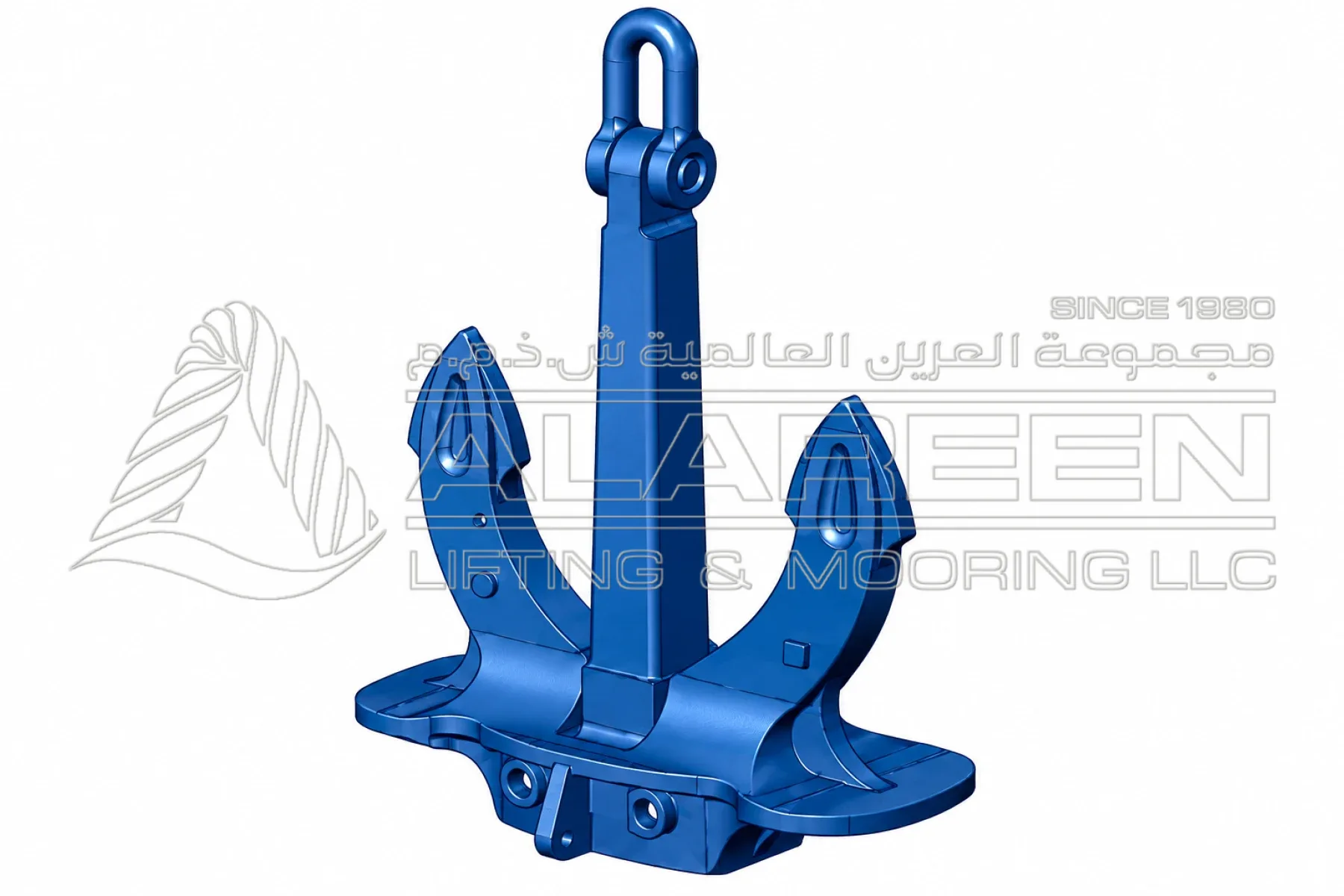
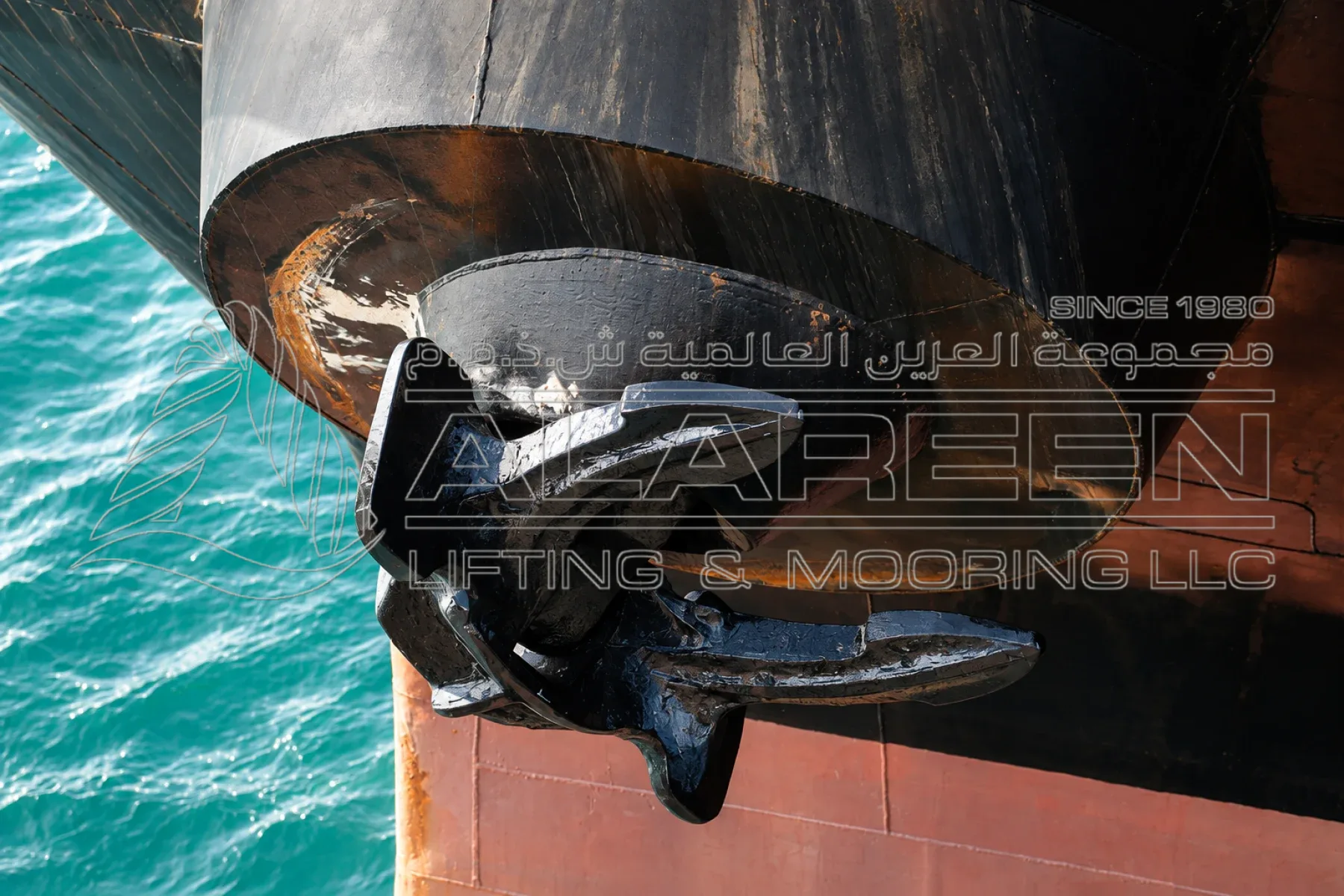
A Hall anchor is a conventional stockless bower-anchor pattern with a central shank and a movable crown carrying two flukes. The shank transmits chain tension to the head; the flukes engage suitable seabed as the vessel lays out the chain. The stockless configuration is intended to recover through an appropriate hawse arrangement and seat in the vessel's anchor pocket. Al Areen Lifting & Mooring LLC handles Hall anchor enquiries as a UAE trader, supplier and stockist.
Identify the exact design before replacing an anchor
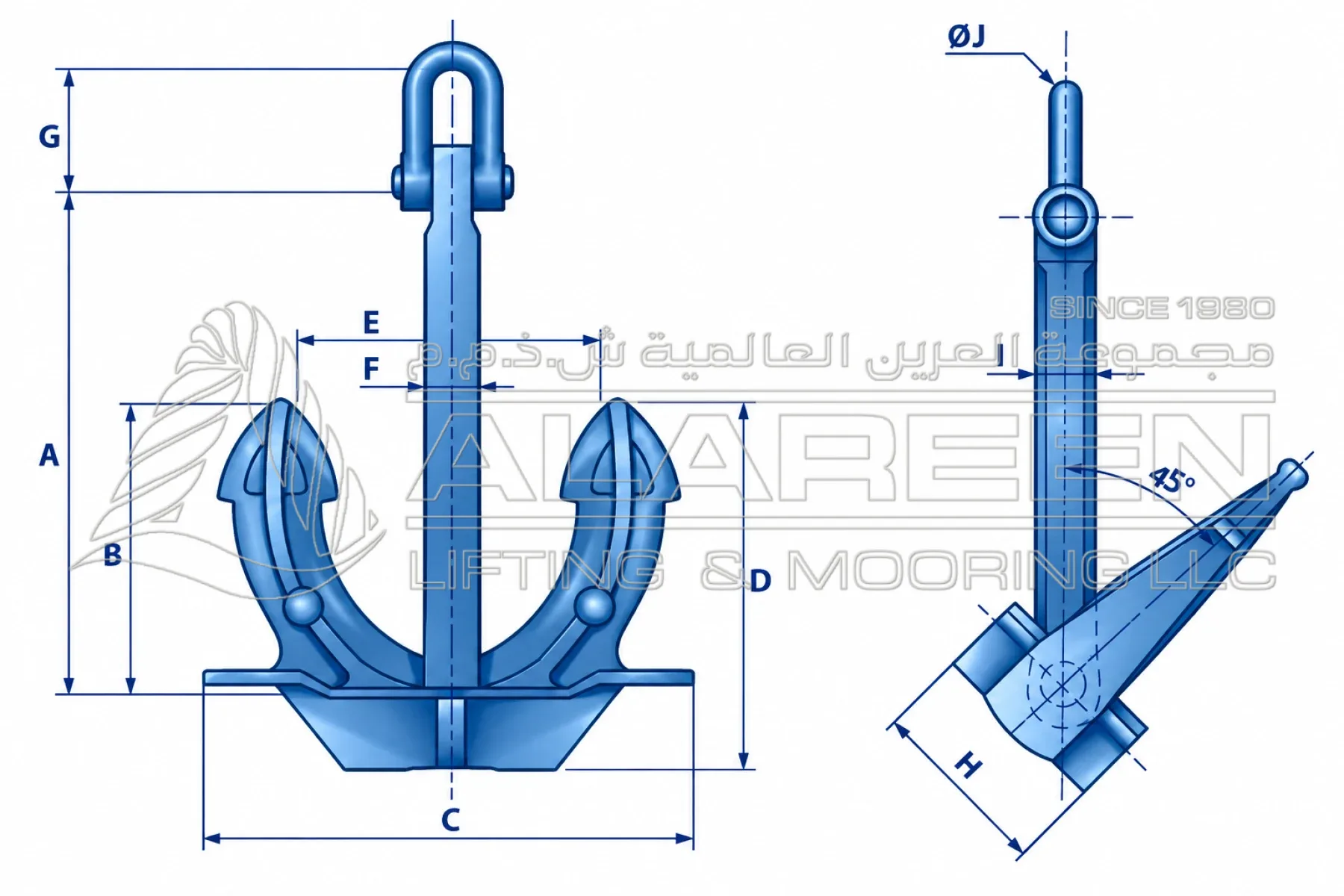
Hall Type A is a common designation, while maker catalogues may also show B, C and other variants. Shank section and length, pivot arrangement, crown and fluke envelope, eye dimensions and pocket seating can differ. A photograph helps identify the pattern but cannot prove a replacement will fit. Start with the approved vessel drawing or original maker reference; compare the offered dimensioned drawing with hawsepipe clearance, pocket seating and the port or starboard arrangement. A regular Hall anchor should not be described as a high-holding-power anchor merely because it appears alongside HHP products in a catalogue.
Chain connection and system compatibility
The anchor eye connects to the vessel's specified chain-end arrangement through an approved shackle and, where required, a swivel or forerunner. Check end-link, jaw and pin dimensions, articulation and retention against the drawing. The windlass, chain stopper, hawsepipe and anchor pocket remain part of the system. A nominal chain diameter or similar anchor mass alone cannot establish compatibility.
Applications and procurement occasions
Hall-type anchors are used where the vessel's approved anchoring equipment specifies that conventional stockless pattern. Typical procurement includes replacement of a damaged or lost bower anchor, scheduled drydock inspection, vessel repair, newbuild completion and planned fleet spares. Ship managers, technical superintendents and yard buyers should state the approved type, mass, drawing, original markings, condition requirement, chain-end details and document package. An alternative anchor pattern requires engineering and any required class or survey acceptance.
Inspection, handling and documentation
Inspect the shank, eye, crown, flukes, pivot and retainers for damage, deformation, corrosion and restricted movement. Lift and transport according to the actual item mass and its moving head; protect identification and coated surfaces. A buyer requiring class documentation should identify the vessel's society and applicable rules in the RFQ, then verify that the actual anchor markings match its drawing, inspection and proof-test records. IACS anchoring-equipment and anchor-manufacture requirements provide a classification framework where adopted by the vessel's society; they do not by themselves certify an unspecified item offered by a trader.
What to send Al Areen for a Hall anchor quote
- Vessel name or technical reference, approved anchor type, nominal mass and replacement position.
- Original maker/model reference, dimensioned drawing, pocket/hawse data and photographs of markings where available.
- Stud-link chain, end-link and anchor-shackle details, including any approved swivel or forerunner.
- Required condition, finish, inspection, test and class/survey documentation.
- Quantity, receiving location and requested schedule for a specific commercial offer.
UAE & GCC Maritime Supply Coverage
Al Areen supports specification-led Hall-type stockless anchor supply enquiries associated with vessels and customers at Port of Fujairah and Khor Fakkan Port on the UAE East Coast. For Abu Dhabi operations, buyers around Mussafah Port and Khalifa Port can send vessel drawings and chain-connection requirements for replacement or planned procurement. In Dubai, Port Rashid (Mina Rashid) enquiries may involve vessel maintenance, while Dubai Maritime City and Drydocks World Dubai are relevant to ship-repair and drydock purchasing. Hamriyah Port in Sharjah is another context for commercial-vessel and marine-contractor enquiries.
Regional buyers working around Port of Duqm in Oman and Khalifa Bin Salman Port in Bahrain can submit the same vessel-specific specification and documentation requirements. Al Areen also receives enquiries across the wider UAE and from Saudi Arabia, Oman, Qatar, Bahrain and Kuwait. Include the actual receiving location and requested schedule in the RFQ so the offered item and logistics can be confirmed.
Technical Specifications
Request DatasheetHall anchor procurement specification
| Buyer input | Verification for the offered item |
|---|---|
| Design and variant | Hall type, maker reference and approved drawing; distinguish Type A or another specified geometry. |
| Nominal mass | Use the vessel equipment schedule and verify the marked item and permitted tolerance against the purchase requirement. |
| Shank and head | Compare shank profile and length, crown/fluke envelope, pivot articulation and retaining components. |
| Vessel fit | Check hawsepipe travel, pocket clearance, seating, hull contact and securing arrangement. |
| Chain-end interface | Check anchor eye, end link, joining shackle and any swivel or forerunner against the approved assembly. |
| Material and finish | State the required steel/material route and coating, then obtain records for the actual offered anchor. |
| Documentation | State class/owner rules, drawing approval, identification, inspection and proof-test records required for the item. |
| Condition and delivery | State new/other accepted condition, quantity, receiving site, handling and documentary import requirements. |
Acceptance sequence
- Review the vessel's approved equipment and the failed or missing anchor record.
- Match the proposed Hall design and dimensions to the bow arrangement.
- Confirm the chain-end connection and each mating component.
- Check the actual item markings, condition and required certificates before shipment.
- Use the vessel or yard's approved fitting and recovery procedure.
Where class rules apply, the buyer should specify the applicable society and rule edition. IACS UR A1 addresses anchoring equipment categories and UR W29 addresses anchor manufacture and testing within its scope. The offered anchor's actual approvals and certificates must be established from its own documentation.
Applications Across Industry
FAQ
What is a Hall-type stockless anchor?+
It is a conventional ship anchor with a central shank and an articulated crown/head carrying two flukes, intended to recover and stow in a compatible hawse and pocket arrangement.
Is every stockless anchor a Hall anchor?+
No. Spek, Spek M and AC-14 are distinct patterns. Match the vessel-approved Hall design and drawing rather than using stockless as a substitute description.
What is the difference between Hall Type A, B and C?+
Maker catalogues use these variant labels for differing shank or head geometries. The exact maker drawing and vessel fit govern the replacement.
Is a Hall anchor an HHP anchor?+
An ordinary Hall pattern should not automatically be claimed as high holding power. HHP requires the applicable design and approval evidence for the actual item.
Does Hall Type A always have the same shank shape?+
A commonly illustrated Type A has a rectangular shank, but drawing-level comparison is needed because catalogue conventions and dimensions vary.
Can a Spek or M-Spek anchor replace Hall Type A?+
Only if engineering and required class/survey acceptance confirm the alternative type, mass, pocket fit, chain connection and documentation.
Why does the crown need to articulate?+
The head moves relative to the shank so the flukes can engage seabed during deployment and the anchor can recover into its designed bow arrangement.
What should be checked at the Hall pivot?+
Check movement, wear, retention, cracking and damage under the applicable approved inspection procedure; do not mix components from unrelated drawings.
Is a proof load the same as seabed holding force?+
No. Structural proof testing and in-service holding are different; the latter depends on seabed and the anchoring system.
Can a Hall bower anchor be specified for permanent offshore mooring?+
Not from the name alone. Permanent mooring requires a project-specific design, approved anchor and connection system.
Which vessel documents should accompany a Hall anchor enquiry?+
Send the approved anchoring-equipment schedule or drawing, original anchor identification, class or owner specification, and any survey report relevant to the replacement.
Is nominal anchor mass enough to select a replacement?+
No. The exact type, drawing, pocket and hawse clearance, chain-end connection and documentation must also match the approved vessel arrangement.
What chain details should the buyer provide?+
State the stud-link chain diameter and grade, end-link geometry, joining arrangement and drawing so mating components can be checked.
When is a swivel or forerunner needed?+
Only when the vessel-approved chain-end arrangement specifies one. Confirm its interface, orientation, pin retention and documentation with the full assembly.
Which material and finish should be requested?+
State the required material specification and coating or finish from the vessel or purchase documents; confirm the actual offered anchor records before purchase.
What should an item-specific document package include?+
Depending on the purchase specification, request the approved drawing, identification, material records, proof-test/inspection evidence and any class or survey document traceable to the physical item.
Does a catalogue certificate cover every anchor of the same type?+
No. Match the actual anchor marking and identification to the supplied test and inspection documents.
What should be inspected on receipt?+
Check markings, dimensions, finish, cracks, deformation, corrosion, the eye and joining interface, and the condition and movement of the head and flukes.
How should a heavy anchor be handled?+
Plan lifting and transport for the actual mass and centre of gravity; restrain the movable head and keep personnel clear of suspended loads and pinch points.
What should be checked during installation?+
Confirm the approved connection and retention, free articulation, hawse travel, pocket seating and securing arrangement using the vessel or yard procedure.
Can an anchor be welded or modified after supply?+
Any structural alteration needs an approved engineering and inspection process and, where applicable, maker/class involvement; it cannot be treated as a routine fit adjustment.
Can this anchor be used as a lifting accessory?+
No. An anchor is part of an anchoring system and should not be used to suspend unrelated loads.
What affects actual seabed holding?+
Seabed, deployment, chain scope, direction of pull, environmental loading and the complete anchoring arrangement affect performance; a universal site holding figure cannot be inferred from the name.
What is needed for a drydock replacement quote?+
Send the vessel identity, failed-item report, approved design and mass, drawings or measurements, chain connection, documentary requirements, receiving point and required schedule.
Can Al Areen supply chain and connection fittings with an anchor enquiry?+
Yes, buyers can submit the complete package for sourcing review. The proposed anchor, chain, shackle and any swivel or forerunner must be verified together.
How is stock availability confirmed?+
Al Areen provides Stock Availability support; the exact pattern, mass, condition and documents available for an order are confirmed in the item-specific quotation.
What does Fast UAE & GCC Delivery mean for this item?+
It is a company-wide service assurance. The actual destination, customs/receiving requirements and item-specific schedule are confirmed with the quotation.
Can I seek support outside normal office hours?+
Al Areen states 24/7 Customer Support. Send the vessel, item and destination details so the relevant team can respond to the enquiry.
Can buyers near Port of Fujairah or Khor Fakkan Port enquire?+
Yes. Provide the vessel specification and receiving location for an East Coast supply enquiry; the quotation establishes the item and commercial terms.
What should a Mussafah Port or Khalifa Port buyer send?+
Send the approved vessel anchor and chain details, required documents and Abu Dhabi receiving point for a specific offer.
How can a Port Rashid (Mina Rashid) buyer request replacement equipment?+
Identify the vessel, approved anchor arrangement and receiving instructions for a Dubai-based enquiry.
What should Dubai Maritime City and Drydocks World Dubai repair teams provide?+
Provide the repair scope, item drawings, condition report, chain-end arrangement, survey needs and yard receiving requirements.
Can a Hamriyah Port contractor request anchor and chain components?+
Yes. Identify the vessel or project, exact anchor pattern, mating chain parts and the Sharjah receiving arrangement.
Are enquiries for Port of Duqm in Oman accepted?+
Yes. Include the vessel specification, documentation and import/receiving information for a regional quotation.
Are enquiries for Khalifa Bin Salman Port in Bahrain accepted?+
Yes. Send the anchor type, drawing, connection details, document package and receiving information.
How are enquiries for a listed maritime hub handled?+
Provide the vessel specification, required item, documentation and precise receiving point. The quotation confirms the available item and delivery arrangement.
Product Overview
Hall-type stockless anchors for vessel anchoring
A Hall anchor is a conventional stockless bower-anchor pattern with a central shank and a movable crown carrying two flukes. The shank transmits chain tension to the head; the flukes engage suitable seabed as the vessel lays out the chain. The stockless configuration is intended to recover through an appropriate hawse arrangement and seat in the vessel's anchor pocket. Al Areen Lifting & Mooring LLC handles Hall anchor enquiries as a UAE trader, supplier and stockist.
Identify the exact design before replacing an anchor
Hall Type A is a common designation, while maker catalogues may also show B, C and other variants. Shank section and length, pivot arrangement, crown and fluke envelope, eye dimensions and pocket seating can differ. A photograph helps identify the pattern but cannot prove a replacement will fit. Start with the approved vessel drawing or original maker reference; compare the offered dimensioned drawing with hawsepipe clearance, pocket seating and the port or starboard arrangement. A regular Hall anchor should not be described as a high-holding-power anchor merely because it appears alongside HHP products in a catalogue.
Chain connection and system compatibility
The anchor eye connects to the vessel's specified chain-end arrangement through an approved shackle and, where required, a swivel or forerunner. Check end-link, jaw and pin dimensions, articulation and retention against the drawing. The windlass, chain stopper, hawsepipe and anchor pocket remain part of the system. A nominal chain diameter or similar anchor mass alone cannot establish compatibility.
Applications and procurement occasions
Hall-type anchors are used where the vessel's approved anchoring equipment specifies that conventional stockless pattern. Typical procurement includes replacement of a damaged or lost bower anchor, scheduled drydock inspection, vessel repair, newbuild completion and planned fleet spares. Ship managers, technical superintendents and yard buyers should state the approved type, mass, drawing, original markings, condition requirement, chain-end details and document package. An alternative anchor pattern requires engineering and any required class or survey acceptance.
Inspection, handling and documentation
Inspect the shank, eye, crown, flukes, pivot and retainers for damage, deformation, corrosion and restricted movement. Lift and transport according to the actual item mass and its moving head; protect identification and coated surfaces. A buyer requiring class documentation should identify the vessel's society and applicable rules in the RFQ, then verify that the actual anchor markings match its drawing, inspection and proof-test records. IACS anchoring-equipment and anchor-manufacture requirements provide a classification framework where adopted by the vessel's society; they do not by themselves certify an unspecified item offered by a trader.
What to send Al Areen for a Hall anchor quote
- Vessel name or technical reference, approved anchor type, nominal mass and replacement position.
- Original maker/model reference, dimensioned drawing, pocket/hawse data and photographs of markings where available.
- Stud-link chain, end-link and anchor-shackle details, including any approved swivel or forerunner.
- Required condition, finish, inspection, test and class/survey documentation.
- Quantity, receiving location and requested schedule for a specific commercial offer.
UAE & GCC Maritime Supply Coverage
Al Areen supports specification-led Hall-type stockless anchor supply enquiries associated with vessels and customers at Port of Fujairah and Khor Fakkan Port on the UAE East Coast. For Abu Dhabi operations, buyers around Mussafah Port and Khalifa Port can send vessel drawings and chain-connection requirements for replacement or planned procurement. In Dubai, Port Rashid (Mina Rashid) enquiries may involve vessel maintenance, while Dubai Maritime City and Drydocks World Dubai are relevant to ship-repair and drydock purchasing. Hamriyah Port in Sharjah is another context for commercial-vessel and marine-contractor enquiries.
Regional buyers working around Port of Duqm in Oman and Khalifa Bin Salman Port in Bahrain can submit the same vessel-specific specification and documentation requirements. Al Areen also receives enquiries across the wider UAE and from Saudi Arabia, Oman, Qatar, Bahrain and Kuwait. Include the actual receiving location and requested schedule in the RFQ so the offered item and logistics can be confirmed.
01 / 10
Technical Specifications
Request DatasheetHall anchor procurement specification
| Buyer input | Verification for the offered item |
|---|---|
| Design and variant | Hall type, maker reference and approved drawing; distinguish Type A or another specified geometry. |
| Nominal mass | Use the vessel equipment schedule and verify the marked item and permitted tolerance against the purchase requirement. |
| Shank and head | Compare shank profile and length, crown/fluke envelope, pivot articulation and retaining components. |
| Vessel fit | Check hawsepipe travel, pocket clearance, seating, hull contact and securing arrangement. |
| Chain-end interface | Check anchor eye, end link, joining shackle and any swivel or forerunner against the approved assembly. |
| Material and finish | State the required steel/material route and coating, then obtain records for the actual offered anchor. |
| Documentation | State class/owner rules, drawing approval, identification, inspection and proof-test records required for the item. |
| Condition and delivery | State new/other accepted condition, quantity, receiving site, handling and documentary import requirements. |
Acceptance sequence
- Review the vessel's approved equipment and the failed or missing anchor record.
- Match the proposed Hall design and dimensions to the bow arrangement.
- Confirm the chain-end connection and each mating component.
- Check the actual item markings, condition and required certificates before shipment.
- Use the vessel or yard's approved fitting and recovery procedure.
Where class rules apply, the buyer should specify the applicable society and rule edition. IACS UR A1 addresses anchoring equipment categories and UR W29 addresses anchor manufacture and testing within its scope. The offered anchor's actual approvals and certificates must be established from its own documentation.
Applications Across Industry
FAQ
What is a Hall-type stockless anchor?+
It is a conventional ship anchor with a central shank and an articulated crown/head carrying two flukes, intended to recover and stow in a compatible hawse and pocket arrangement.
Is every stockless anchor a Hall anchor?+
No. Spek, Spek M and AC-14 are distinct patterns. Match the vessel-approved Hall design and drawing rather than using stockless as a substitute description.
What is the difference between Hall Type A, B and C?+
Maker catalogues use these variant labels for differing shank or head geometries. The exact maker drawing and vessel fit govern the replacement.
Is a Hall anchor an HHP anchor?+
An ordinary Hall pattern should not automatically be claimed as high holding power. HHP requires the applicable design and approval evidence for the actual item.
Does Hall Type A always have the same shank shape?+
A commonly illustrated Type A has a rectangular shank, but drawing-level comparison is needed because catalogue conventions and dimensions vary.
Can a Spek or M-Spek anchor replace Hall Type A?+
Only if engineering and required class/survey acceptance confirm the alternative type, mass, pocket fit, chain connection and documentation.
Why does the crown need to articulate?+
The head moves relative to the shank so the flukes can engage seabed during deployment and the anchor can recover into its designed bow arrangement.
What should be checked at the Hall pivot?+
Check movement, wear, retention, cracking and damage under the applicable approved inspection procedure; do not mix components from unrelated drawings.
Is a proof load the same as seabed holding force?+
No. Structural proof testing and in-service holding are different; the latter depends on seabed and the anchoring system.
Can a Hall bower anchor be specified for permanent offshore mooring?+
Not from the name alone. Permanent mooring requires a project-specific design, approved anchor and connection system.
Which vessel documents should accompany a Hall anchor enquiry?+
Send the approved anchoring-equipment schedule or drawing, original anchor identification, class or owner specification, and any survey report relevant to the replacement.
Is nominal anchor mass enough to select a replacement?+
No. The exact type, drawing, pocket and hawse clearance, chain-end connection and documentation must also match the approved vessel arrangement.
What chain details should the buyer provide?+
State the stud-link chain diameter and grade, end-link geometry, joining arrangement and drawing so mating components can be checked.
When is a swivel or forerunner needed?+
Only when the vessel-approved chain-end arrangement specifies one. Confirm its interface, orientation, pin retention and documentation with the full assembly.
Which material and finish should be requested?+
State the required material specification and coating or finish from the vessel or purchase documents; confirm the actual offered anchor records before purchase.
What should an item-specific document package include?+
Depending on the purchase specification, request the approved drawing, identification, material records, proof-test/inspection evidence and any class or survey document traceable to the physical item.
Does a catalogue certificate cover every anchor of the same type?+
No. Match the actual anchor marking and identification to the supplied test and inspection documents.
What should be inspected on receipt?+
Check markings, dimensions, finish, cracks, deformation, corrosion, the eye and joining interface, and the condition and movement of the head and flukes.
How should a heavy anchor be handled?+
Plan lifting and transport for the actual mass and centre of gravity; restrain the movable head and keep personnel clear of suspended loads and pinch points.
What should be checked during installation?+
Confirm the approved connection and retention, free articulation, hawse travel, pocket seating and securing arrangement using the vessel or yard procedure.
Can an anchor be welded or modified after supply?+
Any structural alteration needs an approved engineering and inspection process and, where applicable, maker/class involvement; it cannot be treated as a routine fit adjustment.
Can this anchor be used as a lifting accessory?+
No. An anchor is part of an anchoring system and should not be used to suspend unrelated loads.
What affects actual seabed holding?+
Seabed, deployment, chain scope, direction of pull, environmental loading and the complete anchoring arrangement affect performance; a universal site holding figure cannot be inferred from the name.
What is needed for a drydock replacement quote?+
Send the vessel identity, failed-item report, approved design and mass, drawings or measurements, chain connection, documentary requirements, receiving point and required schedule.
Can Al Areen supply chain and connection fittings with an anchor enquiry?+
Yes, buyers can submit the complete package for sourcing review. The proposed anchor, chain, shackle and any swivel or forerunner must be verified together.
How is stock availability confirmed?+
Al Areen provides Stock Availability support; the exact pattern, mass, condition and documents available for an order are confirmed in the item-specific quotation.
What does Fast UAE & GCC Delivery mean for this item?+
It is a company-wide service assurance. The actual destination, customs/receiving requirements and item-specific schedule are confirmed with the quotation.
Can I seek support outside normal office hours?+
Al Areen states 24/7 Customer Support. Send the vessel, item and destination details so the relevant team can respond to the enquiry.
Can buyers near Port of Fujairah or Khor Fakkan Port enquire?+
Yes. Provide the vessel specification and receiving location for an East Coast supply enquiry; the quotation establishes the item and commercial terms.
What should a Mussafah Port or Khalifa Port buyer send?+
Send the approved vessel anchor and chain details, required documents and Abu Dhabi receiving point for a specific offer.
How can a Port Rashid (Mina Rashid) buyer request replacement equipment?+
Identify the vessel, approved anchor arrangement and receiving instructions for a Dubai-based enquiry.
What should Dubai Maritime City and Drydocks World Dubai repair teams provide?+
Provide the repair scope, item drawings, condition report, chain-end arrangement, survey needs and yard receiving requirements.
Can a Hamriyah Port contractor request anchor and chain components?+
Yes. Identify the vessel or project, exact anchor pattern, mating chain parts and the Sharjah receiving arrangement.
Are enquiries for Port of Duqm in Oman accepted?+
Yes. Include the vessel specification, documentation and import/receiving information for a regional quotation.
Are enquiries for Khalifa Bin Salman Port in Bahrain accepted?+
Yes. Send the anchor type, drawing, connection details, document package and receiving information.
How are enquiries for a listed maritime hub handled?+
Provide the vessel specification, required item, documentation and precise receiving point. The quotation confirms the available item and delivery arrangement.
Technical Specifications+
Hall anchor procurement specification
| Buyer input | Verification for the offered item |
|---|---|
| Design and variant | Hall type, maker reference and approved drawing; distinguish Type A or another specified geometry. |
| Nominal mass | Use the vessel equipment schedule and verify the marked item and permitted tolerance against the purchase requirement. |
| Shank and head | Compare shank profile and length, crown/fluke envelope, pivot articulation and retaining components. |
| Vessel fit | Check hawsepipe travel, pocket clearance, seating, hull contact and securing arrangement. |
| Chain-end interface | Check anchor eye, end link, joining shackle and any swivel or forerunner against the approved assembly. |
| Material and finish | State the required steel/material route and coating, then obtain records for the actual offered anchor. |
| Documentation | State class/owner rules, drawing approval, identification, inspection and proof-test records required for the item. |
| Condition and delivery | State new/other accepted condition, quantity, receiving site, handling and documentary import requirements. |
Acceptance sequence
- Review the vessel's approved equipment and the failed or missing anchor record.
- Match the proposed Hall design and dimensions to the bow arrangement.
- Confirm the chain-end connection and each mating component.
- Check the actual item markings, condition and required certificates before shipment.
- Use the vessel or yard's approved fitting and recovery procedure.
Where class rules apply, the buyer should specify the applicable society and rule edition. IACS UR A1 addresses anchoring equipment categories and UR W29 addresses anchor manufacture and testing within its scope. The offered anchor's actual approvals and certificates must be established from its own documentation.
Applications Across Industry+
FAQ+
What is a Hall-type stockless anchor?+
It is a conventional ship anchor with a central shank and an articulated crown/head carrying two flukes, intended to recover and stow in a compatible hawse and pocket arrangement.
Is every stockless anchor a Hall anchor?+
No. Spek, Spek M and AC-14 are distinct patterns. Match the vessel-approved Hall design and drawing rather than using stockless as a substitute description.
What is the difference between Hall Type A, B and C?+
Maker catalogues use these variant labels for differing shank or head geometries. The exact maker drawing and vessel fit govern the replacement.
Is a Hall anchor an HHP anchor?+
An ordinary Hall pattern should not automatically be claimed as high holding power. HHP requires the applicable design and approval evidence for the actual item.
Does Hall Type A always have the same shank shape?+
A commonly illustrated Type A has a rectangular shank, but drawing-level comparison is needed because catalogue conventions and dimensions vary.
Can a Spek or M-Spek anchor replace Hall Type A?+
Only if engineering and required class/survey acceptance confirm the alternative type, mass, pocket fit, chain connection and documentation.
Why does the crown need to articulate?+
The head moves relative to the shank so the flukes can engage seabed during deployment and the anchor can recover into its designed bow arrangement.
What should be checked at the Hall pivot?+
Check movement, wear, retention, cracking and damage under the applicable approved inspection procedure; do not mix components from unrelated drawings.
Is a proof load the same as seabed holding force?+
No. Structural proof testing and in-service holding are different; the latter depends on seabed and the anchoring system.
Can a Hall bower anchor be specified for permanent offshore mooring?+
Not from the name alone. Permanent mooring requires a project-specific design, approved anchor and connection system.
Which vessel documents should accompany a Hall anchor enquiry?+
Send the approved anchoring-equipment schedule or drawing, original anchor identification, class or owner specification, and any survey report relevant to the replacement.
Is nominal anchor mass enough to select a replacement?+
No. The exact type, drawing, pocket and hawse clearance, chain-end connection and documentation must also match the approved vessel arrangement.
What chain details should the buyer provide?+
State the stud-link chain diameter and grade, end-link geometry, joining arrangement and drawing so mating components can be checked.
When is a swivel or forerunner needed?+
Only when the vessel-approved chain-end arrangement specifies one. Confirm its interface, orientation, pin retention and documentation with the full assembly.
Which material and finish should be requested?+
State the required material specification and coating or finish from the vessel or purchase documents; confirm the actual offered anchor records before purchase.
What should an item-specific document package include?+
Depending on the purchase specification, request the approved drawing, identification, material records, proof-test/inspection evidence and any class or survey document traceable to the physical item.
Does a catalogue certificate cover every anchor of the same type?+
No. Match the actual anchor marking and identification to the supplied test and inspection documents.
What should be inspected on receipt?+
Check markings, dimensions, finish, cracks, deformation, corrosion, the eye and joining interface, and the condition and movement of the head and flukes.
How should a heavy anchor be handled?+
Plan lifting and transport for the actual mass and centre of gravity; restrain the movable head and keep personnel clear of suspended loads and pinch points.
What should be checked during installation?+
Confirm the approved connection and retention, free articulation, hawse travel, pocket seating and securing arrangement using the vessel or yard procedure.
Can an anchor be welded or modified after supply?+
Any structural alteration needs an approved engineering and inspection process and, where applicable, maker/class involvement; it cannot be treated as a routine fit adjustment.
Can this anchor be used as a lifting accessory?+
No. An anchor is part of an anchoring system and should not be used to suspend unrelated loads.
What affects actual seabed holding?+
Seabed, deployment, chain scope, direction of pull, environmental loading and the complete anchoring arrangement affect performance; a universal site holding figure cannot be inferred from the name.
What is needed for a drydock replacement quote?+
Send the vessel identity, failed-item report, approved design and mass, drawings or measurements, chain connection, documentary requirements, receiving point and required schedule.
Can Al Areen supply chain and connection fittings with an anchor enquiry?+
Yes, buyers can submit the complete package for sourcing review. The proposed anchor, chain, shackle and any swivel or forerunner must be verified together.
How is stock availability confirmed?+
Al Areen provides Stock Availability support; the exact pattern, mass, condition and documents available for an order are confirmed in the item-specific quotation.
What does Fast UAE & GCC Delivery mean for this item?+
It is a company-wide service assurance. The actual destination, customs/receiving requirements and item-specific schedule are confirmed with the quotation.
Can I seek support outside normal office hours?+
Al Areen states 24/7 Customer Support. Send the vessel, item and destination details so the relevant team can respond to the enquiry.
Can buyers near Port of Fujairah or Khor Fakkan Port enquire?+
Yes. Provide the vessel specification and receiving location for an East Coast supply enquiry; the quotation establishes the item and commercial terms.
What should a Mussafah Port or Khalifa Port buyer send?+
Send the approved vessel anchor and chain details, required documents and Abu Dhabi receiving point for a specific offer.
How can a Port Rashid (Mina Rashid) buyer request replacement equipment?+
Identify the vessel, approved anchor arrangement and receiving instructions for a Dubai-based enquiry.
What should Dubai Maritime City and Drydocks World Dubai repair teams provide?+
Provide the repair scope, item drawings, condition report, chain-end arrangement, survey needs and yard receiving requirements.
Can a Hamriyah Port contractor request anchor and chain components?+
Yes. Identify the vessel or project, exact anchor pattern, mating chain parts and the Sharjah receiving arrangement.
Are enquiries for Port of Duqm in Oman accepted?+
Yes. Include the vessel specification, documentation and import/receiving information for a regional quotation.
Are enquiries for Khalifa Bin Salman Port in Bahrain accepted?+
Yes. Send the anchor type, drawing, connection details, document package and receiving information.
How are enquiries for a listed maritime hub handled?+
Provide the vessel specification, required item, documentation and precise receiving point. The quotation confirms the available item and delivery arrangement.
Need help selecting the right product?
Our team will help you choose the best solution for your application.