

Home / Products / Anchors & Anchor Chain Systems
ANCHORS & ANCHOR CHAIN SYSTEMS
Swivel Forerunner Assemblies
Marine product supply for vessel, offshore, shipyard and industrial requirements across the UAE & GCC.
Specification SupportType & compatibility
Marine & OffshoreWide applications
UAE & GCCSupply coverage
GLOBAL MARINE SOLUTIONS PARTNER
 01 / 08
Product Overview
Swivel connections for ship anchor-chain systems
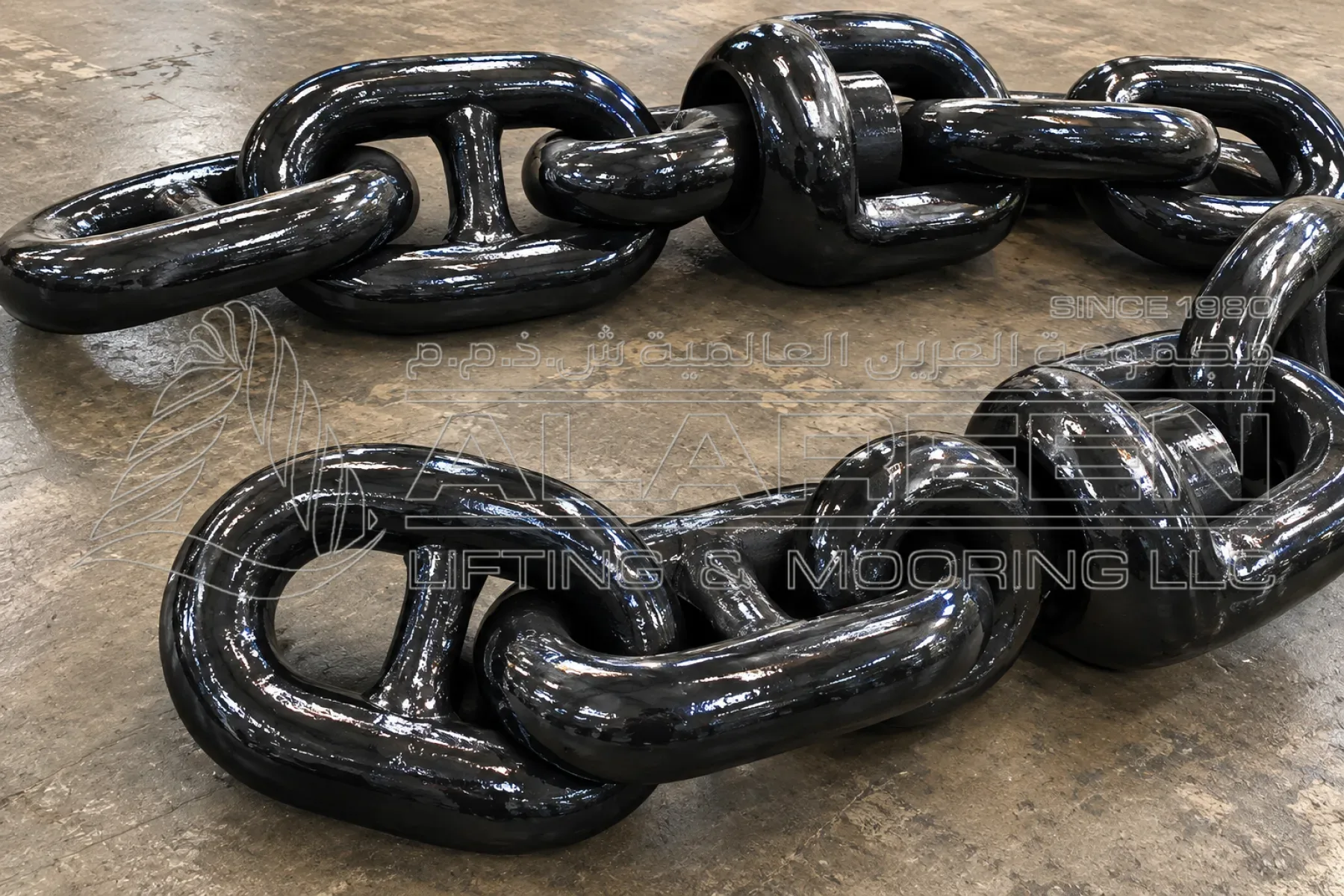
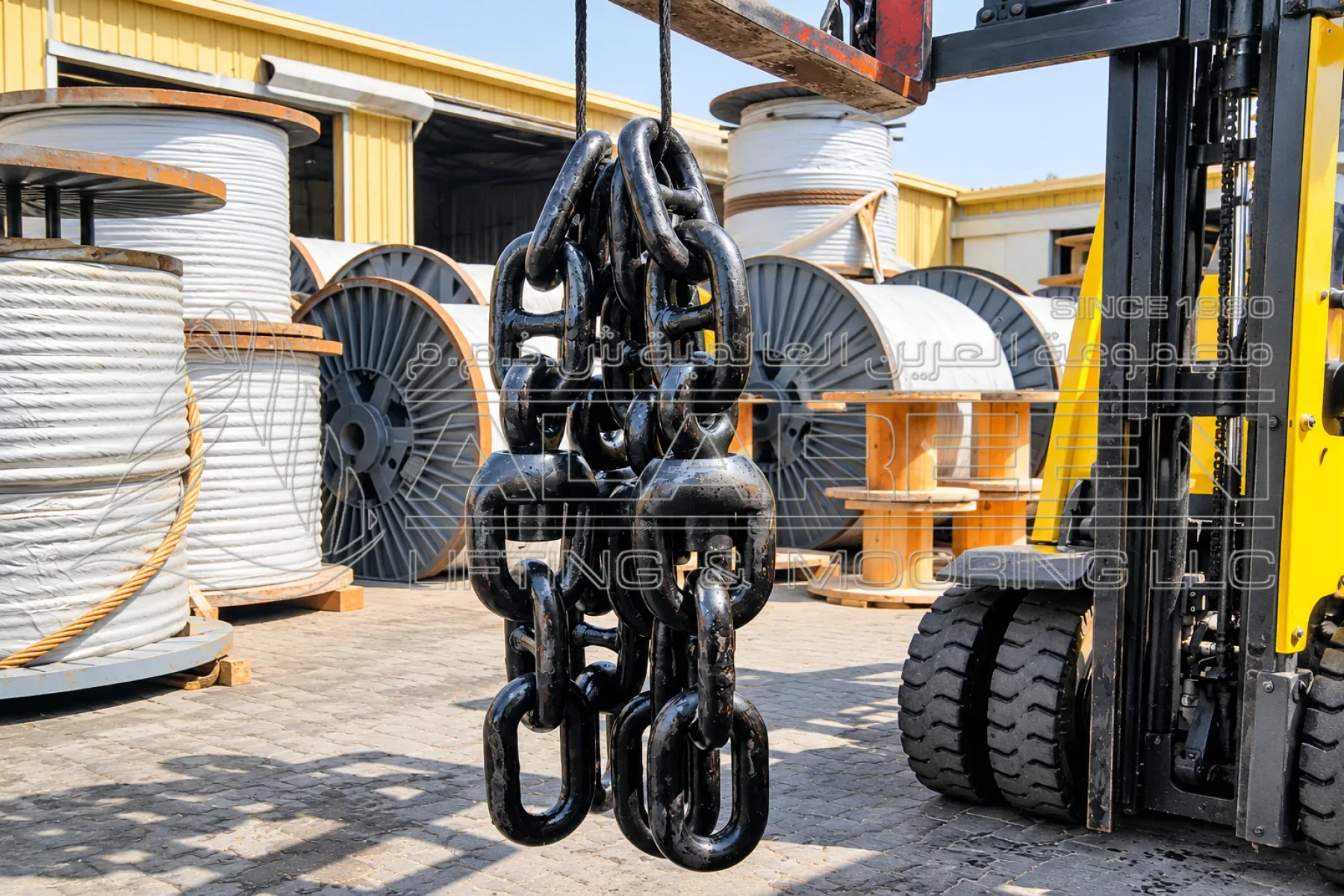
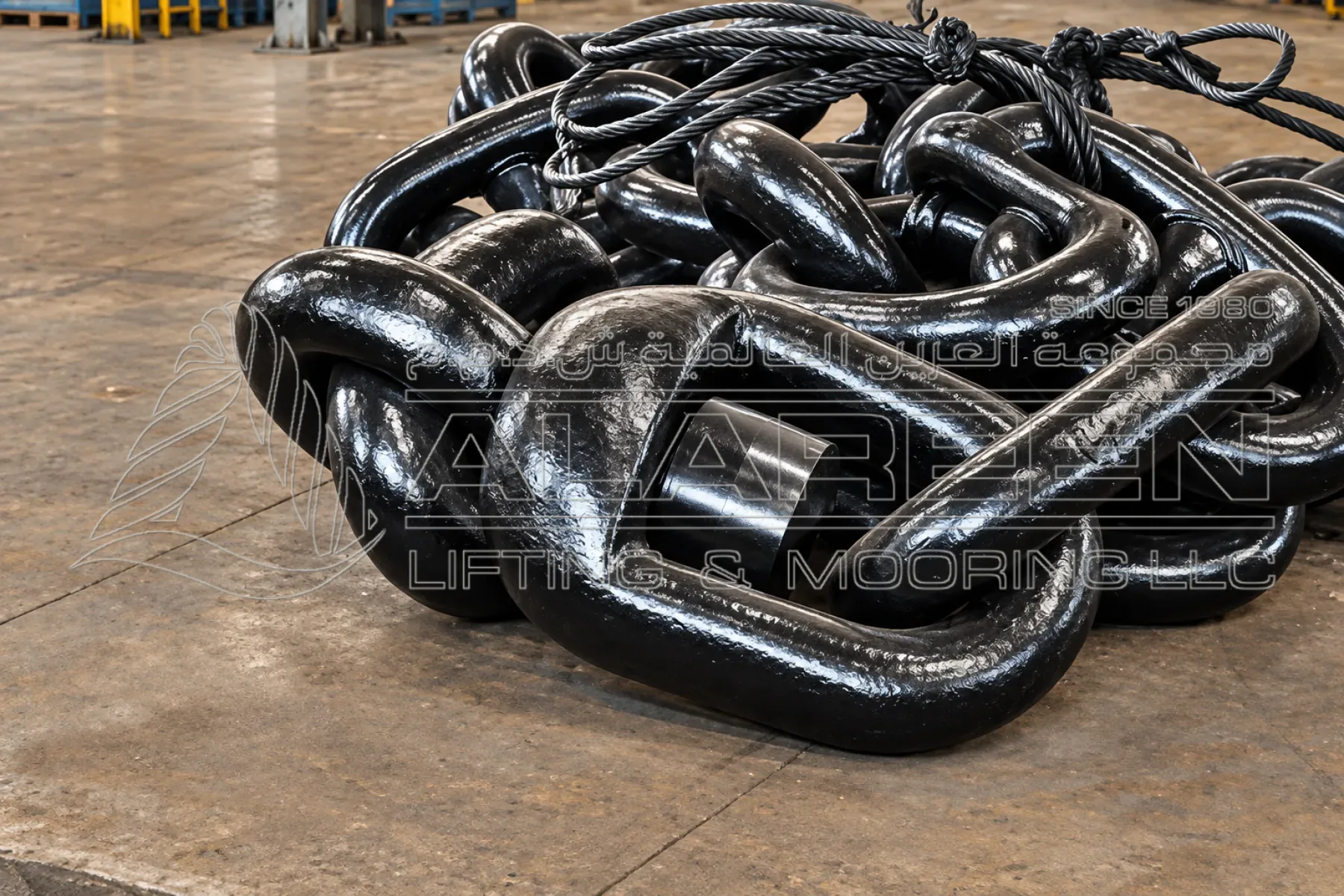
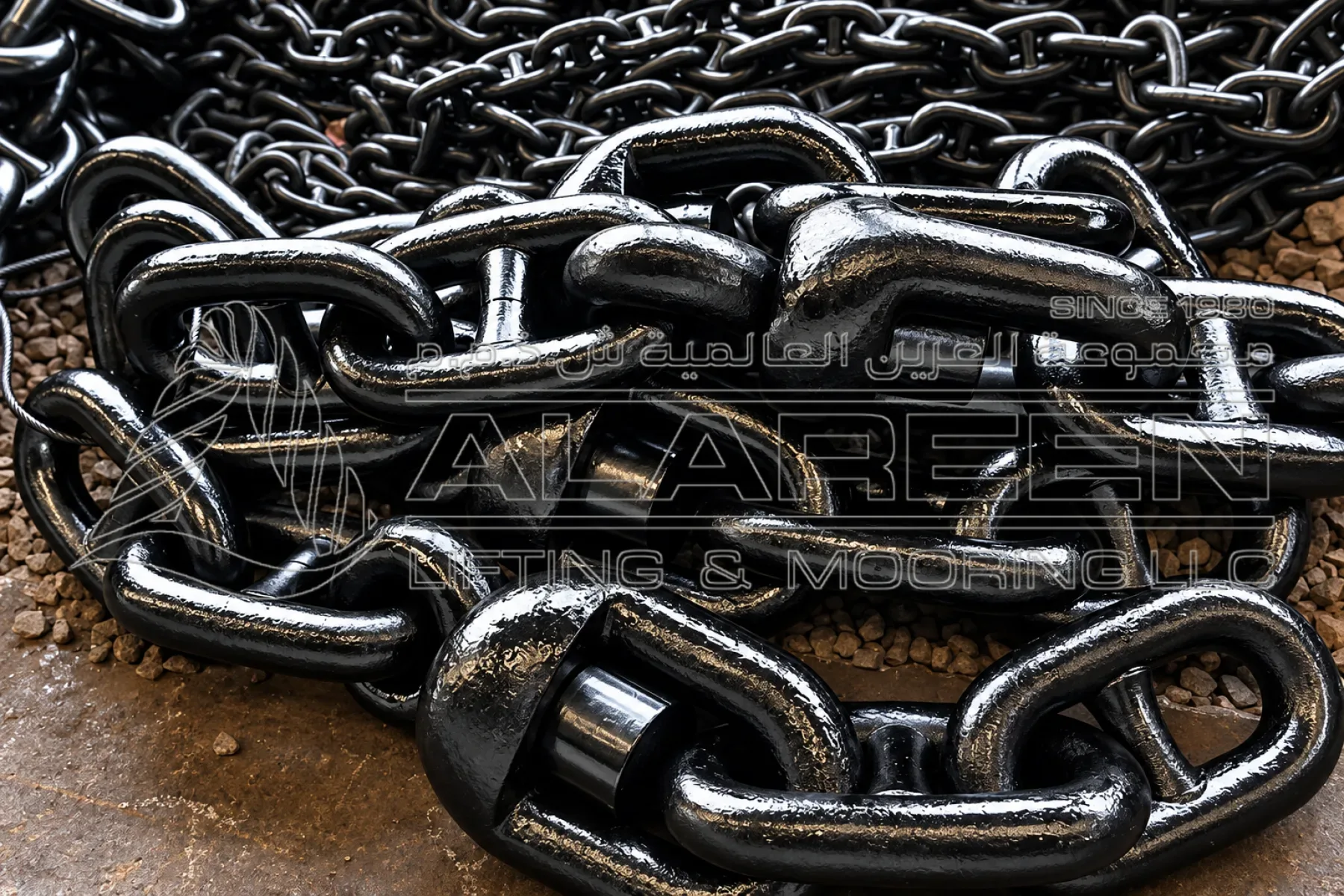
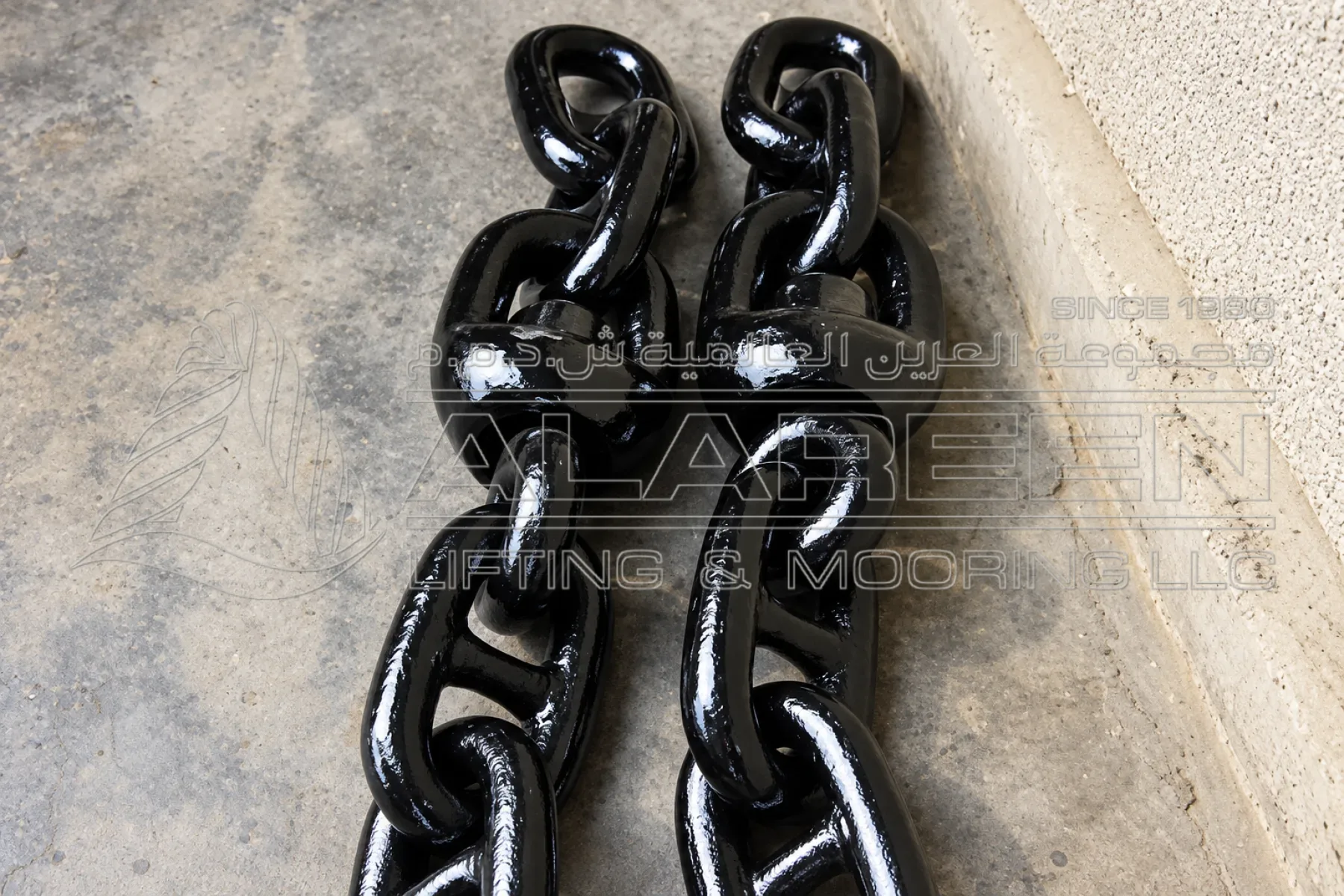
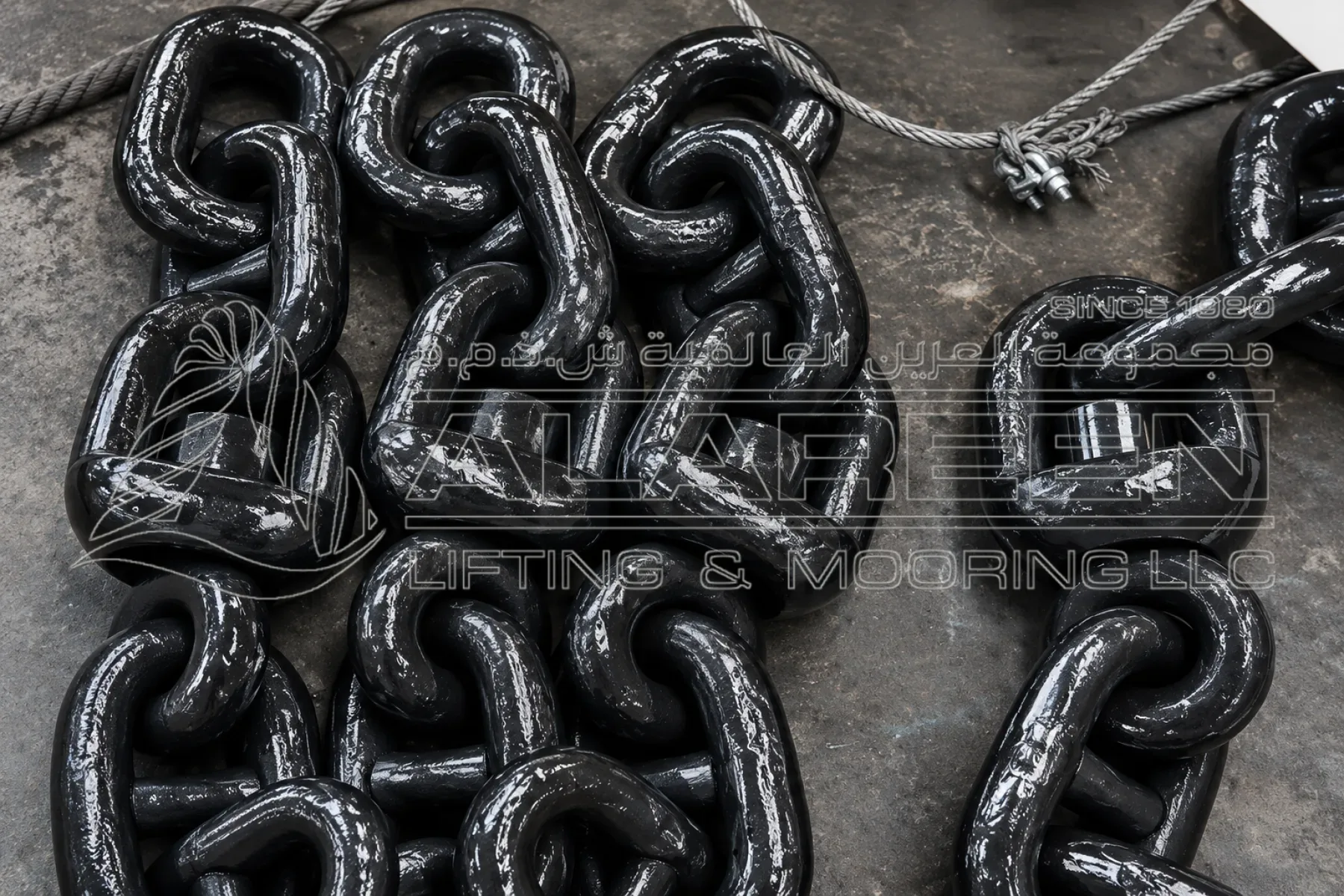
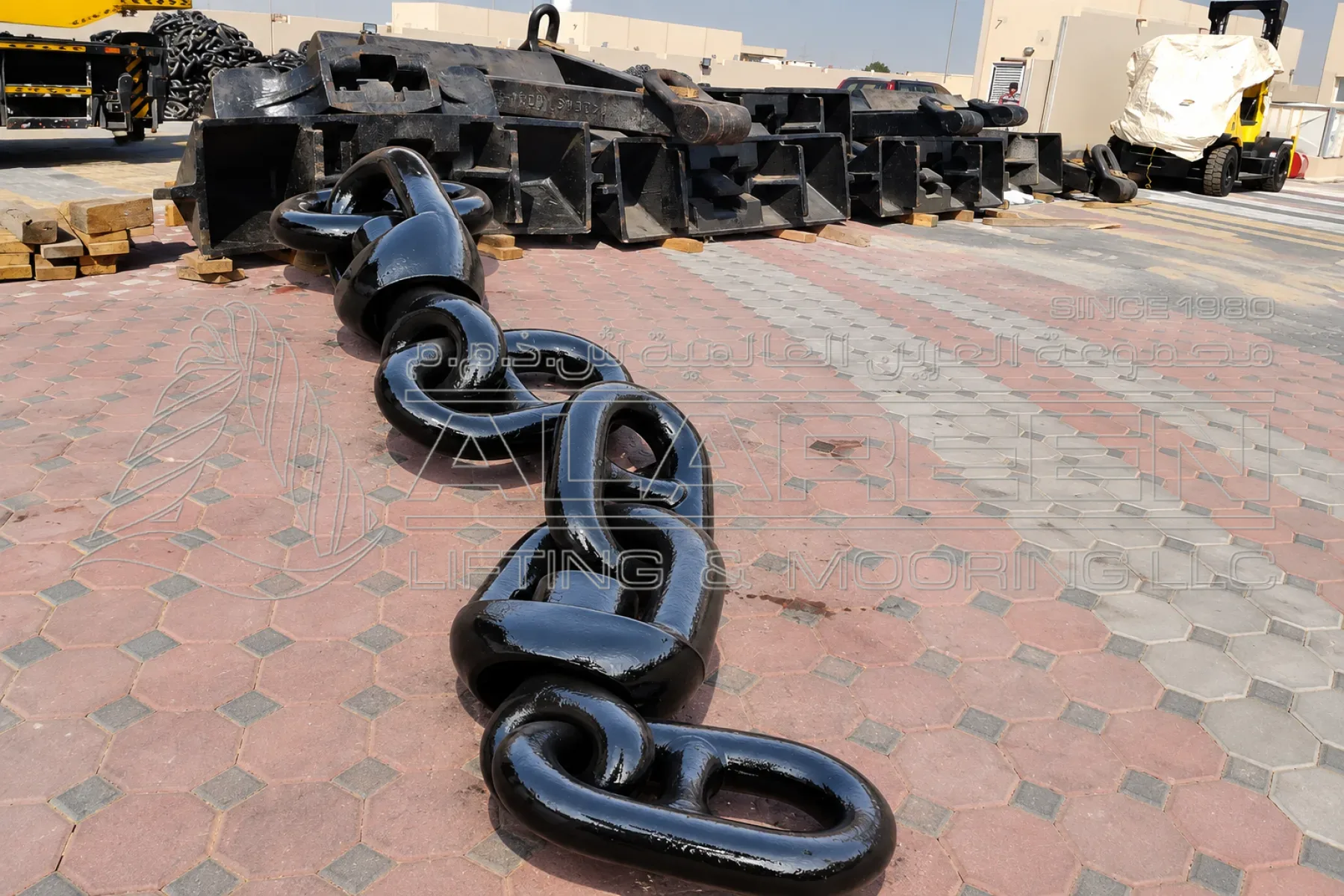
A swivel forerunner is an assembly of chain links and a swivel fitted into a vessel's anchor-chain connection. It transfers the anchoring load while allowing relative rotation between the anchor and chain, helping limit accumulated twist during deployment and recovery. The complete assembly must suit the vessel's chain, connecting shackles and anchoring arrangement.
Al Areen Lifting & Mooring LLC supplies Swivel Forerunner Assemblies as a UAE/GCC trader and stockist. The company brings its Leading Supplier and Certified Supplier positioning to this range, with a Best Quality supply focus and its Largest Stockist and No.1 Supplier positioning across the UAE/GCC. Product grade, material, testing and classification documents are confirmed for the assembly offered.
Components and connection geometry
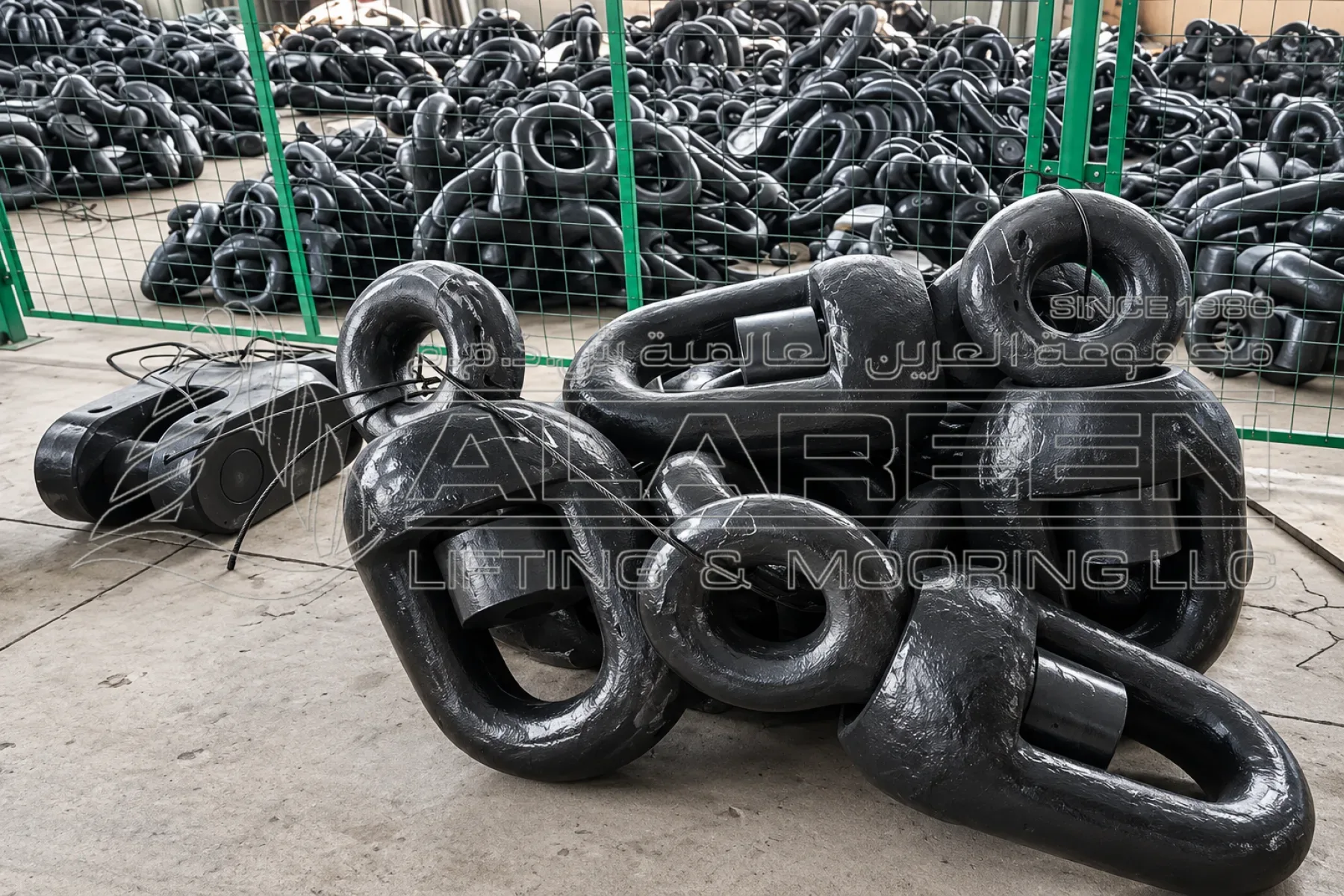
Typical components are an end link, swivel, enlarged transition link or links, and a common chain link. The anchor-side end link normally has no stud, leaving clearance for an anchor D-end shackle. The chain-side common link provides the interface for a compatible Kenter joining shackle. Whether either shackle is included must be agreed in the supply scope.
One documented arrangement is E + SW + EL + C; another is E + EL + SW + EL + C. Here E means end link, SW swivel, EL enlarged link and C common link. Assemblies described as three-link or four-link designs can differ because the swivel is a separate component. Confirm the drawing and component sequence rather than selecting by a catalogue name alone.
Enlarged links accommodate the transition between differently proportioned components. The swivel introduces a rotational joint into the tensile load path; it does not compensate for an incorrectly sized shackle, unsuitable material or inadequate clearance.
Select the arrangement around the vessel
Short and extended forerunners are distinct procurement options. Extra common links can place the swivel in the position required by the yard's anchoring arrangement. Overall length, swivel envelope and articulation must be checked against the chain stopper, hawse arrangement, anchor stowage and nearby deck machinery. Do not assume that the swivel body can pass through or seat in a windlass chainwheel.
Specify the existing chain's nominal diameter and documented grade. U2 and U3 are established ship anchor-chain procurement designations, but the offered accessory must have the corresponding documented suitability. Nominal size alone does not establish strength or interchangeability. Steel designation, manufacturing route, heat treatment and finish belong in the supplier's confirmed specification.
A compact integrated anchor swivel may suit a different space envelope, while a Kenter joining shackle provides a chain connection without replacing the swivel's function. These alternatives require their own interface and approval checks.
Installation, condition and documentation
Installation should follow the vessel's arrangement drawing and the component manufacturer's instructions. Support the assembly during handling, keep personnel clear of suspended components and pinch points, and verify the connecting shackles' specified retention arrangements. Check articulation and swivel movement in a safe, unloaded condition before returning the chain run to service.
Inspect accessible surfaces and contact areas for cracking, deformation, corrosion, wear and abnormal joint clearance. Investigate a seized or stiff swivel and illegible identification. Maintenance, lubrication and replacement criteria depend on the actual design and applicable vessel requirements; an unspecified swivel should not be assumed to have a grease point or a particular bearing.
Match component identification to the relevant material and test documents. ISO 1704 addresses stud-link anchor-chain component geometry; applicable classification requirements also address materials, manufacture and testing. A supplier's commercial certification description does not establish a particular assembly's class acceptance.
UAE & GCC Maritime Supply Coverage
Al Areen supports supply enquiries for vessel operators and marine procurement teams working in and around these maritime hubs. For the Port of Fujairah and Khor Fakkan Port, enquiries can concern anchor-chain accessories for vessels on East Coast port calls or at anchorage. Mussafah Port enquiries can concern compatible anchoring components for workboats and marine maintenance operations.
For Port Rashid (Mina Rashid) and Khalifa Port, buyers can specify the visiting vessel's replacement assembly and documentation requirements. Dubai Maritime City and Drydocks World Dubai provide relevant repair and refit contexts where drawings, measured interfaces and the renewal scope are particularly useful. Hamriyah Port enquiries can cover vessel and marine-contractor anchor-chain sourcing.
For the Port of Duqm, buyers can submit ship-repair or vessel-supply requirements, including the intended drydock or receiving location. Khalifa Bin Salman Port enquiries can cover replacement anchor-chain accessories for vessels calling at Hidd. Wider enquiries are supported across the UAE and GCC, including additional commercial ports and shipyards listed in the coverage data.
Provide the receiving agent or yard, vessel identification, destination and required receipt date so the supply arrangements can be confirmed. Company support includes Fast UAE & GCC Delivery, 24/7 Customer Support and Stock Availability; the particular configuration and delivery schedule are confirmed with the quotation.
Applications and service boundaries
These assemblies are relevant to compatible ship anchoring systems, newbuild chain arrangements and replacement during vessel repair or refit. Offshore support vessels may use them in their own ship anchoring systems. Permanent offshore mooring, buoy mooring or towing connections require an application-specific design review; an ordinary ship anchor-chain forerunner is not automatically an acceptable component for those systems.
Do not select an anchor-chain forerunner as a lifting swivel merely because its documents state a proof or breaking load. General lifting service requires equipment specifically rated and documented for that use.
Technical Specifications
Request DatasheetSpecification and procurement details
Submit an identified assembly drawing with the details below. For a replacement, include the existing certificate or chain specification and photographs showing component markings and both connection interfaces.
| Parameter | Information to specify | Procurement check |
|---|---|---|
| Service and arrangement | Vessel, anchoring arrangement and replacement or newbuild scope. | Confirm the assembly's position and intended load path. |
| Chain designation | Nominal common-link diameter, stud-link or other construction, documented grade. | Match accessory suitability to the chain; do not infer grade from appearance. |
| Assembly configuration | Component sequence, drawing reference, common-link quantity and overall length. | Resolve three-link/four-link naming against the drawing. |
| Anchor interface | Anchor shank connection, D-end shackle dimensions, pin and jaw details, end-link opening. | Check fit, contact and articulation through the intended movement. |
| Chain interface | Common-link geometry and joining-shackle type, size and drawing. | Confirm compatibility with the adjoining chain and connector. |
| Clearance envelope | Swivel body envelope and chain stopper, hawse, stowage and machinery clearances. | Check where the swivel will lie throughout deployment and recovery. |
| Material and manufacture | Required steel designation, manufacturing route and heat-treatment documentation. | Obtain the offered manufacturer's specification and traceability. |
| Finish and preservation | Required coating or finish and storage environment. | Confirm suitability for the design, fit and inspection requirements. |
| Testing and class | Vessel classification society, applicable rule or drawing requirements and required reports. | Verify proof-test evidence and applicable batch breaking-test documentation; do not treat breaking load as WLL. |
| Identification | Required component marks and document references. | Check the supplied item's identity against its certificate and material/test records. |
| Included components | Forerunner only or supply with end shackle, Kenter shackle and chain. | Make the complete bill of materials explicit. |
| Quantity and receiving details | Quantity, destination, vessel/agent or yard contact and requested receipt date. | Confirm configuration availability, packing and delivery arrangements in the quotation. |
Acceptance and operating checks
- Compare delivered components with the approved supply drawing and item identification.
- Verify the document scope, including material, grade, nominal size, heat treatment and applicable test evidence.
- Check for visible damage, unobstructed articulation and satisfactory unloaded swivel movement.
- Use the manufacturer's inspection and maintenance instructions and the vessel's applicable acceptance criteria.
- Do not weld, heat, grind or modify load-bearing parts as an improvised repair. Obtain an authorised technical disposition.
Proof testing and breaking testing serve different purposes. Applicable class requirements can include proof testing of accessories and breaking testing of representative manufacturing batches, with defined exceptions. Obtain the documentation applicable to the actual supplied assembly rather than requesting an unsupported universal test value.
Applications Across Industry
FAQ
What is a swivel forerunner assembly?+
It combines a swivel with chain links to form a compatible connection in an anchor-chain arrangement, allowing relative rotation while transmitting the anchoring load.
How does it connect to the anchor?+
The anchor-side studless end link normally accepts a compatible anchor D-end shackle. Confirm the shackle, anchor connection and available articulation against drawings.
How does it connect to the main chain?+
A common link at the chain end normally connects through a compatible Kenter joining shackle. The connector and adjoining chain geometry must match.
What do E, EL, SW and C mean?+
E denotes end link, EL enlarged link, SW swivel and C common link. The required sequence should be shown on the assembly drawing.
Why do suppliers describe different link counts?+
Catalogues can count the chain links separately from the swivel and offer different arrangements. Use the complete component sequence and drawing reference.
Are E+SW+EL+C and E+EL+SW+EL+C interchangeable?+
Both arrangements are documented, but interchangeable fit is not established by their names. Compare length, component geometry, interfaces and the vessel's required arrangement.
Why are enlarged links included?+
They provide transition geometry between the adjoining components. Their dimensions and position must match the particular assembly rather than an assumed generic layout.
When is a short forerunner useful?+
A short arrangement can suit restricted space near a chain stopper. Check the actual swivel position and clearance before substituting it for a longer assembly.
Why might an assembly include additional common links?+
Extra links can position the swivel relative to the yard's deck machinery and chain stopper. Specify the link quantity and overall arrangement on the drawing.
What chain size should I state?+
State the chain's nominal common-link diameter and its documented specification. Photographs or a worn component measurement alone may not identify the original nominal size.
Can I select an assembly by nominal diameter alone?+
No. Confirm documented grade, connector geometry, material specification, overall arrangement and the applicable acceptance requirements as well as nominal size.
Can a U2 assembly be replaced with U3?+
Do not substitute solely by grade designation. Confirm the proposed accessory's documented suitability, dimensions and acceptance for the chain and vessel arrangement.
What material should the quotation identify?+
Request the actual steel designation, manufacturing route and heat treatment for the offered components. A generic material description does not establish the complete specification.
Is stainless steel a direct replacement for an existing steel forerunner?+
Not automatically. Verify strength, geometry, material compatibility and the vessel's acceptance requirements for the proposed design.
Which surface finishes can be specified?+
Manufacturer catalogues document painted and galvanised variants. State the required finish and obtain confirmation for the offered design, including fit and inspection implications.
Can the swivel pass through the windlass chainwheel?+
Do not assume this. Check the assembly envelope and position against the vessel's chain-handling equipment and arrangement drawing.
Does the swivel always rotate under anchoring load?+
That depends on its design, condition and operating load. Obtain the manufacturer's instructions; satisfactory unloaded movement is not proof of unrestricted loaded rotation.
Is a Kenter joining shackle an alternative to the complete forerunner?+
It performs a joining function and does not provide the forerunner's rotational joint. Any revised connection requires its own arrangement review.
Can an integrated compact anchor swivel replace a forerunner?+
Some compact designs replace a longer connector arrangement. Compare the proposed design's anchor and chain interfaces, clearance and applicable acceptance documents.
Can this assembly be used as a lifting swivel?+
Do not select it for lifting from anchor-chain proof or breaking-load information. Lifting requires a component specifically rated and documented for that service.
Is it suitable for permanent offshore mooring?+
Only after an application-specific review. Offshore mooring loads, component grades, geometry and approval requirements must be checked separately from ship anchoring specifications.
What is the relevance of ISO 1704?+
ISO 1704 specifies the geometry and tolerances of stud-link anchor-chain component parts. Confirm the edition and applicability required by the vessel's specification.
Does ISO 1704 establish that my assembly is class accepted?+
No. Confirm the actual item's material, manufacturing and test documentation and any classification acceptance required for the vessel.
What is the difference between proof and breaking tests?+
Proof testing assesses an accessory at its specified proof load. Breaking testing establishes batch or design strength under the applicable requirements; it is not a WLL rating.
Which documents should accompany a class-required purchase?+
Agree the applicable certificate and reports, with traceability to the offered item's identification, grade, nominal size, material, heat treatment and test evidence.
Does Certified Supplier describe a particular assembly's certificate?+
Certified Supplier describes Al Areen's company positioning. The offered assembly's certification body, document scope and acceptance must be confirmed separately.
What should be checked before installation?+
Confirm the delivered configuration, interface fit, component condition, identification and documentation. Check safe unloaded articulation and swivel movement using the manufacturer's instructions.
How should the connection shackles be secured?+
Use the retention method specified for each supplied shackle. Confirm correct installation against its instructions and the vessel's assembly drawing.
What condition checks are important?+
Examine accessible load-bearing parts and contact areas for cracks, deformation, corrosion, wear, abnormal joint clearance and impaired rotation. Apply design-specific acceptance criteria.
Can a seized swivel be lubricated or repaired on board?+
Follow the actual manufacturer's maintenance instructions and authorised technical disposition. Do not assume a lubrication point or modify a load-bearing part to restore movement.
How should spare assemblies be stored?+
Keep identification and documents together and follow the supplier's preservation instructions. Protect components from damage and inspect their condition before installation.
What should a port or drydock enquiry include?+
Provide the technical specification plus vessel identification, receiving agent or yard, destination and requested receipt date. These details support configuration and delivery confirmation.
Can Al Areen support enquiries for Fujairah and Khor Fakkan?+
Yes. Supply enquiries can cover compatible anchor-chain accessories for vessel operations around the Port of Fujairah and Khor Fakkan Port.
Can repair buyers enquire for Dubai Maritime City or Drydocks World Dubai?+
Yes. Submit the replacement drawing, interfaces and required documents together with the vessel and receiving-yard details.
Can buyers enquire for Duqm and Khalifa Bin Salman Port?+
Yes. Al Areen supports UAE/GCC supply enquiries, including operations around the Port of Duqm and Khalifa Bin Salman Port.
Is the required configuration immediately available?+
Stock Availability is a company assurance. Confirm the particular assembly configuration, documentation and delivery schedule with the quotation.
Product Overview
Swivel connections for ship anchor-chain systems
A swivel forerunner is an assembly of chain links and a swivel fitted into a vessel's anchor-chain connection. It transfers the anchoring load while allowing relative rotation between the anchor and chain, helping limit accumulated twist during deployment and recovery. The complete assembly must suit the vessel's chain, connecting shackles and anchoring arrangement.
Al Areen Lifting & Mooring LLC supplies Swivel Forerunner Assemblies as a UAE/GCC trader and stockist. The company brings its Leading Supplier and Certified Supplier positioning to this range, with a Best Quality supply focus and its Largest Stockist and No.1 Supplier positioning across the UAE/GCC. Product grade, material, testing and classification documents are confirmed for the assembly offered.
Components and connection geometry
Typical components are an end link, swivel, enlarged transition link or links, and a common chain link. The anchor-side end link normally has no stud, leaving clearance for an anchor D-end shackle. The chain-side common link provides the interface for a compatible Kenter joining shackle. Whether either shackle is included must be agreed in the supply scope.
One documented arrangement is E + SW + EL + C; another is E + EL + SW + EL + C. Here E means end link, SW swivel, EL enlarged link and C common link. Assemblies described as three-link or four-link designs can differ because the swivel is a separate component. Confirm the drawing and component sequence rather than selecting by a catalogue name alone.
Enlarged links accommodate the transition between differently proportioned components. The swivel introduces a rotational joint into the tensile load path; it does not compensate for an incorrectly sized shackle, unsuitable material or inadequate clearance.
Select the arrangement around the vessel
Short and extended forerunners are distinct procurement options. Extra common links can place the swivel in the position required by the yard's anchoring arrangement. Overall length, swivel envelope and articulation must be checked against the chain stopper, hawse arrangement, anchor stowage and nearby deck machinery. Do not assume that the swivel body can pass through or seat in a windlass chainwheel.
Specify the existing chain's nominal diameter and documented grade. U2 and U3 are established ship anchor-chain procurement designations, but the offered accessory must have the corresponding documented suitability. Nominal size alone does not establish strength or interchangeability. Steel designation, manufacturing route, heat treatment and finish belong in the supplier's confirmed specification.
A compact integrated anchor swivel may suit a different space envelope, while a Kenter joining shackle provides a chain connection without replacing the swivel's function. These alternatives require their own interface and approval checks.
Installation, condition and documentation
Installation should follow the vessel's arrangement drawing and the component manufacturer's instructions. Support the assembly during handling, keep personnel clear of suspended components and pinch points, and verify the connecting shackles' specified retention arrangements. Check articulation and swivel movement in a safe, unloaded condition before returning the chain run to service.
Inspect accessible surfaces and contact areas for cracking, deformation, corrosion, wear and abnormal joint clearance. Investigate a seized or stiff swivel and illegible identification. Maintenance, lubrication and replacement criteria depend on the actual design and applicable vessel requirements; an unspecified swivel should not be assumed to have a grease point or a particular bearing.
Match component identification to the relevant material and test documents. ISO 1704 addresses stud-link anchor-chain component geometry; applicable classification requirements also address materials, manufacture and testing. A supplier's commercial certification description does not establish a particular assembly's class acceptance.
UAE & GCC Maritime Supply Coverage
Al Areen supports supply enquiries for vessel operators and marine procurement teams working in and around these maritime hubs. For the Port of Fujairah and Khor Fakkan Port, enquiries can concern anchor-chain accessories for vessels on East Coast port calls or at anchorage. Mussafah Port enquiries can concern compatible anchoring components for workboats and marine maintenance operations.
For Port Rashid (Mina Rashid) and Khalifa Port, buyers can specify the visiting vessel's replacement assembly and documentation requirements. Dubai Maritime City and Drydocks World Dubai provide relevant repair and refit contexts where drawings, measured interfaces and the renewal scope are particularly useful. Hamriyah Port enquiries can cover vessel and marine-contractor anchor-chain sourcing.
For the Port of Duqm, buyers can submit ship-repair or vessel-supply requirements, including the intended drydock or receiving location. Khalifa Bin Salman Port enquiries can cover replacement anchor-chain accessories for vessels calling at Hidd. Wider enquiries are supported across the UAE and GCC, including additional commercial ports and shipyards listed in the coverage data.
Provide the receiving agent or yard, vessel identification, destination and required receipt date so the supply arrangements can be confirmed. Company support includes Fast UAE & GCC Delivery, 24/7 Customer Support and Stock Availability; the particular configuration and delivery schedule are confirmed with the quotation.
Applications and service boundaries
These assemblies are relevant to compatible ship anchoring systems, newbuild chain arrangements and replacement during vessel repair or refit. Offshore support vessels may use them in their own ship anchoring systems. Permanent offshore mooring, buoy mooring or towing connections require an application-specific design review; an ordinary ship anchor-chain forerunner is not automatically an acceptable component for those systems.
Do not select an anchor-chain forerunner as a lifting swivel merely because its documents state a proof or breaking load. General lifting service requires equipment specifically rated and documented for that use.
01 / 08
Technical Specifications
Request DatasheetSpecification and procurement details
Submit an identified assembly drawing with the details below. For a replacement, include the existing certificate or chain specification and photographs showing component markings and both connection interfaces.
| Parameter | Information to specify | Procurement check |
|---|---|---|
| Service and arrangement | Vessel, anchoring arrangement and replacement or newbuild scope. | Confirm the assembly's position and intended load path. |
| Chain designation | Nominal common-link diameter, stud-link or other construction, documented grade. | Match accessory suitability to the chain; do not infer grade from appearance. |
| Assembly configuration | Component sequence, drawing reference, common-link quantity and overall length. | Resolve three-link/four-link naming against the drawing. |
| Anchor interface | Anchor shank connection, D-end shackle dimensions, pin and jaw details, end-link opening. | Check fit, contact and articulation through the intended movement. |
| Chain interface | Common-link geometry and joining-shackle type, size and drawing. | Confirm compatibility with the adjoining chain and connector. |
| Clearance envelope | Swivel body envelope and chain stopper, hawse, stowage and machinery clearances. | Check where the swivel will lie throughout deployment and recovery. |
| Material and manufacture | Required steel designation, manufacturing route and heat-treatment documentation. | Obtain the offered manufacturer's specification and traceability. |
| Finish and preservation | Required coating or finish and storage environment. | Confirm suitability for the design, fit and inspection requirements. |
| Testing and class | Vessel classification society, applicable rule or drawing requirements and required reports. | Verify proof-test evidence and applicable batch breaking-test documentation; do not treat breaking load as WLL. |
| Identification | Required component marks and document references. | Check the supplied item's identity against its certificate and material/test records. |
| Included components | Forerunner only or supply with end shackle, Kenter shackle and chain. | Make the complete bill of materials explicit. |
| Quantity and receiving details | Quantity, destination, vessel/agent or yard contact and requested receipt date. | Confirm configuration availability, packing and delivery arrangements in the quotation. |
Acceptance and operating checks
- Compare delivered components with the approved supply drawing and item identification.
- Verify the document scope, including material, grade, nominal size, heat treatment and applicable test evidence.
- Check for visible damage, unobstructed articulation and satisfactory unloaded swivel movement.
- Use the manufacturer's inspection and maintenance instructions and the vessel's applicable acceptance criteria.
- Do not weld, heat, grind or modify load-bearing parts as an improvised repair. Obtain an authorised technical disposition.
Proof testing and breaking testing serve different purposes. Applicable class requirements can include proof testing of accessories and breaking testing of representative manufacturing batches, with defined exceptions. Obtain the documentation applicable to the actual supplied assembly rather than requesting an unsupported universal test value.
Applications Across Industry
FAQ
What is a swivel forerunner assembly?+
It combines a swivel with chain links to form a compatible connection in an anchor-chain arrangement, allowing relative rotation while transmitting the anchoring load.
How does it connect to the anchor?+
The anchor-side studless end link normally accepts a compatible anchor D-end shackle. Confirm the shackle, anchor connection and available articulation against drawings.
How does it connect to the main chain?+
A common link at the chain end normally connects through a compatible Kenter joining shackle. The connector and adjoining chain geometry must match.
What do E, EL, SW and C mean?+
E denotes end link, EL enlarged link, SW swivel and C common link. The required sequence should be shown on the assembly drawing.
Why do suppliers describe different link counts?+
Catalogues can count the chain links separately from the swivel and offer different arrangements. Use the complete component sequence and drawing reference.
Are E+SW+EL+C and E+EL+SW+EL+C interchangeable?+
Both arrangements are documented, but interchangeable fit is not established by their names. Compare length, component geometry, interfaces and the vessel's required arrangement.
Why are enlarged links included?+
They provide transition geometry between the adjoining components. Their dimensions and position must match the particular assembly rather than an assumed generic layout.
When is a short forerunner useful?+
A short arrangement can suit restricted space near a chain stopper. Check the actual swivel position and clearance before substituting it for a longer assembly.
Why might an assembly include additional common links?+
Extra links can position the swivel relative to the yard's deck machinery and chain stopper. Specify the link quantity and overall arrangement on the drawing.
What chain size should I state?+
State the chain's nominal common-link diameter and its documented specification. Photographs or a worn component measurement alone may not identify the original nominal size.
Can I select an assembly by nominal diameter alone?+
No. Confirm documented grade, connector geometry, material specification, overall arrangement and the applicable acceptance requirements as well as nominal size.
Can a U2 assembly be replaced with U3?+
Do not substitute solely by grade designation. Confirm the proposed accessory's documented suitability, dimensions and acceptance for the chain and vessel arrangement.
What material should the quotation identify?+
Request the actual steel designation, manufacturing route and heat treatment for the offered components. A generic material description does not establish the complete specification.
Is stainless steel a direct replacement for an existing steel forerunner?+
Not automatically. Verify strength, geometry, material compatibility and the vessel's acceptance requirements for the proposed design.
Which surface finishes can be specified?+
Manufacturer catalogues document painted and galvanised variants. State the required finish and obtain confirmation for the offered design, including fit and inspection implications.
Can the swivel pass through the windlass chainwheel?+
Do not assume this. Check the assembly envelope and position against the vessel's chain-handling equipment and arrangement drawing.
Does the swivel always rotate under anchoring load?+
That depends on its design, condition and operating load. Obtain the manufacturer's instructions; satisfactory unloaded movement is not proof of unrestricted loaded rotation.
Is a Kenter joining shackle an alternative to the complete forerunner?+
It performs a joining function and does not provide the forerunner's rotational joint. Any revised connection requires its own arrangement review.
Can an integrated compact anchor swivel replace a forerunner?+
Some compact designs replace a longer connector arrangement. Compare the proposed design's anchor and chain interfaces, clearance and applicable acceptance documents.
Can this assembly be used as a lifting swivel?+
Do not select it for lifting from anchor-chain proof or breaking-load information. Lifting requires a component specifically rated and documented for that service.
Is it suitable for permanent offshore mooring?+
Only after an application-specific review. Offshore mooring loads, component grades, geometry and approval requirements must be checked separately from ship anchoring specifications.
What is the relevance of ISO 1704?+
ISO 1704 specifies the geometry and tolerances of stud-link anchor-chain component parts. Confirm the edition and applicability required by the vessel's specification.
Does ISO 1704 establish that my assembly is class accepted?+
No. Confirm the actual item's material, manufacturing and test documentation and any classification acceptance required for the vessel.
What is the difference between proof and breaking tests?+
Proof testing assesses an accessory at its specified proof load. Breaking testing establishes batch or design strength under the applicable requirements; it is not a WLL rating.
Which documents should accompany a class-required purchase?+
Agree the applicable certificate and reports, with traceability to the offered item's identification, grade, nominal size, material, heat treatment and test evidence.
Does Certified Supplier describe a particular assembly's certificate?+
Certified Supplier describes Al Areen's company positioning. The offered assembly's certification body, document scope and acceptance must be confirmed separately.
What should be checked before installation?+
Confirm the delivered configuration, interface fit, component condition, identification and documentation. Check safe unloaded articulation and swivel movement using the manufacturer's instructions.
How should the connection shackles be secured?+
Use the retention method specified for each supplied shackle. Confirm correct installation against its instructions and the vessel's assembly drawing.
What condition checks are important?+
Examine accessible load-bearing parts and contact areas for cracks, deformation, corrosion, wear, abnormal joint clearance and impaired rotation. Apply design-specific acceptance criteria.
Can a seized swivel be lubricated or repaired on board?+
Follow the actual manufacturer's maintenance instructions and authorised technical disposition. Do not assume a lubrication point or modify a load-bearing part to restore movement.
How should spare assemblies be stored?+
Keep identification and documents together and follow the supplier's preservation instructions. Protect components from damage and inspect their condition before installation.
What should a port or drydock enquiry include?+
Provide the technical specification plus vessel identification, receiving agent or yard, destination and requested receipt date. These details support configuration and delivery confirmation.
Can Al Areen support enquiries for Fujairah and Khor Fakkan?+
Yes. Supply enquiries can cover compatible anchor-chain accessories for vessel operations around the Port of Fujairah and Khor Fakkan Port.
Can repair buyers enquire for Dubai Maritime City or Drydocks World Dubai?+
Yes. Submit the replacement drawing, interfaces and required documents together with the vessel and receiving-yard details.
Can buyers enquire for Duqm and Khalifa Bin Salman Port?+
Yes. Al Areen supports UAE/GCC supply enquiries, including operations around the Port of Duqm and Khalifa Bin Salman Port.
Is the required configuration immediately available?+
Stock Availability is a company assurance. Confirm the particular assembly configuration, documentation and delivery schedule with the quotation.
Technical Specifications+
Specification and procurement details
Submit an identified assembly drawing with the details below. For a replacement, include the existing certificate or chain specification and photographs showing component markings and both connection interfaces.
| Parameter | Information to specify | Procurement check |
|---|---|---|
| Service and arrangement | Vessel, anchoring arrangement and replacement or newbuild scope. | Confirm the assembly's position and intended load path. |
| Chain designation | Nominal common-link diameter, stud-link or other construction, documented grade. | Match accessory suitability to the chain; do not infer grade from appearance. |
| Assembly configuration | Component sequence, drawing reference, common-link quantity and overall length. | Resolve three-link/four-link naming against the drawing. |
| Anchor interface | Anchor shank connection, D-end shackle dimensions, pin and jaw details, end-link opening. | Check fit, contact and articulation through the intended movement. |
| Chain interface | Common-link geometry and joining-shackle type, size and drawing. | Confirm compatibility with the adjoining chain and connector. |
| Clearance envelope | Swivel body envelope and chain stopper, hawse, stowage and machinery clearances. | Check where the swivel will lie throughout deployment and recovery. |
| Material and manufacture | Required steel designation, manufacturing route and heat-treatment documentation. | Obtain the offered manufacturer's specification and traceability. |
| Finish and preservation | Required coating or finish and storage environment. | Confirm suitability for the design, fit and inspection requirements. |
| Testing and class | Vessel classification society, applicable rule or drawing requirements and required reports. | Verify proof-test evidence and applicable batch breaking-test documentation; do not treat breaking load as WLL. |
| Identification | Required component marks and document references. | Check the supplied item's identity against its certificate and material/test records. |
| Included components | Forerunner only or supply with end shackle, Kenter shackle and chain. | Make the complete bill of materials explicit. |
| Quantity and receiving details | Quantity, destination, vessel/agent or yard contact and requested receipt date. | Confirm configuration availability, packing and delivery arrangements in the quotation. |
Acceptance and operating checks
- Compare delivered components with the approved supply drawing and item identification.
- Verify the document scope, including material, grade, nominal size, heat treatment and applicable test evidence.
- Check for visible damage, unobstructed articulation and satisfactory unloaded swivel movement.
- Use the manufacturer's inspection and maintenance instructions and the vessel's applicable acceptance criteria.
- Do not weld, heat, grind or modify load-bearing parts as an improvised repair. Obtain an authorised technical disposition.
Proof testing and breaking testing serve different purposes. Applicable class requirements can include proof testing of accessories and breaking testing of representative manufacturing batches, with defined exceptions. Obtain the documentation applicable to the actual supplied assembly rather than requesting an unsupported universal test value.
Applications Across Industry+
FAQ+
What is a swivel forerunner assembly?+
It combines a swivel with chain links to form a compatible connection in an anchor-chain arrangement, allowing relative rotation while transmitting the anchoring load.
How does it connect to the anchor?+
The anchor-side studless end link normally accepts a compatible anchor D-end shackle. Confirm the shackle, anchor connection and available articulation against drawings.
How does it connect to the main chain?+
A common link at the chain end normally connects through a compatible Kenter joining shackle. The connector and adjoining chain geometry must match.
What do E, EL, SW and C mean?+
E denotes end link, EL enlarged link, SW swivel and C common link. The required sequence should be shown on the assembly drawing.
Why do suppliers describe different link counts?+
Catalogues can count the chain links separately from the swivel and offer different arrangements. Use the complete component sequence and drawing reference.
Are E+SW+EL+C and E+EL+SW+EL+C interchangeable?+
Both arrangements are documented, but interchangeable fit is not established by their names. Compare length, component geometry, interfaces and the vessel's required arrangement.
Why are enlarged links included?+
They provide transition geometry between the adjoining components. Their dimensions and position must match the particular assembly rather than an assumed generic layout.
When is a short forerunner useful?+
A short arrangement can suit restricted space near a chain stopper. Check the actual swivel position and clearance before substituting it for a longer assembly.
Why might an assembly include additional common links?+
Extra links can position the swivel relative to the yard's deck machinery and chain stopper. Specify the link quantity and overall arrangement on the drawing.
What chain size should I state?+
State the chain's nominal common-link diameter and its documented specification. Photographs or a worn component measurement alone may not identify the original nominal size.
Can I select an assembly by nominal diameter alone?+
No. Confirm documented grade, connector geometry, material specification, overall arrangement and the applicable acceptance requirements as well as nominal size.
Can a U2 assembly be replaced with U3?+
Do not substitute solely by grade designation. Confirm the proposed accessory's documented suitability, dimensions and acceptance for the chain and vessel arrangement.
What material should the quotation identify?+
Request the actual steel designation, manufacturing route and heat treatment for the offered components. A generic material description does not establish the complete specification.
Is stainless steel a direct replacement for an existing steel forerunner?+
Not automatically. Verify strength, geometry, material compatibility and the vessel's acceptance requirements for the proposed design.
Which surface finishes can be specified?+
Manufacturer catalogues document painted and galvanised variants. State the required finish and obtain confirmation for the offered design, including fit and inspection implications.
Can the swivel pass through the windlass chainwheel?+
Do not assume this. Check the assembly envelope and position against the vessel's chain-handling equipment and arrangement drawing.
Does the swivel always rotate under anchoring load?+
That depends on its design, condition and operating load. Obtain the manufacturer's instructions; satisfactory unloaded movement is not proof of unrestricted loaded rotation.
Is a Kenter joining shackle an alternative to the complete forerunner?+
It performs a joining function and does not provide the forerunner's rotational joint. Any revised connection requires its own arrangement review.
Can an integrated compact anchor swivel replace a forerunner?+
Some compact designs replace a longer connector arrangement. Compare the proposed design's anchor and chain interfaces, clearance and applicable acceptance documents.
Can this assembly be used as a lifting swivel?+
Do not select it for lifting from anchor-chain proof or breaking-load information. Lifting requires a component specifically rated and documented for that service.
Is it suitable for permanent offshore mooring?+
Only after an application-specific review. Offshore mooring loads, component grades, geometry and approval requirements must be checked separately from ship anchoring specifications.
What is the relevance of ISO 1704?+
ISO 1704 specifies the geometry and tolerances of stud-link anchor-chain component parts. Confirm the edition and applicability required by the vessel's specification.
Does ISO 1704 establish that my assembly is class accepted?+
No. Confirm the actual item's material, manufacturing and test documentation and any classification acceptance required for the vessel.
What is the difference between proof and breaking tests?+
Proof testing assesses an accessory at its specified proof load. Breaking testing establishes batch or design strength under the applicable requirements; it is not a WLL rating.
Which documents should accompany a class-required purchase?+
Agree the applicable certificate and reports, with traceability to the offered item's identification, grade, nominal size, material, heat treatment and test evidence.
Does Certified Supplier describe a particular assembly's certificate?+
Certified Supplier describes Al Areen's company positioning. The offered assembly's certification body, document scope and acceptance must be confirmed separately.
What should be checked before installation?+
Confirm the delivered configuration, interface fit, component condition, identification and documentation. Check safe unloaded articulation and swivel movement using the manufacturer's instructions.
How should the connection shackles be secured?+
Use the retention method specified for each supplied shackle. Confirm correct installation against its instructions and the vessel's assembly drawing.
What condition checks are important?+
Examine accessible load-bearing parts and contact areas for cracks, deformation, corrosion, wear, abnormal joint clearance and impaired rotation. Apply design-specific acceptance criteria.
Can a seized swivel be lubricated or repaired on board?+
Follow the actual manufacturer's maintenance instructions and authorised technical disposition. Do not assume a lubrication point or modify a load-bearing part to restore movement.
How should spare assemblies be stored?+
Keep identification and documents together and follow the supplier's preservation instructions. Protect components from damage and inspect their condition before installation.
What should a port or drydock enquiry include?+
Provide the technical specification plus vessel identification, receiving agent or yard, destination and requested receipt date. These details support configuration and delivery confirmation.
Can Al Areen support enquiries for Fujairah and Khor Fakkan?+
Yes. Supply enquiries can cover compatible anchor-chain accessories for vessel operations around the Port of Fujairah and Khor Fakkan Port.
Can repair buyers enquire for Dubai Maritime City or Drydocks World Dubai?+
Yes. Submit the replacement drawing, interfaces and required documents together with the vessel and receiving-yard details.
Can buyers enquire for Duqm and Khalifa Bin Salman Port?+
Yes. Al Areen supports UAE/GCC supply enquiries, including operations around the Port of Duqm and Khalifa Bin Salman Port.
Is the required configuration immediately available?+
Stock Availability is a company assurance. Confirm the particular assembly configuration, documentation and delivery schedule with the quotation.
Need help selecting the right product?
Our team will help you choose the best solution for your application.