

Home / Products / Anchors & Anchor Chain Systems
ANCHORS & ANCHOR CHAIN SYSTEMS
Swivel Shackles
Marine product supply for vessel, offshore, shipyard and industrial requirements across the UAE & GCC.
Specification SupportType & compatibility
Marine & OffshoreWide applications
UAE & GCCSupply coverage
GLOBAL MARINE SOLUTIONS PARTNER





 01 / 08
Product Overview
Swivel Shackles for Marine Anchor-Chain Connections
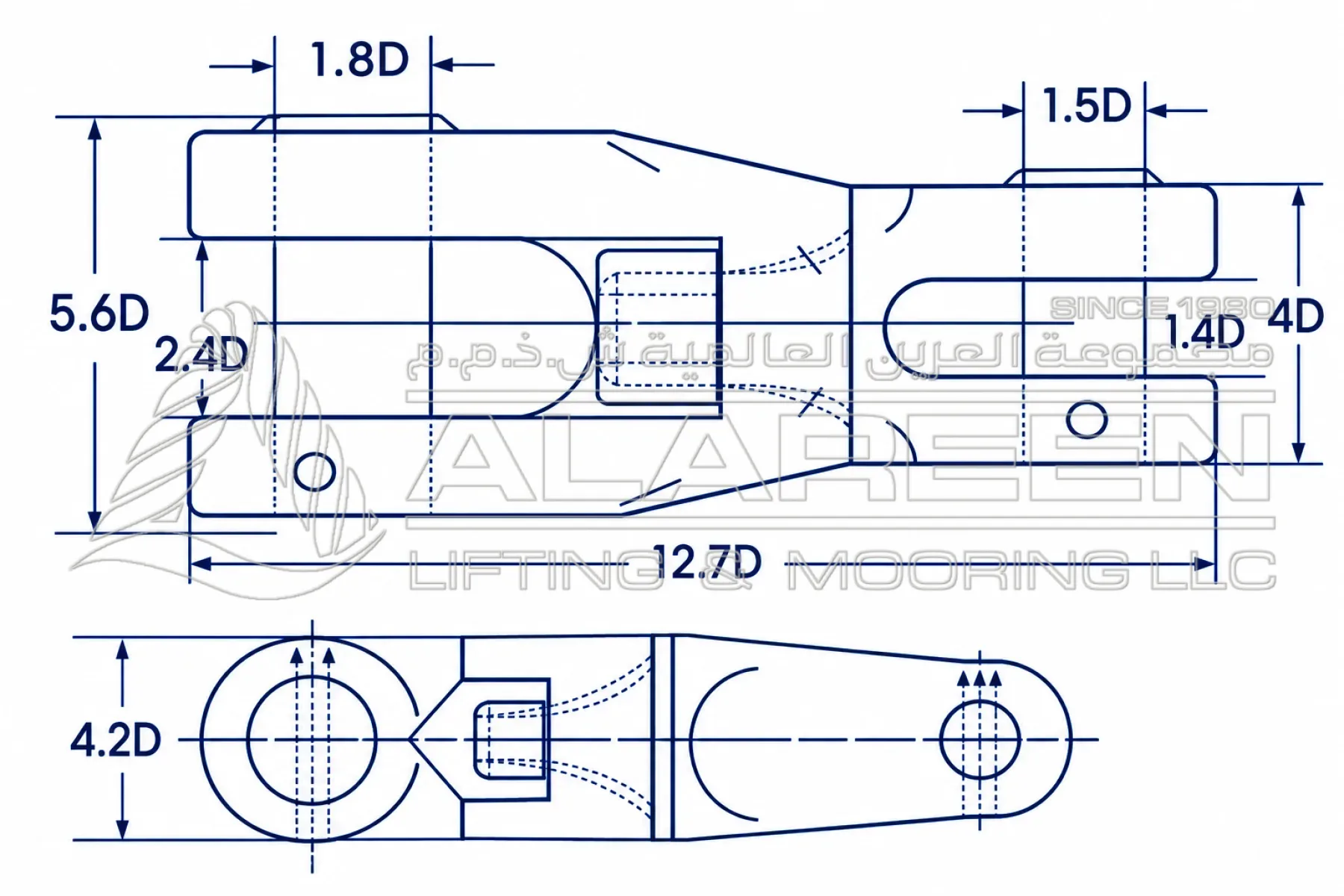
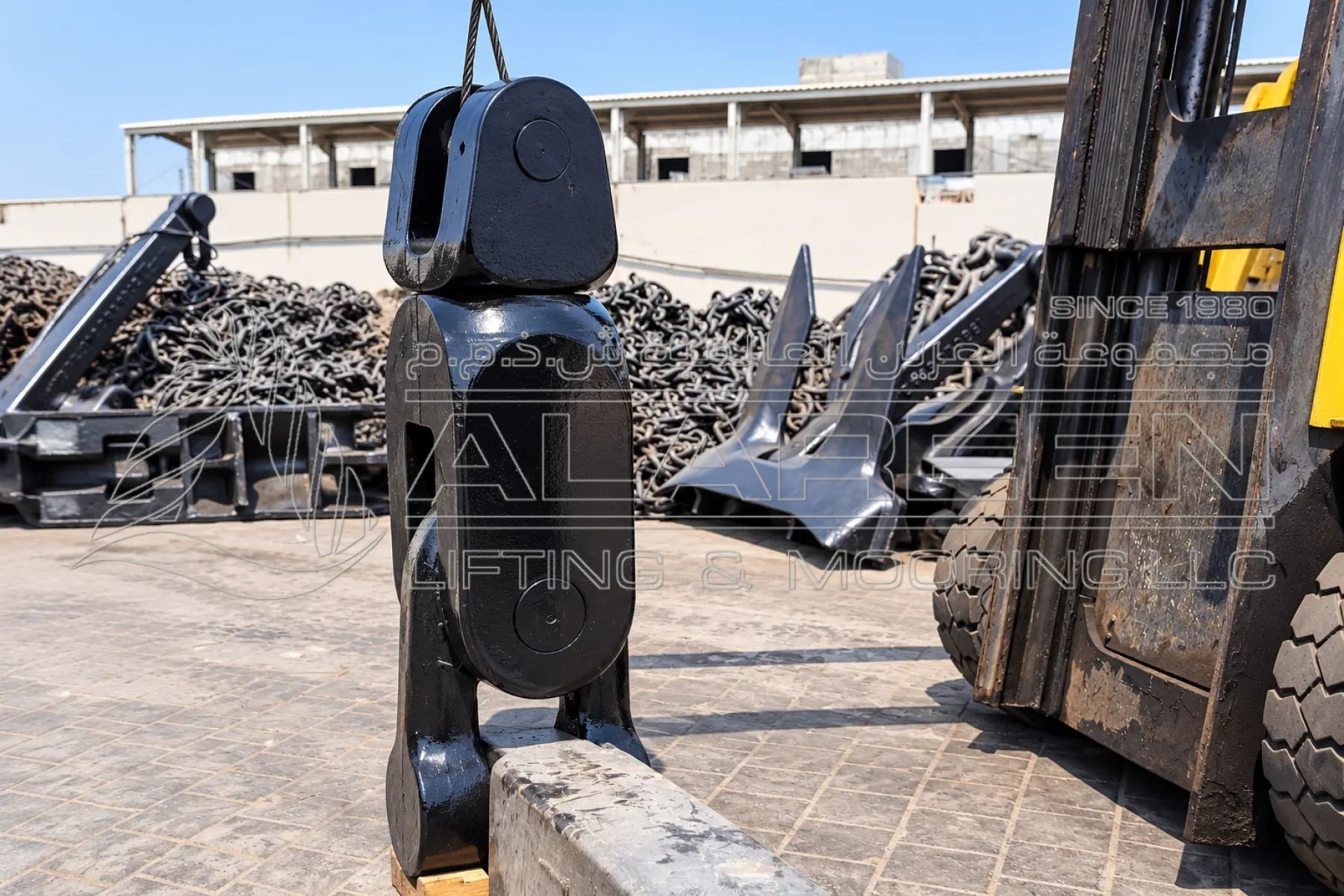
A marine anchor swivel shackle combines a load-carrying connection with a rotating joint between an anchor and its chain cable. It allows relative rotation within the designed connection, helping accommodate chain twist. The fitting belongs to the anchoring assembly: its interfaces, strength basis and securing arrangement must suit the vessel's approved equipment.
Al Areen Lifting & Mooring LLC is a UAE/GCC trader, supplier and stockist of Swivel Shackles. Its commercial positioning combines Leading Supplier and Certified Supplier with Best Quality sourcing, Largest Stockist and No.1 Supplier. Specific materials, tests and classification documents are checked against the item offered.
Understand the anchor-side and chain-side geometry
The assembly normally includes two connection ends, a central swivel joint, load-bearing pins or connecting elements, and the securing components specified by its maker. In a jaw-and-jaw arrangement, each jaw has its own opening and pin interface. The anchor end must accommodate the shank or approved anchor attachment; the chain end must accept the intended link or connecting fitting.
These interfaces are not necessarily identical. Pin diameter, clear jaw width, bearing length and the opening in the connected component determine whether the assembly fits and articulates correctly. Rotation of the swivel and articulation at the anchor pin are separate movements; one does not compensate for a jammed or incorrectly sized connection.
Choose the configuration from the complete assembly drawing
- Direct anchor-chain swivel shackles: compact connections may attach the anchor shank to a common chain link when their particular design permits it.
- Jaw-and-jaw patterns: some designs connect directly to an anchor and a chain end link. End-link geometry therefore matters when replacing a fitting.
- Type A and Type B patterns: these names appear in marine catalogues, but do not by themselves establish interchangeable pins, chain ends or installation arrangements.
- Swivel forerunner assemblies: an alternative incorporating a swivel and chain links, with the corresponding end and joining shackles. Compare the whole assembly, including its length and attachment points.
A Kenter joining shackle joins compatible chain sections and does not provide swivel rotation. A fixed anchor D-end shackle provides a connection without the rotating joint. Sailing snap shackles, lifting swivels and small stainless-steel yacht connectors require their own selection criteria; they are not automatic substitutes for a ship's anchor-chain swivel shackle.
Material, grade and finish must follow the specified fitting
Marine catalogues include forged and cast steel swivel-shackle designs. Ship anchor-chain systems commonly use Grade 2 and Grade 3 terminology, also encountered as U2 and U3 in supplier literature. Confirm the manufacturer's actual material designation, heat treatment and compatibility with the chain rather than treating catalogue labels as a material certificate.
Painted, galvanized and stainless-steel versions exist in manufacturer ranges. A requested finish must be permitted for the selected design and operating environment. Stainless steel alone does not establish strength, bearing performance or compatibility with adjacent chain. Offshore mooring grades and purpose-designed bearing swivels require a separate engineering assessment.
Check the load path and the vessel arrangement
The connected anchor, pins, jaws, swivel joint and chain transmit the anchoring load as a system. Review the required load basis alongside chain grade, mating-component geometry and the vessel's class requirements. Do not convert a breaking-load or proof-test figure into a working load limit using an assumed factor.
Check articulation through the intended movement, the envelope around the anchor shank, and clearance at the roller, hawse pipe, chain stopper and windlass arrangement. A connector that fits while stationary can still bind during retrieval or stowage. Do not assume every anchor fitting may pass over the chain wheel.
Side loading and restricted articulation can introduce bending at the pins or jaws. A swivel is not a guarantee of free rotation under tension; verify that operating condition for the selected design. Anchoring hardware should not be selected for lifting, towing or permanent offshore mooring merely because its dimensions appear suitable.
Installation, inspection and replacement
Use the manufacturer's assembly instructions and the vessel's accepted securing arrangement. Fit the correct original-specification pins and retaining parts, check engagement and security, and confirm the assembled joint moves as intended. Support heavy components during handling and keep personnel clear of suspended or tensioned equipment.
Inspect the swivel body, jaws, pins, retention devices and accessible bearing or engagement surfaces for corrosion, wear, deformation, cracking, looseness and seizure. Compare measured condition with the manufacturer's rejection criteria and the applicable survey requirements. Missing identification or an uncertain replacement pin should be resolved before the assembly returns to service.
Cleaning, lubrication, dismantling and preservation depend on the design. Protect stored fittings and their identification from corrosion and impact, keep matched parts together, and retain the documents. Welding, heating, grinding or changing the securing method requires an expressly accepted procedure; it is not a routine field repair.
Documents that support purchasing and acceptance
Request the dimensional drawing, material and grade details, traceable identification, and the relevant test and inspection documents. Where classification certification is required, specify the society and the required document scope with the enquiry. A supplier's general company certification does not establish approval of an individual fitting.
ISO 1704 addresses the geometry and tolerances of stud-link anchor-chain components. It is a specification reference to assess where applicable, not evidence that an offered item is compliant. The vessel's applicable class rules and the actual manufacturer's documents govern acceptance.
UAE & GCC Maritime Supply / Service Coverage
Al Areen supports Swivel Shackle supply enquiries from shipowners, ship managers, chandlers, repair yards and marine contractors serving the following hubs. State the vessel or project, delivery contact and required handover point so the quotation can address the operational requirement.
| Maritime hub | Relevant enquiry context |
|---|---|
| Port of Fujairah | Anchor-connection spares for vessels calling at the port or using the East Coast / Gulf of Oman anchorage; coordinate the enquiry with the vessel's agent. |
| Khor Fakkan Port | Ship-manager or chandler requests for compatible anchor-chain fittings for calling vessels on Sharjah's Gulf of Oman coast. |
| Mussafah Port | Anchor-connection procurement for vessels and marine contractors working around Abu Dhabi's Mussafah Industrial Area. |
| Port Rashid (Mina Rashid) | Vessel spare-part or refit enquiries; distinguish commercial-vessel fittings from yacht-scale connectors. |
| Dubai Maritime City | Repair-yard replacement requests supported by existing assembly dimensions and the vessel's acceptance requirements. |
| Hamriyah Port | Marine contractor and offshore-support-vessel enquiries around Sharjah and Hamriyah Free Zone, with duty and chain grade clearly specified. |
| Khalifa Port | Anchor-chain spare procurement for calling vessels and their purchasing teams around Taweelah, Abu Dhabi. |
| Drydocks World Dubai | Planned docking or repair procurement requiring a matched replacement, traceability and the requested survey documentation. |
| Port of Duqm | Oman vessel-repair and drydock enquiries in Al Wusta; identify the yard contact and the fitting's full assembly drawing. |
| Khalifa Bin Salman Port | Hidd, Bahrain vessel-supply enquiries, including fitting identification and documentary requirements for the ship's purchasing team. |
Additional enquiry coverage includes Jebel Ali Port, Port Khalid and Saqr Port; Saudi Arabian shipping and repair markets around Dammam, Jeddah, Jubail, Yanbu and Ras Al Khair; Sohar and Salalah in Oman; Hamad Port, Ras Laffan and Mesaieed in Qatar; ASRY in Bahrain; and Shuwaikh and Shuaiba in Kuwait. The fitting's approved duty determines suitability for each request.
Send a technically complete Swivel Shackle enquiry
Use the procurement checklist below to identify the required item. For a replacement, send clear photographs of the complete connection, readable markings and existing documents alongside the measured interfaces. The requested handover schedule and quantity help Al Areen confirm sourcing and item availability.
Company support: Fast UAE & GCC Delivery, 24/7 Customer Support and Stock Availability. The quotation confirms the specified configuration and delivery arrangements.
For related anchoring equipment, see Stud Link Anchor Chains & Accessories and Anchors.
Technical Specifications
Request DatasheetSwivel Shackle Specification and Procurement Checklist
Specify the connection as an assembly. A nominal chain diameter is a starting point, not a complete purchase specification.
| Specification input | Information to provide | Reason for checking |
|---|---|---|
| Duty and equipment | Vessel or project identification; ship anchoring, replacement or another engineered duty; anchor make/type and existing assembly reference. | Establishes the required design and acceptance basis. |
| Chain | Nominal diameter, grade, stud-link or studless construction, maker if known, and measured terminal-link geometry. | Distinguishes chain size from the usable connection opening. |
| Configuration | Manufacturer pattern, Type A/Type B designation where used, jaw-and-jaw or other end arrangement, drawing and revision. | Prevents substitution based only on a catalogue type name. |
| Anchor interface | Shank or attachment thickness, hole diameter, jaw clearance, pin diameter, bearing length and articulation envelope. | Checks fit, engagement and freedom of movement. |
| Chain interface | Common link, enlarged link, end link or intermediate shackle; internal opening, section size and pin compatibility. | Establishes the actual chain-side connection. |
| Assembly envelope | Overall and effective connecting length; clearance drawing for the roller, hawse pipe, stopper and retrieval/stowage arrangement. | Checks the operating path rather than only static fit. |
| Material and finish | Required steel/material designation, forging or casting route where specified, heat treatment, coating and preservation requirements. | Controls material and environmental suitability. |
| Strength basis | Required approved rating or design load; chain-related proof and breaking requirements; units and governing specification. | Avoids mixing WLL/SWL, proof load and breaking load. |
| Joint and retention | Pin and locking arrangement; maker's securing instructions; whether rotation under load is required and expressly supported. | Checks load-bearing engagement and the permitted operation. |
| Inspection and documents | Identification/heat or batch traceability; drawing; material, test and inspection records; class society and survey/document scope where required. | Supports receipt inspection and vessel acceptance. |
| Commercial handover | Quantity, spare matched parts if required, destination, vessel agent or yard contact, requested date and packing instructions. | Allows a configuration-specific quotation and handover plan. |
Receipt checks
Match the delivered fitting and its markings to the purchase order, approved drawing and supplied records. Verify both interfaces, completeness of the retaining parts, visible condition and permitted movement. Resolve discrepancies before installation; arrange further inspection or testing when the purchasing specification or class survey requires it.
Applications Across Industry
FAQ
What is an anchor-chain swivel shackle?+
It is an anchor-chain connection incorporating a rotating joint. Its load-bearing ends connect the anchor attachment and the specified chain-side interface; the complete fitting must suit the approved anchoring assembly.
What components should I identify on the fitting?+
Identify the connection ends, swivel joint, load-bearing pins or connecting elements, and all retaining parts. The manufacturer drawing determines the exact components and their assembly.
Are Type A and Type B descriptions enough to order a replacement?+
No. Send the maker, drawing or clear assembly photographs and measured interfaces. Catalogue type names alone do not establish pin dimensions or the intended chain-side connection.
What does jaw-and-jaw mean?+
It describes a connection with a jaw at each end. Check the opening and pin geometry at both ends separately, since the anchor-side and chain-side interfaces may differ.
Can a swivel shackle attach directly to the anchor shank?+
Some designs permit direct attachment. The shank hole, thickness, jaw opening, pin fit and allowed articulation must match that specific design.
Does the chain end need a common link or an end link?+
That depends on the fitting. Some compact designs accept a common link; certain jaw-and-jaw arrangements require an end link. Identify the actual termination on the assembly drawing.
Is a swivel forerunner the same product?+
A forerunner is an assembly incorporating a swivel with associated chain links and connecting fittings. Compare its complete attachment arrangement and effective length with the proposed swivel shackle.
Can a Kenter shackle replace a swivel shackle?+
A Kenter joining shackle connects compatible chain sections and does not add swivel rotation. Substitution requires a reviewed assembly design rather than a size comparison alone.
How does a fixed anchor D-end shackle differ?+
It provides a fixed connection without a swivel joint. Whether it is suitable depends on the vessel connection scheme, mating components and intended operation.
Are stainless-steel sailing snap shackles equivalent?+
No equivalence should be assumed. Snap shackles and yacht fittings have their own interfaces and ratings; select the documented fitting appropriate to the anchoring equipment.
Which chain details are needed for selection?+
Provide diameter, grade, stud-link or studless construction and the terminal link dimensions. Include the chain documents and manufacturer reference when available.
What do U2 and U3 mean in supplier catalogues?+
They are commonly used anchor-chain grade designations corresponding to Grade 2 and Grade 3 terminology. Confirm the offered fitting and chain grade through the manufacturer documents.
Is nominal chain diameter the same as the shackle pin diameter?+
Do not treat them as equal. The fitting has separately defined dimensions; both connection pins and their mating openings must be checked against the drawing.
Which anchor-side measurements matter most?+
Provide the attachment thickness, hole diameter, jaw opening, pin diameter and bearing length. Include surrounding geometry so articulation and interference can be assessed.
Why must the overall connection length be checked?+
A replacement can alter the anchor position and retrieval or stowage clearances. Check effective connecting length and the full envelope against the vessel arrangement.
Can every swivel shackle pass over the windlass chain wheel?+
No. Verify the permitted operating path for the selected fitting and the windlass arrangement. Do not assume that all anchor connection accessories are intended to engage or pass over the chain wheel.
Does the swivel rotate freely under load?+
That operating capability must be confirmed for the exact design. A rotating joint is not automatically a bearing swivel approved for continuous rotation under tension.
Does a swivel joint prevent all side loading?+
No. A restricted anchor interface or an obstructed connection can introduce bending. Check articulation and the permitted loading conditions independently of swivel rotation.
Are forged and cast versions interchangeable?+
Not on manufacturing route alone. Compare material, heat treatment, geometry, strength basis and the applicable approval documents for the complete fitting.
Can I specify painted, galvanized or stainless-steel construction?+
State the required finish or material in the enquiry. Manufacturer ranges include different versions, but suitability and availability must be confirmed for the selected design.
Does stainless steel establish marine strength or class approval?+
No. The alloy, design, documented rating and acceptance requirements still need verification. A material description does not replace the fitting-specific technical records.
How do WLL/SWL, proof load and breaking load differ?+
A working or safe load designation relates to permitted service under its stated conditions; proof load is a specified test level, and breaking load concerns strength verification. Do not interchange them or apply an assumed conversion factor.
Can a ship anchor swivel be used for lifting?+
Use a fitting expressly specified and documented for the lifting duty. Ship anchoring accessories must not be assigned a lifting rating from chain diameter or breaking-load data.
Is the same fitting suitable for permanent offshore mooring?+
Permanent mooring may require different grades, fatigue assessment and swivel designs. Submit the mooring-system specification for a separate compatibility review.
Can I use a swivel shackle in a towing connection?+
Only where the towing arrangement expressly specifies and accepts the fitting. An anchoring application does not establish towing suitability or a towing load rating.
How should the pins be secured?+
Follow the maker instructions and the vessel accepted securing arrangement, using the specified pins and retaining parts. Do not substitute an improvised locking method.
Can I replace a damaged pin with a locally made pin?+
Do not substitute an unidentified pin. Obtain a replacement meeting the original specification and the required acceptance documents, or replace the matched assembly as directed.
What should an inspection examine?+
Check the body, jaws, pins, retention and accessible joint surfaces for wear, corrosion, cracks, distortion, looseness and seizure. Apply the maker rejection criteria and the applicable survey requirements.
What wear limit or inspection interval applies?+
Use the limits and intervals governing the specific fitting and vessel. A universal percentage or calendar interval should not be assumed from unrelated shackles or chain products.
Can I weld, heat or grind the fitting during repair?+
Only an expressly accepted procedure can justify such work. Obtain the manufacturer and relevant vessel/class acceptance before altering the fitting or its securing arrangement.
How should the swivel be maintained and stored?+
Follow the design-specific cleaning, lubrication and preservation instructions. Protect against corrosion and impact, keep matched components together and preserve readable identification and the associated records.
What documents should accompany a purchase?+
Specify the drawing, material and grade information, traceability, and the required test/inspection records. Where class certification is required, identify the society and document scope in the enquiry.
Does ISO 1704 alone establish acceptance of the offered item?+
No. It is a dimensional specification reference for stud-link anchor-chain components. Check the offered design, claimed compliance and vessel/class requirements against the actual documents.
Does Certified Supplier mean every item has a class certificate?+
It is Al Areen company positioning. An individual fitting certificate, material record or classification approval must be confirmed for the item and requirements stated in the quotation.
What should I send for a Fujairah or Khor Fakkan vessel-spares enquiry?+
Send the fitting identification, chain details, assembly photographs and measurements, quantity, vessel agent and intended handover point. This supports configuration matching for an East Coast port or anchorage requirement.
What information helps a Dubai Maritime City or Drydocks World repair order?+
Provide the existing drawing and documents, surveyed condition or replacement reason, required acceptance records, yard contact and docking schedule. The replacement should be checked against the complete vessel assembly.
Can I enquire for Mussafah, Hamriyah, Khalifa Port or Mina Rashid?+
Yes. State the vessel or marine-contractor requirement, fitting specification and exact handover contact. Identify commercial-vessel anchoring duty or yacht-scale equipment clearly.
Can Al Areen support enquiries for Duqm, Bahrain and other GCC markets?+
Al Areen supports UAE/GCC supply enquiries, including Port of Duqm and Khalifa Bin Salman Port. Include destination, technical specification, documentary requirements and the requested handover schedule.
How do I compare competing Swivel Shackle quotations?+
Compare the same drawing, interfaces, material and grade, documented load basis, securing arrangement and required records. Include packing and delivery scope; a similar product name is not enough to establish equivalence.
Does Stock Availability guarantee my exact configuration is ready?+
It is a company support assurance. Al Areen confirms the availability of the requested size, pattern, material and documentation when preparing the quotation.
Product Overview
Swivel Shackles for Marine Anchor-Chain Connections
A marine anchor swivel shackle combines a load-carrying connection with a rotating joint between an anchor and its chain cable. It allows relative rotation within the designed connection, helping accommodate chain twist. The fitting belongs to the anchoring assembly: its interfaces, strength basis and securing arrangement must suit the vessel's approved equipment.
Al Areen Lifting & Mooring LLC is a UAE/GCC trader, supplier and stockist of Swivel Shackles. Its commercial positioning combines Leading Supplier and Certified Supplier with Best Quality sourcing, Largest Stockist and No.1 Supplier. Specific materials, tests and classification documents are checked against the item offered.
Understand the anchor-side and chain-side geometry
The assembly normally includes two connection ends, a central swivel joint, load-bearing pins or connecting elements, and the securing components specified by its maker. In a jaw-and-jaw arrangement, each jaw has its own opening and pin interface. The anchor end must accommodate the shank or approved anchor attachment; the chain end must accept the intended link or connecting fitting.
These interfaces are not necessarily identical. Pin diameter, clear jaw width, bearing length and the opening in the connected component determine whether the assembly fits and articulates correctly. Rotation of the swivel and articulation at the anchor pin are separate movements; one does not compensate for a jammed or incorrectly sized connection.
Choose the configuration from the complete assembly drawing
- Direct anchor-chain swivel shackles: compact connections may attach the anchor shank to a common chain link when their particular design permits it.
- Jaw-and-jaw patterns: some designs connect directly to an anchor and a chain end link. End-link geometry therefore matters when replacing a fitting.
- Type A and Type B patterns: these names appear in marine catalogues, but do not by themselves establish interchangeable pins, chain ends or installation arrangements.
- Swivel forerunner assemblies: an alternative incorporating a swivel and chain links, with the corresponding end and joining shackles. Compare the whole assembly, including its length and attachment points.
A Kenter joining shackle joins compatible chain sections and does not provide swivel rotation. A fixed anchor D-end shackle provides a connection without the rotating joint. Sailing snap shackles, lifting swivels and small stainless-steel yacht connectors require their own selection criteria; they are not automatic substitutes for a ship's anchor-chain swivel shackle.
Material, grade and finish must follow the specified fitting
Marine catalogues include forged and cast steel swivel-shackle designs. Ship anchor-chain systems commonly use Grade 2 and Grade 3 terminology, also encountered as U2 and U3 in supplier literature. Confirm the manufacturer's actual material designation, heat treatment and compatibility with the chain rather than treating catalogue labels as a material certificate.
Painted, galvanized and stainless-steel versions exist in manufacturer ranges. A requested finish must be permitted for the selected design and operating environment. Stainless steel alone does not establish strength, bearing performance or compatibility with adjacent chain. Offshore mooring grades and purpose-designed bearing swivels require a separate engineering assessment.
Check the load path and the vessel arrangement
The connected anchor, pins, jaws, swivel joint and chain transmit the anchoring load as a system. Review the required load basis alongside chain grade, mating-component geometry and the vessel's class requirements. Do not convert a breaking-load or proof-test figure into a working load limit using an assumed factor.
Check articulation through the intended movement, the envelope around the anchor shank, and clearance at the roller, hawse pipe, chain stopper and windlass arrangement. A connector that fits while stationary can still bind during retrieval or stowage. Do not assume every anchor fitting may pass over the chain wheel.
Side loading and restricted articulation can introduce bending at the pins or jaws. A swivel is not a guarantee of free rotation under tension; verify that operating condition for the selected design. Anchoring hardware should not be selected for lifting, towing or permanent offshore mooring merely because its dimensions appear suitable.
Installation, inspection and replacement
Use the manufacturer's assembly instructions and the vessel's accepted securing arrangement. Fit the correct original-specification pins and retaining parts, check engagement and security, and confirm the assembled joint moves as intended. Support heavy components during handling and keep personnel clear of suspended or tensioned equipment.
Inspect the swivel body, jaws, pins, retention devices and accessible bearing or engagement surfaces for corrosion, wear, deformation, cracking, looseness and seizure. Compare measured condition with the manufacturer's rejection criteria and the applicable survey requirements. Missing identification or an uncertain replacement pin should be resolved before the assembly returns to service.
Cleaning, lubrication, dismantling and preservation depend on the design. Protect stored fittings and their identification from corrosion and impact, keep matched parts together, and retain the documents. Welding, heating, grinding or changing the securing method requires an expressly accepted procedure; it is not a routine field repair.
Documents that support purchasing and acceptance
Request the dimensional drawing, material and grade details, traceable identification, and the relevant test and inspection documents. Where classification certification is required, specify the society and the required document scope with the enquiry. A supplier's general company certification does not establish approval of an individual fitting.
ISO 1704 addresses the geometry and tolerances of stud-link anchor-chain components. It is a specification reference to assess where applicable, not evidence that an offered item is compliant. The vessel's applicable class rules and the actual manufacturer's documents govern acceptance.
UAE & GCC Maritime Supply / Service Coverage
Al Areen supports Swivel Shackle supply enquiries from shipowners, ship managers, chandlers, repair yards and marine contractors serving the following hubs. State the vessel or project, delivery contact and required handover point so the quotation can address the operational requirement.
| Maritime hub | Relevant enquiry context |
|---|---|
| Port of Fujairah | Anchor-connection spares for vessels calling at the port or using the East Coast / Gulf of Oman anchorage; coordinate the enquiry with the vessel's agent. |
| Khor Fakkan Port | Ship-manager or chandler requests for compatible anchor-chain fittings for calling vessels on Sharjah's Gulf of Oman coast. |
| Mussafah Port | Anchor-connection procurement for vessels and marine contractors working around Abu Dhabi's Mussafah Industrial Area. |
| Port Rashid (Mina Rashid) | Vessel spare-part or refit enquiries; distinguish commercial-vessel fittings from yacht-scale connectors. |
| Dubai Maritime City | Repair-yard replacement requests supported by existing assembly dimensions and the vessel's acceptance requirements. |
| Hamriyah Port | Marine contractor and offshore-support-vessel enquiries around Sharjah and Hamriyah Free Zone, with duty and chain grade clearly specified. |
| Khalifa Port | Anchor-chain spare procurement for calling vessels and their purchasing teams around Taweelah, Abu Dhabi. |
| Drydocks World Dubai | Planned docking or repair procurement requiring a matched replacement, traceability and the requested survey documentation. |
| Port of Duqm | Oman vessel-repair and drydock enquiries in Al Wusta; identify the yard contact and the fitting's full assembly drawing. |
| Khalifa Bin Salman Port | Hidd, Bahrain vessel-supply enquiries, including fitting identification and documentary requirements for the ship's purchasing team. |
Additional enquiry coverage includes Jebel Ali Port, Port Khalid and Saqr Port; Saudi Arabian shipping and repair markets around Dammam, Jeddah, Jubail, Yanbu and Ras Al Khair; Sohar and Salalah in Oman; Hamad Port, Ras Laffan and Mesaieed in Qatar; ASRY in Bahrain; and Shuwaikh and Shuaiba in Kuwait. The fitting's approved duty determines suitability for each request.
Send a technically complete Swivel Shackle enquiry
Use the procurement checklist below to identify the required item. For a replacement, send clear photographs of the complete connection, readable markings and existing documents alongside the measured interfaces. The requested handover schedule and quantity help Al Areen confirm sourcing and item availability.
Company support: Fast UAE & GCC Delivery, 24/7 Customer Support and Stock Availability. The quotation confirms the specified configuration and delivery arrangements.
For related anchoring equipment, see Stud Link Anchor Chains & Accessories and Anchors.
01 / 08
Technical Specifications
Request DatasheetSwivel Shackle Specification and Procurement Checklist
Specify the connection as an assembly. A nominal chain diameter is a starting point, not a complete purchase specification.
| Specification input | Information to provide | Reason for checking |
|---|---|---|
| Duty and equipment | Vessel or project identification; ship anchoring, replacement or another engineered duty; anchor make/type and existing assembly reference. | Establishes the required design and acceptance basis. |
| Chain | Nominal diameter, grade, stud-link or studless construction, maker if known, and measured terminal-link geometry. | Distinguishes chain size from the usable connection opening. |
| Configuration | Manufacturer pattern, Type A/Type B designation where used, jaw-and-jaw or other end arrangement, drawing and revision. | Prevents substitution based only on a catalogue type name. |
| Anchor interface | Shank or attachment thickness, hole diameter, jaw clearance, pin diameter, bearing length and articulation envelope. | Checks fit, engagement and freedom of movement. |
| Chain interface | Common link, enlarged link, end link or intermediate shackle; internal opening, section size and pin compatibility. | Establishes the actual chain-side connection. |
| Assembly envelope | Overall and effective connecting length; clearance drawing for the roller, hawse pipe, stopper and retrieval/stowage arrangement. | Checks the operating path rather than only static fit. |
| Material and finish | Required steel/material designation, forging or casting route where specified, heat treatment, coating and preservation requirements. | Controls material and environmental suitability. |
| Strength basis | Required approved rating or design load; chain-related proof and breaking requirements; units and governing specification. | Avoids mixing WLL/SWL, proof load and breaking load. |
| Joint and retention | Pin and locking arrangement; maker's securing instructions; whether rotation under load is required and expressly supported. | Checks load-bearing engagement and the permitted operation. |
| Inspection and documents | Identification/heat or batch traceability; drawing; material, test and inspection records; class society and survey/document scope where required. | Supports receipt inspection and vessel acceptance. |
| Commercial handover | Quantity, spare matched parts if required, destination, vessel agent or yard contact, requested date and packing instructions. | Allows a configuration-specific quotation and handover plan. |
Receipt checks
Match the delivered fitting and its markings to the purchase order, approved drawing and supplied records. Verify both interfaces, completeness of the retaining parts, visible condition and permitted movement. Resolve discrepancies before installation; arrange further inspection or testing when the purchasing specification or class survey requires it.
Applications Across Industry
FAQ
What is an anchor-chain swivel shackle?+
It is an anchor-chain connection incorporating a rotating joint. Its load-bearing ends connect the anchor attachment and the specified chain-side interface; the complete fitting must suit the approved anchoring assembly.
What components should I identify on the fitting?+
Identify the connection ends, swivel joint, load-bearing pins or connecting elements, and all retaining parts. The manufacturer drawing determines the exact components and their assembly.
Are Type A and Type B descriptions enough to order a replacement?+
No. Send the maker, drawing or clear assembly photographs and measured interfaces. Catalogue type names alone do not establish pin dimensions or the intended chain-side connection.
What does jaw-and-jaw mean?+
It describes a connection with a jaw at each end. Check the opening and pin geometry at both ends separately, since the anchor-side and chain-side interfaces may differ.
Can a swivel shackle attach directly to the anchor shank?+
Some designs permit direct attachment. The shank hole, thickness, jaw opening, pin fit and allowed articulation must match that specific design.
Does the chain end need a common link or an end link?+
That depends on the fitting. Some compact designs accept a common link; certain jaw-and-jaw arrangements require an end link. Identify the actual termination on the assembly drawing.
Is a swivel forerunner the same product?+
A forerunner is an assembly incorporating a swivel with associated chain links and connecting fittings. Compare its complete attachment arrangement and effective length with the proposed swivel shackle.
Can a Kenter shackle replace a swivel shackle?+
A Kenter joining shackle connects compatible chain sections and does not add swivel rotation. Substitution requires a reviewed assembly design rather than a size comparison alone.
How does a fixed anchor D-end shackle differ?+
It provides a fixed connection without a swivel joint. Whether it is suitable depends on the vessel connection scheme, mating components and intended operation.
Are stainless-steel sailing snap shackles equivalent?+
No equivalence should be assumed. Snap shackles and yacht fittings have their own interfaces and ratings; select the documented fitting appropriate to the anchoring equipment.
Which chain details are needed for selection?+
Provide diameter, grade, stud-link or studless construction and the terminal link dimensions. Include the chain documents and manufacturer reference when available.
What do U2 and U3 mean in supplier catalogues?+
They are commonly used anchor-chain grade designations corresponding to Grade 2 and Grade 3 terminology. Confirm the offered fitting and chain grade through the manufacturer documents.
Is nominal chain diameter the same as the shackle pin diameter?+
Do not treat them as equal. The fitting has separately defined dimensions; both connection pins and their mating openings must be checked against the drawing.
Which anchor-side measurements matter most?+
Provide the attachment thickness, hole diameter, jaw opening, pin diameter and bearing length. Include surrounding geometry so articulation and interference can be assessed.
Why must the overall connection length be checked?+
A replacement can alter the anchor position and retrieval or stowage clearances. Check effective connecting length and the full envelope against the vessel arrangement.
Can every swivel shackle pass over the windlass chain wheel?+
No. Verify the permitted operating path for the selected fitting and the windlass arrangement. Do not assume that all anchor connection accessories are intended to engage or pass over the chain wheel.
Does the swivel rotate freely under load?+
That operating capability must be confirmed for the exact design. A rotating joint is not automatically a bearing swivel approved for continuous rotation under tension.
Does a swivel joint prevent all side loading?+
No. A restricted anchor interface or an obstructed connection can introduce bending. Check articulation and the permitted loading conditions independently of swivel rotation.
Are forged and cast versions interchangeable?+
Not on manufacturing route alone. Compare material, heat treatment, geometry, strength basis and the applicable approval documents for the complete fitting.
Can I specify painted, galvanized or stainless-steel construction?+
State the required finish or material in the enquiry. Manufacturer ranges include different versions, but suitability and availability must be confirmed for the selected design.
Does stainless steel establish marine strength or class approval?+
No. The alloy, design, documented rating and acceptance requirements still need verification. A material description does not replace the fitting-specific technical records.
How do WLL/SWL, proof load and breaking load differ?+
A working or safe load designation relates to permitted service under its stated conditions; proof load is a specified test level, and breaking load concerns strength verification. Do not interchange them or apply an assumed conversion factor.
Can a ship anchor swivel be used for lifting?+
Use a fitting expressly specified and documented for the lifting duty. Ship anchoring accessories must not be assigned a lifting rating from chain diameter or breaking-load data.
Is the same fitting suitable for permanent offshore mooring?+
Permanent mooring may require different grades, fatigue assessment and swivel designs. Submit the mooring-system specification for a separate compatibility review.
Can I use a swivel shackle in a towing connection?+
Only where the towing arrangement expressly specifies and accepts the fitting. An anchoring application does not establish towing suitability or a towing load rating.
How should the pins be secured?+
Follow the maker instructions and the vessel accepted securing arrangement, using the specified pins and retaining parts. Do not substitute an improvised locking method.
Can I replace a damaged pin with a locally made pin?+
Do not substitute an unidentified pin. Obtain a replacement meeting the original specification and the required acceptance documents, or replace the matched assembly as directed.
What should an inspection examine?+
Check the body, jaws, pins, retention and accessible joint surfaces for wear, corrosion, cracks, distortion, looseness and seizure. Apply the maker rejection criteria and the applicable survey requirements.
What wear limit or inspection interval applies?+
Use the limits and intervals governing the specific fitting and vessel. A universal percentage or calendar interval should not be assumed from unrelated shackles or chain products.
Can I weld, heat or grind the fitting during repair?+
Only an expressly accepted procedure can justify such work. Obtain the manufacturer and relevant vessel/class acceptance before altering the fitting or its securing arrangement.
How should the swivel be maintained and stored?+
Follow the design-specific cleaning, lubrication and preservation instructions. Protect against corrosion and impact, keep matched components together and preserve readable identification and the associated records.
What documents should accompany a purchase?+
Specify the drawing, material and grade information, traceability, and the required test/inspection records. Where class certification is required, identify the society and document scope in the enquiry.
Does ISO 1704 alone establish acceptance of the offered item?+
No. It is a dimensional specification reference for stud-link anchor-chain components. Check the offered design, claimed compliance and vessel/class requirements against the actual documents.
Does Certified Supplier mean every item has a class certificate?+
It is Al Areen company positioning. An individual fitting certificate, material record or classification approval must be confirmed for the item and requirements stated in the quotation.
What should I send for a Fujairah or Khor Fakkan vessel-spares enquiry?+
Send the fitting identification, chain details, assembly photographs and measurements, quantity, vessel agent and intended handover point. This supports configuration matching for an East Coast port or anchorage requirement.
What information helps a Dubai Maritime City or Drydocks World repair order?+
Provide the existing drawing and documents, surveyed condition or replacement reason, required acceptance records, yard contact and docking schedule. The replacement should be checked against the complete vessel assembly.
Can I enquire for Mussafah, Hamriyah, Khalifa Port or Mina Rashid?+
Yes. State the vessel or marine-contractor requirement, fitting specification and exact handover contact. Identify commercial-vessel anchoring duty or yacht-scale equipment clearly.
Can Al Areen support enquiries for Duqm, Bahrain and other GCC markets?+
Al Areen supports UAE/GCC supply enquiries, including Port of Duqm and Khalifa Bin Salman Port. Include destination, technical specification, documentary requirements and the requested handover schedule.
How do I compare competing Swivel Shackle quotations?+
Compare the same drawing, interfaces, material and grade, documented load basis, securing arrangement and required records. Include packing and delivery scope; a similar product name is not enough to establish equivalence.
Does Stock Availability guarantee my exact configuration is ready?+
It is a company support assurance. Al Areen confirms the availability of the requested size, pattern, material and documentation when preparing the quotation.
Technical Specifications+
Swivel Shackle Specification and Procurement Checklist
Specify the connection as an assembly. A nominal chain diameter is a starting point, not a complete purchase specification.
| Specification input | Information to provide | Reason for checking |
|---|---|---|
| Duty and equipment | Vessel or project identification; ship anchoring, replacement or another engineered duty; anchor make/type and existing assembly reference. | Establishes the required design and acceptance basis. |
| Chain | Nominal diameter, grade, stud-link or studless construction, maker if known, and measured terminal-link geometry. | Distinguishes chain size from the usable connection opening. |
| Configuration | Manufacturer pattern, Type A/Type B designation where used, jaw-and-jaw or other end arrangement, drawing and revision. | Prevents substitution based only on a catalogue type name. |
| Anchor interface | Shank or attachment thickness, hole diameter, jaw clearance, pin diameter, bearing length and articulation envelope. | Checks fit, engagement and freedom of movement. |
| Chain interface | Common link, enlarged link, end link or intermediate shackle; internal opening, section size and pin compatibility. | Establishes the actual chain-side connection. |
| Assembly envelope | Overall and effective connecting length; clearance drawing for the roller, hawse pipe, stopper and retrieval/stowage arrangement. | Checks the operating path rather than only static fit. |
| Material and finish | Required steel/material designation, forging or casting route where specified, heat treatment, coating and preservation requirements. | Controls material and environmental suitability. |
| Strength basis | Required approved rating or design load; chain-related proof and breaking requirements; units and governing specification. | Avoids mixing WLL/SWL, proof load and breaking load. |
| Joint and retention | Pin and locking arrangement; maker's securing instructions; whether rotation under load is required and expressly supported. | Checks load-bearing engagement and the permitted operation. |
| Inspection and documents | Identification/heat or batch traceability; drawing; material, test and inspection records; class society and survey/document scope where required. | Supports receipt inspection and vessel acceptance. |
| Commercial handover | Quantity, spare matched parts if required, destination, vessel agent or yard contact, requested date and packing instructions. | Allows a configuration-specific quotation and handover plan. |
Receipt checks
Match the delivered fitting and its markings to the purchase order, approved drawing and supplied records. Verify both interfaces, completeness of the retaining parts, visible condition and permitted movement. Resolve discrepancies before installation; arrange further inspection or testing when the purchasing specification or class survey requires it.
Applications Across Industry+
FAQ+
What is an anchor-chain swivel shackle?+
It is an anchor-chain connection incorporating a rotating joint. Its load-bearing ends connect the anchor attachment and the specified chain-side interface; the complete fitting must suit the approved anchoring assembly.
What components should I identify on the fitting?+
Identify the connection ends, swivel joint, load-bearing pins or connecting elements, and all retaining parts. The manufacturer drawing determines the exact components and their assembly.
Are Type A and Type B descriptions enough to order a replacement?+
No. Send the maker, drawing or clear assembly photographs and measured interfaces. Catalogue type names alone do not establish pin dimensions or the intended chain-side connection.
What does jaw-and-jaw mean?+
It describes a connection with a jaw at each end. Check the opening and pin geometry at both ends separately, since the anchor-side and chain-side interfaces may differ.
Can a swivel shackle attach directly to the anchor shank?+
Some designs permit direct attachment. The shank hole, thickness, jaw opening, pin fit and allowed articulation must match that specific design.
Does the chain end need a common link or an end link?+
That depends on the fitting. Some compact designs accept a common link; certain jaw-and-jaw arrangements require an end link. Identify the actual termination on the assembly drawing.
Is a swivel forerunner the same product?+
A forerunner is an assembly incorporating a swivel with associated chain links and connecting fittings. Compare its complete attachment arrangement and effective length with the proposed swivel shackle.
Can a Kenter shackle replace a swivel shackle?+
A Kenter joining shackle connects compatible chain sections and does not add swivel rotation. Substitution requires a reviewed assembly design rather than a size comparison alone.
How does a fixed anchor D-end shackle differ?+
It provides a fixed connection without a swivel joint. Whether it is suitable depends on the vessel connection scheme, mating components and intended operation.
Are stainless-steel sailing snap shackles equivalent?+
No equivalence should be assumed. Snap shackles and yacht fittings have their own interfaces and ratings; select the documented fitting appropriate to the anchoring equipment.
Which chain details are needed for selection?+
Provide diameter, grade, stud-link or studless construction and the terminal link dimensions. Include the chain documents and manufacturer reference when available.
What do U2 and U3 mean in supplier catalogues?+
They are commonly used anchor-chain grade designations corresponding to Grade 2 and Grade 3 terminology. Confirm the offered fitting and chain grade through the manufacturer documents.
Is nominal chain diameter the same as the shackle pin diameter?+
Do not treat them as equal. The fitting has separately defined dimensions; both connection pins and their mating openings must be checked against the drawing.
Which anchor-side measurements matter most?+
Provide the attachment thickness, hole diameter, jaw opening, pin diameter and bearing length. Include surrounding geometry so articulation and interference can be assessed.
Why must the overall connection length be checked?+
A replacement can alter the anchor position and retrieval or stowage clearances. Check effective connecting length and the full envelope against the vessel arrangement.
Can every swivel shackle pass over the windlass chain wheel?+
No. Verify the permitted operating path for the selected fitting and the windlass arrangement. Do not assume that all anchor connection accessories are intended to engage or pass over the chain wheel.
Does the swivel rotate freely under load?+
That operating capability must be confirmed for the exact design. A rotating joint is not automatically a bearing swivel approved for continuous rotation under tension.
Does a swivel joint prevent all side loading?+
No. A restricted anchor interface or an obstructed connection can introduce bending. Check articulation and the permitted loading conditions independently of swivel rotation.
Are forged and cast versions interchangeable?+
Not on manufacturing route alone. Compare material, heat treatment, geometry, strength basis and the applicable approval documents for the complete fitting.
Can I specify painted, galvanized or stainless-steel construction?+
State the required finish or material in the enquiry. Manufacturer ranges include different versions, but suitability and availability must be confirmed for the selected design.
Does stainless steel establish marine strength or class approval?+
No. The alloy, design, documented rating and acceptance requirements still need verification. A material description does not replace the fitting-specific technical records.
How do WLL/SWL, proof load and breaking load differ?+
A working or safe load designation relates to permitted service under its stated conditions; proof load is a specified test level, and breaking load concerns strength verification. Do not interchange them or apply an assumed conversion factor.
Can a ship anchor swivel be used for lifting?+
Use a fitting expressly specified and documented for the lifting duty. Ship anchoring accessories must not be assigned a lifting rating from chain diameter or breaking-load data.
Is the same fitting suitable for permanent offshore mooring?+
Permanent mooring may require different grades, fatigue assessment and swivel designs. Submit the mooring-system specification for a separate compatibility review.
Can I use a swivel shackle in a towing connection?+
Only where the towing arrangement expressly specifies and accepts the fitting. An anchoring application does not establish towing suitability or a towing load rating.
How should the pins be secured?+
Follow the maker instructions and the vessel accepted securing arrangement, using the specified pins and retaining parts. Do not substitute an improvised locking method.
Can I replace a damaged pin with a locally made pin?+
Do not substitute an unidentified pin. Obtain a replacement meeting the original specification and the required acceptance documents, or replace the matched assembly as directed.
What should an inspection examine?+
Check the body, jaws, pins, retention and accessible joint surfaces for wear, corrosion, cracks, distortion, looseness and seizure. Apply the maker rejection criteria and the applicable survey requirements.
What wear limit or inspection interval applies?+
Use the limits and intervals governing the specific fitting and vessel. A universal percentage or calendar interval should not be assumed from unrelated shackles or chain products.
Can I weld, heat or grind the fitting during repair?+
Only an expressly accepted procedure can justify such work. Obtain the manufacturer and relevant vessel/class acceptance before altering the fitting or its securing arrangement.
How should the swivel be maintained and stored?+
Follow the design-specific cleaning, lubrication and preservation instructions. Protect against corrosion and impact, keep matched components together and preserve readable identification and the associated records.
What documents should accompany a purchase?+
Specify the drawing, material and grade information, traceability, and the required test/inspection records. Where class certification is required, identify the society and document scope in the enquiry.
Does ISO 1704 alone establish acceptance of the offered item?+
No. It is a dimensional specification reference for stud-link anchor-chain components. Check the offered design, claimed compliance and vessel/class requirements against the actual documents.
Does Certified Supplier mean every item has a class certificate?+
It is Al Areen company positioning. An individual fitting certificate, material record or classification approval must be confirmed for the item and requirements stated in the quotation.
What should I send for a Fujairah or Khor Fakkan vessel-spares enquiry?+
Send the fitting identification, chain details, assembly photographs and measurements, quantity, vessel agent and intended handover point. This supports configuration matching for an East Coast port or anchorage requirement.
What information helps a Dubai Maritime City or Drydocks World repair order?+
Provide the existing drawing and documents, surveyed condition or replacement reason, required acceptance records, yard contact and docking schedule. The replacement should be checked against the complete vessel assembly.
Can I enquire for Mussafah, Hamriyah, Khalifa Port or Mina Rashid?+
Yes. State the vessel or marine-contractor requirement, fitting specification and exact handover contact. Identify commercial-vessel anchoring duty or yacht-scale equipment clearly.
Can Al Areen support enquiries for Duqm, Bahrain and other GCC markets?+
Al Areen supports UAE/GCC supply enquiries, including Port of Duqm and Khalifa Bin Salman Port. Include destination, technical specification, documentary requirements and the requested handover schedule.
How do I compare competing Swivel Shackle quotations?+
Compare the same drawing, interfaces, material and grade, documented load basis, securing arrangement and required records. Include packing and delivery scope; a similar product name is not enough to establish equivalence.
Does Stock Availability guarantee my exact configuration is ready?+
It is a company support assurance. Al Areen confirms the availability of the requested size, pattern, material and documentation when preparing the quotation.
Need help selecting the right product?
Our team will help you choose the best solution for your application.