

Home / Products / Anchors & Anchor Chain Systems
ANCHORS & ANCHOR CHAIN SYSTEMS
Three-Link Adaptors
Marine product supply for vessel, offshore, shipyard and industrial requirements across the UAE & GCC.
Specification SupportType & compatibility
Marine & OffshoreWide applications
UAE & GCCSupply coverage
GLOBAL MARINE SOLUTIONS PARTNER
 01 / 06
Product Overview
Three-Link Adaptors for Anchor Chain Connections
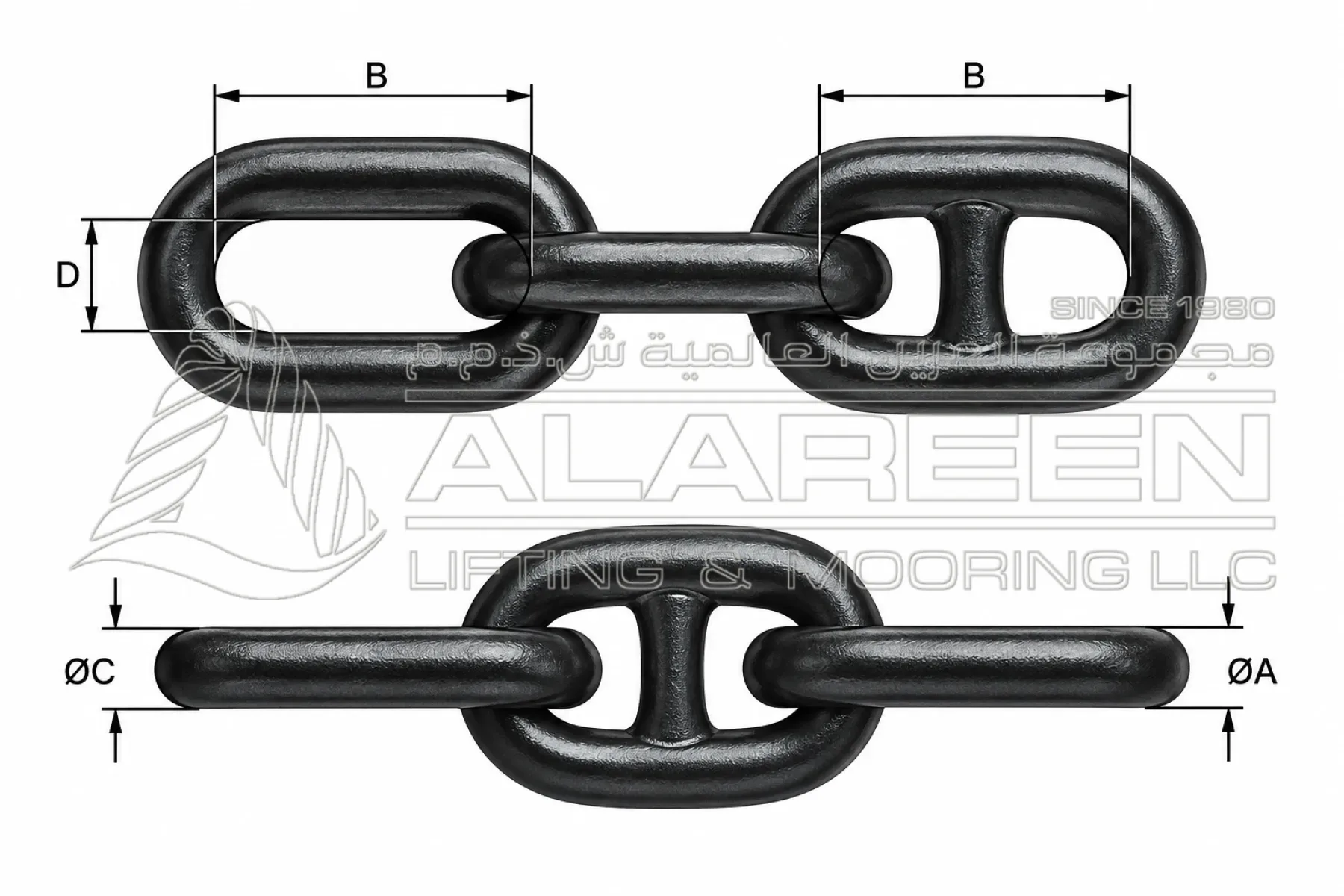
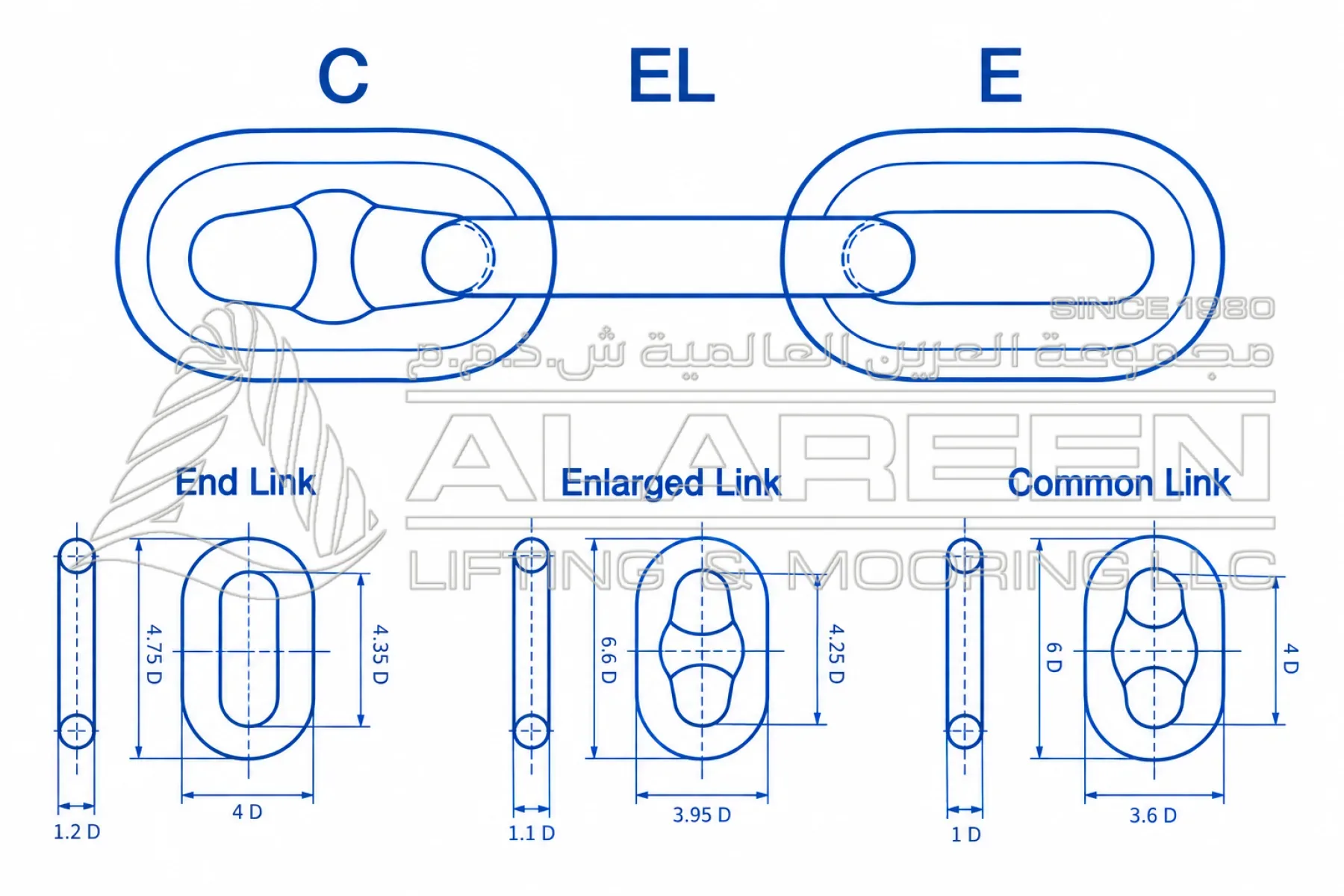
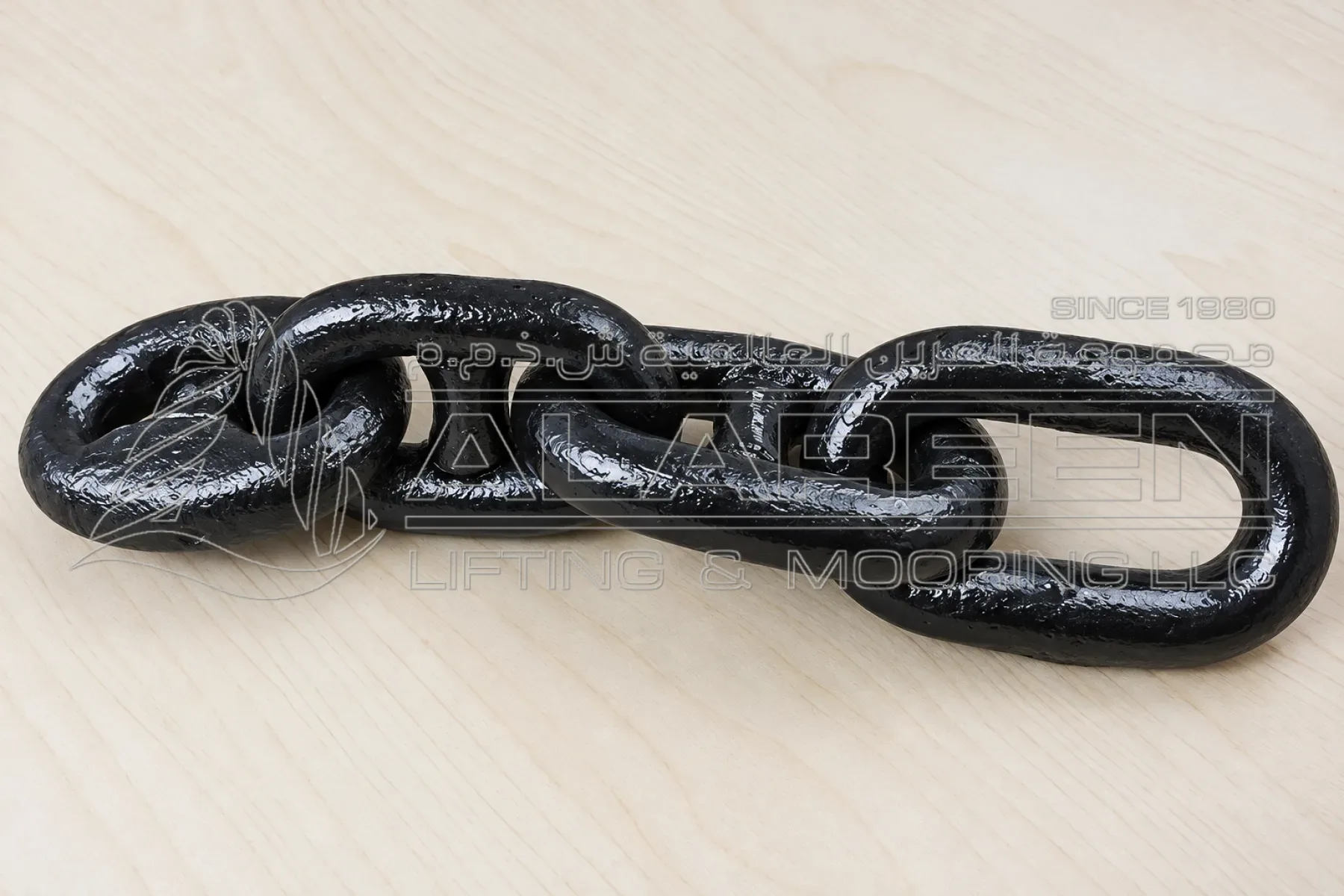
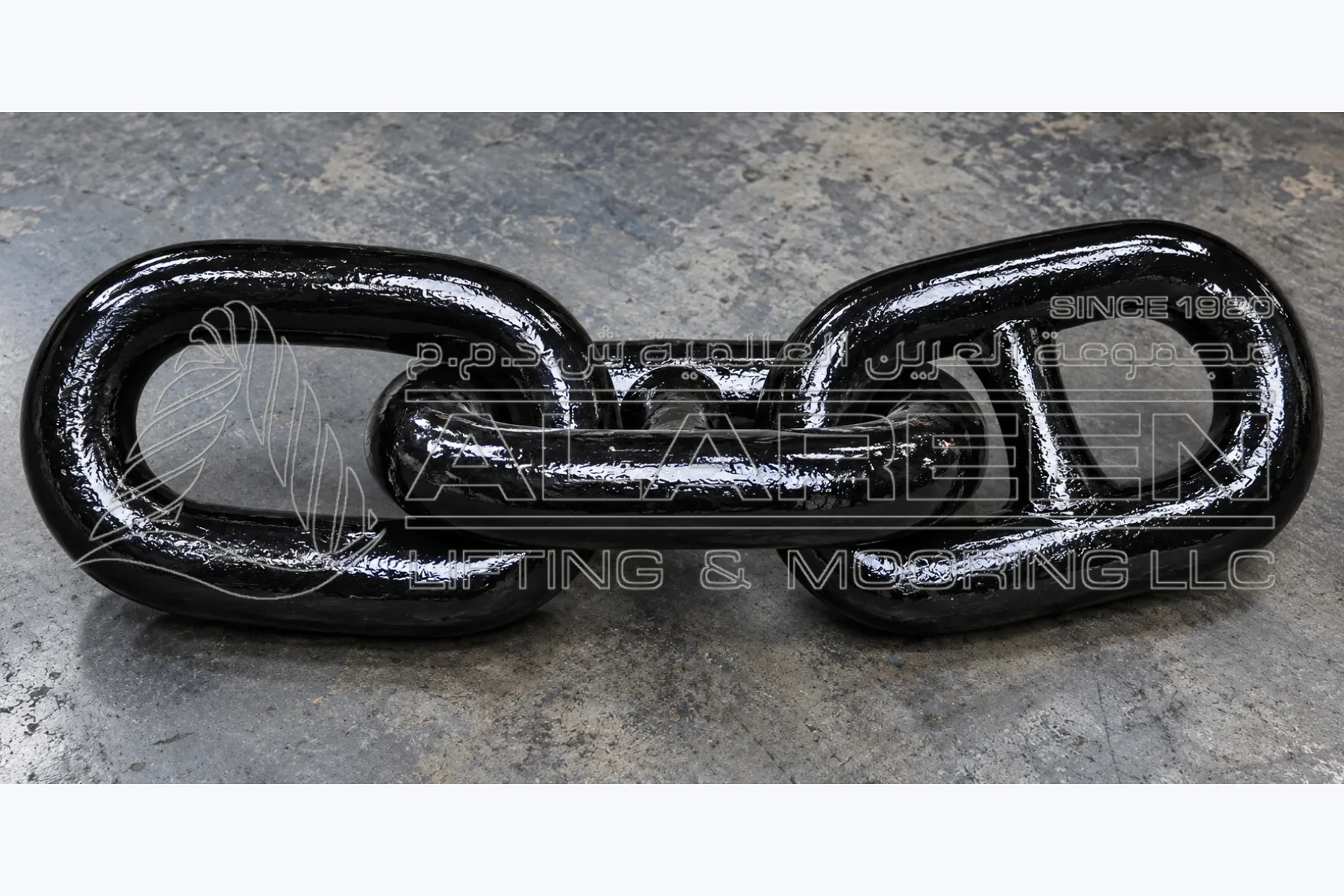
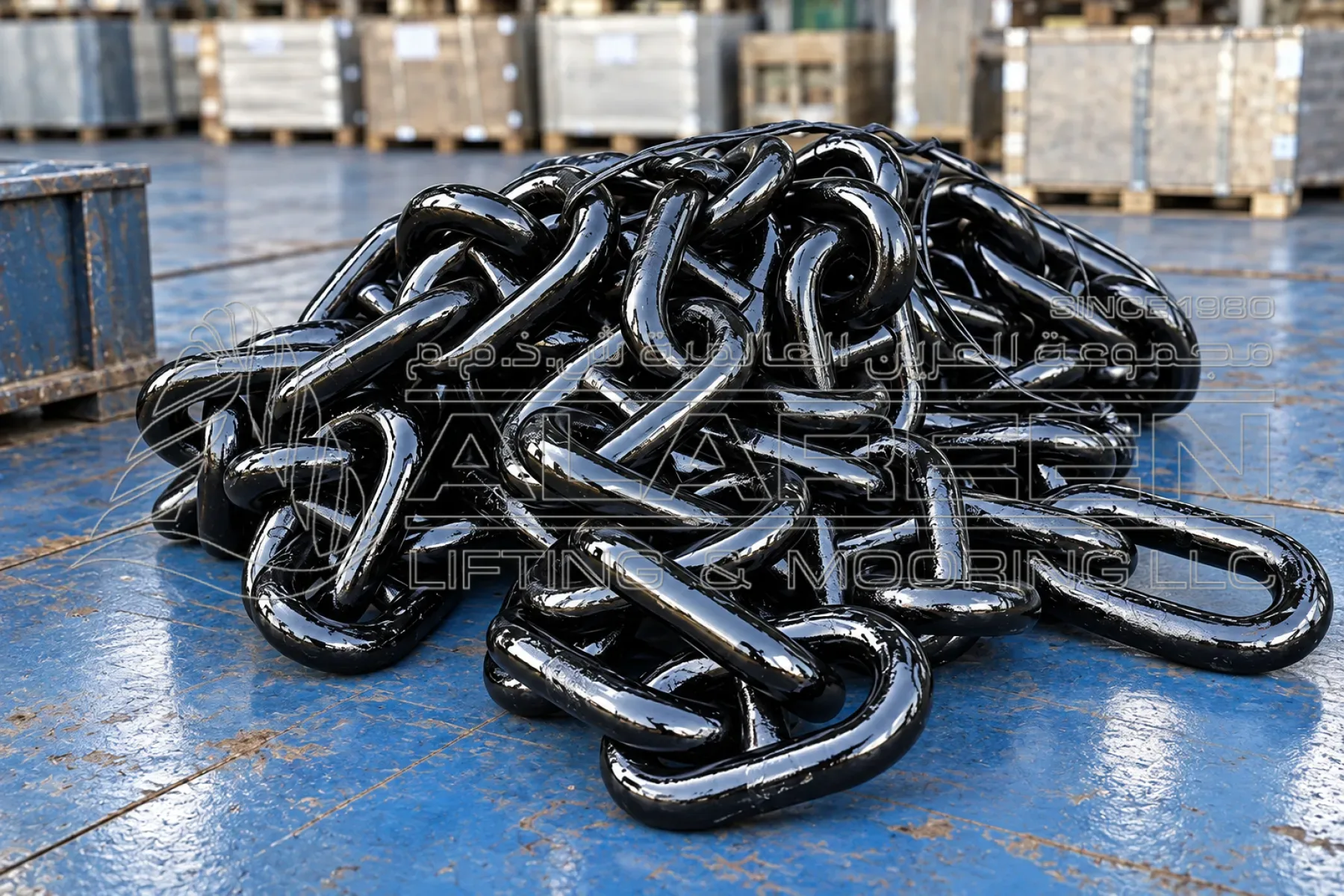
A three-link adaptor changes the connection geometry at the end of an anchor chain. In the conventional stud-link arrangement, a common stud link connects through an enlarged stud link to a larger, studless end link. The end link provides an interface for the specified anchor shackle, swivel assembly or chain-locker end connection. Choosing the assembly starts with its position in the vessel's chain arrangement, rather than its appearance alone.
Al Areen Lifting & Mooring LLC is a UAE/GCC trader, Leading Supplier, Certified Supplier and Largest Stockist of Three-Link Adaptors. As a No.1 Supplier, we support Best Quality sourcing for ship-specific anchor-chain requirements.
How the Three Links Form the Transition
| Component | Role in the conventional assembly | Connection detail to check |
|---|---|---|
| Common link — C or CL | Interfaces with the ordinary stud-link chain side. | Nominal chain size, link proportions and the specified joining arrangement. |
| Enlarged link — EL | Provides the intermediate link between common and end links. | Section size, internal space and articulation with both neighbouring links. |
| End link — E | Provides the larger studless opening for the end fitting. | Internal length and width, section diameter, shackle pin and jaw clearances. |
The expression open end link refers to the opening without a central stud in this context. It does not specify a cut or detachable link. The adjoining links remain individual, interlinked components.
Match the Adaptor to the Complete Anchor Cable
Anchor-side and chain-locker connections
An anchor-side transition must suit the selected anchor-end fitting and the vessel's stowage arrangement. A locker-side adaptor must suit the specified end fastening or cable clench. Those connections perform different jobs, so a replacement should follow the assembly drawing and the vessel's requirements. Where a mixed rope-and-chain arrangement uses a thimble eye or socket, assess the intervening shackle and termination together.
Geometry, grade and movement
Check the chain designation against the adaptor drawing, then check every adjoining interface. A fitting can share the chain's nominal size yet have an incompatible pin, jaw or internal opening. Consider articulation and the travel envelope through the equipment the assembly actually reaches, including the hawse arrangement, anchor pocket, chain stopper or windlass. Do not assume enlarged or end links will pass through a chainwheel designed for common links.
The assembly carries tension through successive link contacts. Trapped articulation, an unintended bearing point or a forced fit changes that connection. Resolve dimensional conflicts before installation. Steel grade, manufacturing condition and the required strength documentation must also suit the approved arrangement; increasing a nominal grade does not resolve a geometric mismatch.
Choose the Required Assembly, Not a Similar Fitting
A three-link adaptor provides a chain-end transition. A Kenter joining shackle provides a detachable joining connection. A swivel forerunner assembly includes a rotating component. Five-link and studless adaptor arrangements have their own drawings and interfaces. They should be assessed as alternative designs rather than automatic replacements.
For a complete enquiry, review the connected stud-link anchor chain and accessories alongside the anchor D-end shackle or specified swivel shackle. A conventional adaptor is not specified as a three-leg lifting master-link assembly. Towing or offshore mooring use requires a design explicitly selected for that duty.
Receipt, Installation and Inspection
At receipt, reconcile the assembly with its drawing and identification documents. Check all links for damage, visible cracking, deformation, significant corrosion, abnormal contact wear and stud condition where studs are fitted. Confirm that adjoining fittings can articulate as intended and that their locking arrangements follow the relevant instructions.
Have the responsible vessel or yard team secure the chain and control stored loads before changing a connection. Use a handling plan appropriate to the assembly's documented mass and shape. Do not force incompatible parts together, remove a stud, heat a link or modify a load-bearing section to obtain clearance without an approved repair or modification procedure.
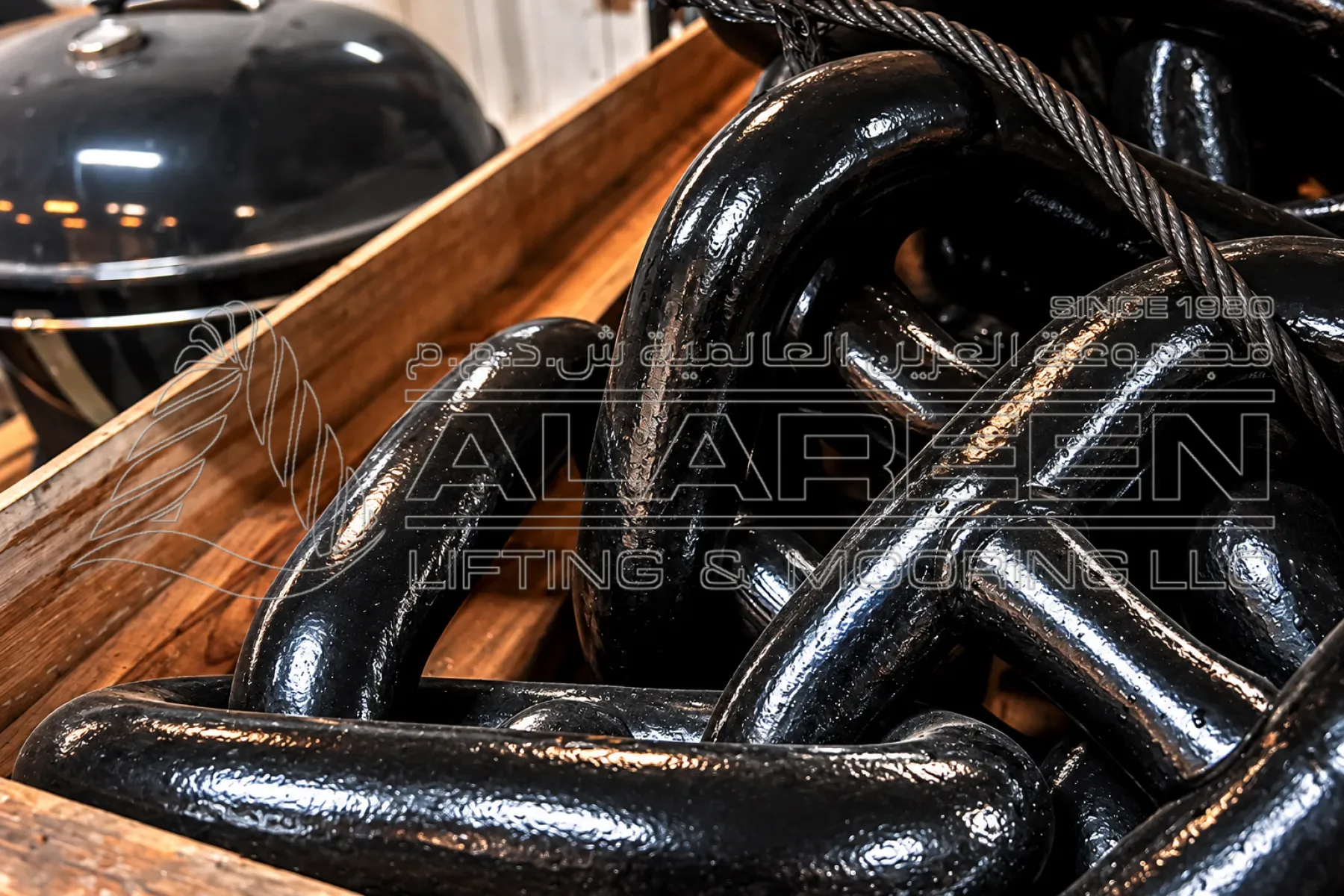
Keep stored assemblies identified, supported and protected from avoidable impact and corrosive exposure. Preserve markings when cleaning or maintaining the finish. Service inspections should follow the vessel's maintenance programme and applicable acceptance criteria; visual appearance alone cannot establish residual strength.
UAE & GCC Maritime Supply Coverage
Al Areen supports Three-Link Adaptor supply enquiries for customers and operations in or around the following maritime hubs. Provide the vessel or project reference, receiving location and required connection documents so the requirement can be coordinated with the nominated buyer, agent or repair yard.
| Maritime hub | Relevant enquiry context |
|---|---|
| Port of Fujairah | Fujairah and Gulf of Oman vessel or anchorage spares: identify the anchor-end arrangement and coordinate receipt through the nominated agent. |
| Khor Fakkan Port | Sharjah East Coast port-call procurement: match the visiting vessel's chain and end fitting when sourcing replacement anchor-cable components. |
| Mussafah Port | Abu Dhabi industrial-area marine buyers and workboat operators: assess the vessel-chain transition and connected termination, rather than general industrial chain hardware. |
| Port Rashid (Mina Rashid) | Dubai visiting-vessel and cruise-vessel technical enquiries: use vessel equipment records to identify the correct replacement connection. |
| Dubai Maritime City | Repair and refit procurement: reconcile removed components, inspection findings and connection drawings before specifying the replacement. |
| Hamriyah Port | Sharjah marine and industrial-vessel enquiries around Hamriyah Free Zone: distinguish anchor-chain parts from lifting or fender-chain fittings. |
| Khalifa Port | Taweelah shipowner, ship-manager and support-vessel enquiries: confirm chain-end geometry and vessel documents for the nominated receiving arrangement. |
| Drydocks World Dubai | Planned drydock renewal enquiries: review the adjoining chain, shackles and fastening condition so replacement scope reflects the inspection findings. |
| Port of Duqm | Al Wusta, Oman port and nearby drydock procurement: specify the complete connection and documentation required by the vessel or yard. |
| Khalifa Bin Salman Port | Hidd, Bahrain vessel-spares enquiries: agree the assembly identification, supporting documents and agent or consignee details for receipt. |
Enquiries also cover Jebel Ali Port, Zayed Port, Port Khalid, Saqr Port, Al Jazeera Port, Ajman Port and Dibba Port; Sohar Port, Port of Salalah and Asyad Drydock; Jeddah Islamic Port, King Abdulaziz Port, Jubail, Yanbu, Ras Al-Khair and Port of NEOM; Hamad Port, Ras Laffan and Mesaieed; ASRY and Mina Salman; and Shuwaikh, Shuaiba and HEISCO Shipyard. Wider markets include Dubai, Abu Dhabi, Sharjah, Fujairah, Ajman, Umm Al Quwain and Ras Al Khaimah, together with Saudi Arabia, Oman, Qatar, Bahrain and Kuwait.
Request a Three-Link Adaptor Quotation
Use the specification checklist below to describe the required assembly. A marked-up drawing and clear photographs of the connected fittings help distinguish a complete adaptor from a request for an individual end or enlarged link. Send the requirement through Get a Quote; the proposed configuration and supporting documentation should be agreed before ordering.
Company support includes Fast UAE & GCC Delivery, 24/7 Customer Support and Stock Availability. Confirm the required configuration and delivery arrangement in the quotation.
Technical Specifications
Request DatasheetThree-Link Adaptor Specification and Procurement Checklist
Specify a complete common-link/enlarged-link/end-link assembly where that configuration is required. Use the chain's original nominal designation and approved documents; measurements of a worn component alone are not a reliable new-part specification.
| Enquiry parameter | Information to provide or confirm | Reason for the check |
|---|---|---|
| Assembly position and duty | Anchor side, chain-locker end fastening or an explicitly designed mixed rope/chain connection; vessel and drawing reference. | Defines the connected hardware and operating arrangement. |
| Chain identification | Nominal chain diameter, stud-link or studless construction, grade designation and existing chain documents. | Establishes the chain family and required compatibility basis. |
| Assembly drawing | Common, enlarged and end-link section diameters; internal and external dimensions; stud arrangement; overall assembly length and tolerances. | Prevents selection by nominal diameter or a photograph alone. |
| End-fitting interfaces | Shackle or connector type, pin diameter, jaw width, bearing geometry and available articulation space. | Checks fit and intended contact without interference. |
| Equipment envelope | Clearances and travel route through the relevant anchor pocket, hawse arrangement, stopper, chainwheel or locker connection. | Checks where the enlarged geometry will actually travel or seat. |
| Material and manufacturing condition | Specified steel grade, manufacturing route and heat-treatment condition from the proposed manufacturer's documents. | A coating or visual finish does not establish material properties. |
| Strength and test requirements | Required proof-load and breaking-load evidence, accepted test basis and any purchaser/class requirements. | Uses the vessel's approved basis rather than an invented lifting WLL. |
| Surface finish and environment | Required protective finish, seawater exposure, service temperature and any special environmental restrictions. | Confirms suitability without assuming a particular coating or temperature rating. |
| Inspection and traceability | Item identification, manufacturer, grade, heat/batch reference, dimensional report and relevant material, test and class documents. | Allows the delivered assembly and paperwork to be reconciled. |
| Order and receiving details | Quantity, complete assembly or constituent parts, receiving port/yard, consignee or agent, packing instructions and required date. | Defines the quotation and logistics request; availability is confirmed against that request. |
Standards and Classification Basis
ISO 1704:2022 addresses the geometry and dimensional tolerances of stud-link anchor-chain components. Grade-specific adaptor specifications also exist: DIN 81854 addresses Grade K4 three-link adapter pieces, while VG 84516 addresses Grade GL-K3 assemblies. These references describe different specification bases and should not be applied indiscriminately to another grade or design.
State the vessel's applicable classification requirements and the required document type in the enquiry. Agreement on a standard, test evidence or class document must refer to the actual proposed assembly. Company supplier positioning does not establish an individual product's approval.
Document Review Before Acceptance
Match the assembly identification to the relevant drawing and reports. Distinguish a proof-load test from breaking-load evidence: they are different acceptance checks, and batch or design evidence must not be represented as a destructive test of every delivered item. Refer inspection findings, uncertain markings or proposed deviations to the responsible technical authority.
Applications Across Industry
FAQ
What is a Three-Link Adaptor?+
It is a chain-end transition assembly. The conventional stud-link type combines a common stud link, enlarged stud link and larger studless end link to connect the chain to its specified end fitting.
Why is an enlarged link included?+
It provides the intermediate geometry between the common chain link and the larger end link. Its section and internal dimensions must suit both neighbouring links.
What does open end link mean?+
For this assembly, it means an end link without a central stud. It does not mean the link is cut open or supplied as a detachable joining link.
Are all three links the same size?+
No. The conventional arrangement uses different link geometries. Obtain the drawing for the selected nominal chain size rather than assuming three identical common links.
Does the adaptor prevent chain twisting?+
A conventional three-link adaptor has no swivel mechanism. Where rotation is required, select the specified swivel or swivel-forerunner arrangement and check the complete connection.
Is it the same as a three-leg lifting master link?+
No. This product is an anchor-chain transition. A lifting master-link assembly has a different duty and selection basis; a lifting WLL cannot be assumed for an anchor-chain adaptor.
Where can an adaptor be fitted in an anchor cable?+
Depending on the design, it can form an anchor-side transition or a chain-locker end connection. Its actual position and adjoining fittings should follow the vessel's approved arrangement.
What is a cable clench connection?+
It is the vessel's inboard anchor-cable end fastening in the chain locker. An adaptor used there must suit the fastening arrangement; it is not selected solely from the anchor-end hardware.
Can it connect chain to a wire-rope termination?+
A designed mixed rope/chain arrangement may use an adaptor and suitable shackle to connect to a thimble eye or socket. Review the termination, shackle and chain together before selecting components.
Is nominal chain diameter enough to order?+
No. Also identify the grade, link construction, drawing, assembly position and end-fitting interfaces. Nominal diameter does not establish shackle clearance or equipment-envelope compatibility.
Which dimensions matter most at the end link?+
Check section diameter, internal opening dimensions, external envelope and contact geometry. Confirm the adjoining fitting's pin and jaw clearances and its intended articulation.
Can I use the measured diameter of a worn link as the ordered size?+
Use the original nominal designation and equipment records wherever possible. Wear changes the measured section, so an existing measurement should be treated as inspection information, not the complete new-part specification.
Will it fit any shackle with the same nominal size?+
Do not assume that. Different shackle types and models can have different pin diameters, jaw widths and bearing geometry. Check the actual drawings of both items.
Can the enlarged links run through a windlass chainwheel?+
Only where the equipment and approved arrangement accommodate them. Confirm the travel route and clearances; a chainwheel matched to common links may not accommodate the enlarged end geometry.
Which grades are available for my requirement?+
State the grade required by the connected chain and vessel specification. The proposed grade and documents are confirmed with the quotation; no universal grade or stock range applies to every enquiry.
Does a higher grade make an unsuitable adaptor compatible?+
No. Strength designation, geometry and the approval basis are separate checks. A higher grade does not correct a pin, opening, articulation or equipment-clearance conflict.
Can a studless chain use the same adaptor?+
Select the appropriate studless or other specified assembly by drawing. Do not assume that a conventional common-stud-link adaptor is interchangeable with a studless-chain transition.
When should I consider a five-link adaptor?+
When the connection drawing calls for that arrangement or an approved design review selects it. Compare overall length, interfaces and link construction; link count alone is not a substitution rule.
How does it differ from a Kenter joining shackle?+
A Kenter shackle is a detachable joining component. A three-link adaptor changes the chain-end geometry. Some arrangements use both, with each selected for its specific position.
Are painted and galvanized finishes interchangeable?+
Specify the required finish and confirm its suitability for the selected grade and design. Colour alone does not identify a coating system, material grade or corrosion-performance rating.
Can I cut out a stud to make an end connection fit?+
Do not modify a load-bearing assembly to obtain clearance without an approved technical procedure. Select the correct end-link geometry and connected fitting instead.
What should the installation team check before replacing it?+
Secure the chain and control stored loads, confirm the replacement drawing, check adjoining components and follow their assembly and locking instructions. Plan handling using the documented mass and shape.
What should be checked during inspection?+
Look for visible cracking, deformation, corrosion, unusual contact wear, damage and stud condition where fitted. Compare measurements and findings with the applicable vessel and manufacturer acceptance criteria.
What is the permissible wear limit?+
Use the limit applicable to the actual component, grade and vessel requirements. A universal percentage should not be applied to all three links or inferred from a generic chain listing.
What is the difference between proof-load and breaking-load evidence?+
Proof loading and breaking-load verification serve different purposes. Confirm the test basis and whether evidence relates to the delivered item, its manufacturing batch or an approved design.
What traceability documents should I request?+
Specify the drawing and identification requirements, then request the relevant material, test and class documents. Check manufacturer, grade, nominal size and heat/batch references against the assembly and paperwork.
Does Certified Supplier mean the adaptor has a class certificate?+
Certified Supplier is Al Areen's company positioning. The document required for an individual adaptor must be agreed and verified for the actual item; it is not established by a supplier label.
Does every adaptor comply with ISO 1704, DIN 81854 and VG 84516?+
No blanket claim applies. ISO 1704 concerns stud-link chain-component geometry; the DIN and VG adaptor specifications have specific grade scopes. Confirm the specification basis for the proposed assembly.
Can this item be used for towing or permanent offshore mooring?+
Only when an appropriate design has been selected and accepted for that duty. Do not equate a conventional ship anchor-chain adaptor with another offshore connector simply because both names contain adaptor.
How should spare adaptors be stored?+
Keep their identification and documents together, support them against avoidable damage and protect them from unnecessary corrosive exposure. Preserve markings and follow the selected product's storage and finish instructions.
What information helps obtain a quotation quickly?+
Provide the specification checklist, drawing or clear photographs, required quantity and receiving details. Identify whether you need the complete assembly or only an individual link.
Can Al Areen support an enquiry for Port of Fujairah or Khor Fakkan Port?+
Yes. Provide the vessel reference, required assembly and nominated agent or receiving details. Technical compatibility and the supply arrangement are confirmed for the particular enquiry.
What is needed for a Dubai drydock or repair-yard enquiry?+
Include the removed assembly's identification, inspection findings, connection drawing and the yard's required documentation and receiving date. This helps establish the replacement scope before ordering.
Can Abu Dhabi and Sharjah marine contractors enquire?+
Yes. Identify the actual vessel or anchoring arrangement and receiving location. An industrial-area or port address does not determine the required chain grade or adaptor design.
Can Al Areen handle Port of Duqm or Bahrain enquiries?+
Yes. Provide the assembly specification, vessel or yard reference, required documents and consignee/agent details. Confirm the proposed configuration and cross-border receiving arrangement in the quotation.
Are enquiries supported across all six GCC countries?+
Yes. Al Areen supports UAE, Saudi Arabia, Oman, Qatar, Bahrain and Kuwait enquiries. Product selection, documents, availability and delivery arrangements are confirmed for the requested configuration.
Product Overview
Three-Link Adaptors for Anchor Chain Connections
A three-link adaptor changes the connection geometry at the end of an anchor chain. In the conventional stud-link arrangement, a common stud link connects through an enlarged stud link to a larger, studless end link. The end link provides an interface for the specified anchor shackle, swivel assembly or chain-locker end connection. Choosing the assembly starts with its position in the vessel's chain arrangement, rather than its appearance alone.
Al Areen Lifting & Mooring LLC is a UAE/GCC trader, Leading Supplier, Certified Supplier and Largest Stockist of Three-Link Adaptors. As a No.1 Supplier, we support Best Quality sourcing for ship-specific anchor-chain requirements.
How the Three Links Form the Transition
| Component | Role in the conventional assembly | Connection detail to check |
|---|---|---|
| Common link — C or CL | Interfaces with the ordinary stud-link chain side. | Nominal chain size, link proportions and the specified joining arrangement. |
| Enlarged link — EL | Provides the intermediate link between common and end links. | Section size, internal space and articulation with both neighbouring links. |
| End link — E | Provides the larger studless opening for the end fitting. | Internal length and width, section diameter, shackle pin and jaw clearances. |
The expression open end link refers to the opening without a central stud in this context. It does not specify a cut or detachable link. The adjoining links remain individual, interlinked components.
Match the Adaptor to the Complete Anchor Cable
Anchor-side and chain-locker connections
An anchor-side transition must suit the selected anchor-end fitting and the vessel's stowage arrangement. A locker-side adaptor must suit the specified end fastening or cable clench. Those connections perform different jobs, so a replacement should follow the assembly drawing and the vessel's requirements. Where a mixed rope-and-chain arrangement uses a thimble eye or socket, assess the intervening shackle and termination together.
Geometry, grade and movement
Check the chain designation against the adaptor drawing, then check every adjoining interface. A fitting can share the chain's nominal size yet have an incompatible pin, jaw or internal opening. Consider articulation and the travel envelope through the equipment the assembly actually reaches, including the hawse arrangement, anchor pocket, chain stopper or windlass. Do not assume enlarged or end links will pass through a chainwheel designed for common links.
The assembly carries tension through successive link contacts. Trapped articulation, an unintended bearing point or a forced fit changes that connection. Resolve dimensional conflicts before installation. Steel grade, manufacturing condition and the required strength documentation must also suit the approved arrangement; increasing a nominal grade does not resolve a geometric mismatch.
Choose the Required Assembly, Not a Similar Fitting
A three-link adaptor provides a chain-end transition. A Kenter joining shackle provides a detachable joining connection. A swivel forerunner assembly includes a rotating component. Five-link and studless adaptor arrangements have their own drawings and interfaces. They should be assessed as alternative designs rather than automatic replacements.
For a complete enquiry, review the connected stud-link anchor chain and accessories alongside the anchor D-end shackle or specified swivel shackle. A conventional adaptor is not specified as a three-leg lifting master-link assembly. Towing or offshore mooring use requires a design explicitly selected for that duty.
Receipt, Installation and Inspection
At receipt, reconcile the assembly with its drawing and identification documents. Check all links for damage, visible cracking, deformation, significant corrosion, abnormal contact wear and stud condition where studs are fitted. Confirm that adjoining fittings can articulate as intended and that their locking arrangements follow the relevant instructions.
Have the responsible vessel or yard team secure the chain and control stored loads before changing a connection. Use a handling plan appropriate to the assembly's documented mass and shape. Do not force incompatible parts together, remove a stud, heat a link or modify a load-bearing section to obtain clearance without an approved repair or modification procedure.
Keep stored assemblies identified, supported and protected from avoidable impact and corrosive exposure. Preserve markings when cleaning or maintaining the finish. Service inspections should follow the vessel's maintenance programme and applicable acceptance criteria; visual appearance alone cannot establish residual strength.
UAE & GCC Maritime Supply Coverage
Al Areen supports Three-Link Adaptor supply enquiries for customers and operations in or around the following maritime hubs. Provide the vessel or project reference, receiving location and required connection documents so the requirement can be coordinated with the nominated buyer, agent or repair yard.
| Maritime hub | Relevant enquiry context |
|---|---|
| Port of Fujairah | Fujairah and Gulf of Oman vessel or anchorage spares: identify the anchor-end arrangement and coordinate receipt through the nominated agent. |
| Khor Fakkan Port | Sharjah East Coast port-call procurement: match the visiting vessel's chain and end fitting when sourcing replacement anchor-cable components. |
| Mussafah Port | Abu Dhabi industrial-area marine buyers and workboat operators: assess the vessel-chain transition and connected termination, rather than general industrial chain hardware. |
| Port Rashid (Mina Rashid) | Dubai visiting-vessel and cruise-vessel technical enquiries: use vessel equipment records to identify the correct replacement connection. |
| Dubai Maritime City | Repair and refit procurement: reconcile removed components, inspection findings and connection drawings before specifying the replacement. |
| Hamriyah Port | Sharjah marine and industrial-vessel enquiries around Hamriyah Free Zone: distinguish anchor-chain parts from lifting or fender-chain fittings. |
| Khalifa Port | Taweelah shipowner, ship-manager and support-vessel enquiries: confirm chain-end geometry and vessel documents for the nominated receiving arrangement. |
| Drydocks World Dubai | Planned drydock renewal enquiries: review the adjoining chain, shackles and fastening condition so replacement scope reflects the inspection findings. |
| Port of Duqm | Al Wusta, Oman port and nearby drydock procurement: specify the complete connection and documentation required by the vessel or yard. |
| Khalifa Bin Salman Port | Hidd, Bahrain vessel-spares enquiries: agree the assembly identification, supporting documents and agent or consignee details for receipt. |
Enquiries also cover Jebel Ali Port, Zayed Port, Port Khalid, Saqr Port, Al Jazeera Port, Ajman Port and Dibba Port; Sohar Port, Port of Salalah and Asyad Drydock; Jeddah Islamic Port, King Abdulaziz Port, Jubail, Yanbu, Ras Al-Khair and Port of NEOM; Hamad Port, Ras Laffan and Mesaieed; ASRY and Mina Salman; and Shuwaikh, Shuaiba and HEISCO Shipyard. Wider markets include Dubai, Abu Dhabi, Sharjah, Fujairah, Ajman, Umm Al Quwain and Ras Al Khaimah, together with Saudi Arabia, Oman, Qatar, Bahrain and Kuwait.
Request a Three-Link Adaptor Quotation
Use the specification checklist below to describe the required assembly. A marked-up drawing and clear photographs of the connected fittings help distinguish a complete adaptor from a request for an individual end or enlarged link. Send the requirement through Get a Quote; the proposed configuration and supporting documentation should be agreed before ordering.
Company support includes Fast UAE & GCC Delivery, 24/7 Customer Support and Stock Availability. Confirm the required configuration and delivery arrangement in the quotation.
01 / 06
Technical Specifications
Request DatasheetThree-Link Adaptor Specification and Procurement Checklist
Specify a complete common-link/enlarged-link/end-link assembly where that configuration is required. Use the chain's original nominal designation and approved documents; measurements of a worn component alone are not a reliable new-part specification.
| Enquiry parameter | Information to provide or confirm | Reason for the check |
|---|---|---|
| Assembly position and duty | Anchor side, chain-locker end fastening or an explicitly designed mixed rope/chain connection; vessel and drawing reference. | Defines the connected hardware and operating arrangement. |
| Chain identification | Nominal chain diameter, stud-link or studless construction, grade designation and existing chain documents. | Establishes the chain family and required compatibility basis. |
| Assembly drawing | Common, enlarged and end-link section diameters; internal and external dimensions; stud arrangement; overall assembly length and tolerances. | Prevents selection by nominal diameter or a photograph alone. |
| End-fitting interfaces | Shackle or connector type, pin diameter, jaw width, bearing geometry and available articulation space. | Checks fit and intended contact without interference. |
| Equipment envelope | Clearances and travel route through the relevant anchor pocket, hawse arrangement, stopper, chainwheel or locker connection. | Checks where the enlarged geometry will actually travel or seat. |
| Material and manufacturing condition | Specified steel grade, manufacturing route and heat-treatment condition from the proposed manufacturer's documents. | A coating or visual finish does not establish material properties. |
| Strength and test requirements | Required proof-load and breaking-load evidence, accepted test basis and any purchaser/class requirements. | Uses the vessel's approved basis rather than an invented lifting WLL. |
| Surface finish and environment | Required protective finish, seawater exposure, service temperature and any special environmental restrictions. | Confirms suitability without assuming a particular coating or temperature rating. |
| Inspection and traceability | Item identification, manufacturer, grade, heat/batch reference, dimensional report and relevant material, test and class documents. | Allows the delivered assembly and paperwork to be reconciled. |
| Order and receiving details | Quantity, complete assembly or constituent parts, receiving port/yard, consignee or agent, packing instructions and required date. | Defines the quotation and logistics request; availability is confirmed against that request. |
Standards and Classification Basis
ISO 1704:2022 addresses the geometry and dimensional tolerances of stud-link anchor-chain components. Grade-specific adaptor specifications also exist: DIN 81854 addresses Grade K4 three-link adapter pieces, while VG 84516 addresses Grade GL-K3 assemblies. These references describe different specification bases and should not be applied indiscriminately to another grade or design.
State the vessel's applicable classification requirements and the required document type in the enquiry. Agreement on a standard, test evidence or class document must refer to the actual proposed assembly. Company supplier positioning does not establish an individual product's approval.
Document Review Before Acceptance
Match the assembly identification to the relevant drawing and reports. Distinguish a proof-load test from breaking-load evidence: they are different acceptance checks, and batch or design evidence must not be represented as a destructive test of every delivered item. Refer inspection findings, uncertain markings or proposed deviations to the responsible technical authority.
Applications Across Industry
FAQ
What is a Three-Link Adaptor?+
It is a chain-end transition assembly. The conventional stud-link type combines a common stud link, enlarged stud link and larger studless end link to connect the chain to its specified end fitting.
Why is an enlarged link included?+
It provides the intermediate geometry between the common chain link and the larger end link. Its section and internal dimensions must suit both neighbouring links.
What does open end link mean?+
For this assembly, it means an end link without a central stud. It does not mean the link is cut open or supplied as a detachable joining link.
Are all three links the same size?+
No. The conventional arrangement uses different link geometries. Obtain the drawing for the selected nominal chain size rather than assuming three identical common links.
Does the adaptor prevent chain twisting?+
A conventional three-link adaptor has no swivel mechanism. Where rotation is required, select the specified swivel or swivel-forerunner arrangement and check the complete connection.
Is it the same as a three-leg lifting master link?+
No. This product is an anchor-chain transition. A lifting master-link assembly has a different duty and selection basis; a lifting WLL cannot be assumed for an anchor-chain adaptor.
Where can an adaptor be fitted in an anchor cable?+
Depending on the design, it can form an anchor-side transition or a chain-locker end connection. Its actual position and adjoining fittings should follow the vessel's approved arrangement.
What is a cable clench connection?+
It is the vessel's inboard anchor-cable end fastening in the chain locker. An adaptor used there must suit the fastening arrangement; it is not selected solely from the anchor-end hardware.
Can it connect chain to a wire-rope termination?+
A designed mixed rope/chain arrangement may use an adaptor and suitable shackle to connect to a thimble eye or socket. Review the termination, shackle and chain together before selecting components.
Is nominal chain diameter enough to order?+
No. Also identify the grade, link construction, drawing, assembly position and end-fitting interfaces. Nominal diameter does not establish shackle clearance or equipment-envelope compatibility.
Which dimensions matter most at the end link?+
Check section diameter, internal opening dimensions, external envelope and contact geometry. Confirm the adjoining fitting's pin and jaw clearances and its intended articulation.
Can I use the measured diameter of a worn link as the ordered size?+
Use the original nominal designation and equipment records wherever possible. Wear changes the measured section, so an existing measurement should be treated as inspection information, not the complete new-part specification.
Will it fit any shackle with the same nominal size?+
Do not assume that. Different shackle types and models can have different pin diameters, jaw widths and bearing geometry. Check the actual drawings of both items.
Can the enlarged links run through a windlass chainwheel?+
Only where the equipment and approved arrangement accommodate them. Confirm the travel route and clearances; a chainwheel matched to common links may not accommodate the enlarged end geometry.
Which grades are available for my requirement?+
State the grade required by the connected chain and vessel specification. The proposed grade and documents are confirmed with the quotation; no universal grade or stock range applies to every enquiry.
Does a higher grade make an unsuitable adaptor compatible?+
No. Strength designation, geometry and the approval basis are separate checks. A higher grade does not correct a pin, opening, articulation or equipment-clearance conflict.
Can a studless chain use the same adaptor?+
Select the appropriate studless or other specified assembly by drawing. Do not assume that a conventional common-stud-link adaptor is interchangeable with a studless-chain transition.
When should I consider a five-link adaptor?+
When the connection drawing calls for that arrangement or an approved design review selects it. Compare overall length, interfaces and link construction; link count alone is not a substitution rule.
How does it differ from a Kenter joining shackle?+
A Kenter shackle is a detachable joining component. A three-link adaptor changes the chain-end geometry. Some arrangements use both, with each selected for its specific position.
Are painted and galvanized finishes interchangeable?+
Specify the required finish and confirm its suitability for the selected grade and design. Colour alone does not identify a coating system, material grade or corrosion-performance rating.
Can I cut out a stud to make an end connection fit?+
Do not modify a load-bearing assembly to obtain clearance without an approved technical procedure. Select the correct end-link geometry and connected fitting instead.
What should the installation team check before replacing it?+
Secure the chain and control stored loads, confirm the replacement drawing, check adjoining components and follow their assembly and locking instructions. Plan handling using the documented mass and shape.
What should be checked during inspection?+
Look for visible cracking, deformation, corrosion, unusual contact wear, damage and stud condition where fitted. Compare measurements and findings with the applicable vessel and manufacturer acceptance criteria.
What is the permissible wear limit?+
Use the limit applicable to the actual component, grade and vessel requirements. A universal percentage should not be applied to all three links or inferred from a generic chain listing.
What is the difference between proof-load and breaking-load evidence?+
Proof loading and breaking-load verification serve different purposes. Confirm the test basis and whether evidence relates to the delivered item, its manufacturing batch or an approved design.
What traceability documents should I request?+
Specify the drawing and identification requirements, then request the relevant material, test and class documents. Check manufacturer, grade, nominal size and heat/batch references against the assembly and paperwork.
Does Certified Supplier mean the adaptor has a class certificate?+
Certified Supplier is Al Areen's company positioning. The document required for an individual adaptor must be agreed and verified for the actual item; it is not established by a supplier label.
Does every adaptor comply with ISO 1704, DIN 81854 and VG 84516?+
No blanket claim applies. ISO 1704 concerns stud-link chain-component geometry; the DIN and VG adaptor specifications have specific grade scopes. Confirm the specification basis for the proposed assembly.
Can this item be used for towing or permanent offshore mooring?+
Only when an appropriate design has been selected and accepted for that duty. Do not equate a conventional ship anchor-chain adaptor with another offshore connector simply because both names contain adaptor.
How should spare adaptors be stored?+
Keep their identification and documents together, support them against avoidable damage and protect them from unnecessary corrosive exposure. Preserve markings and follow the selected product's storage and finish instructions.
What information helps obtain a quotation quickly?+
Provide the specification checklist, drawing or clear photographs, required quantity and receiving details. Identify whether you need the complete assembly or only an individual link.
Can Al Areen support an enquiry for Port of Fujairah or Khor Fakkan Port?+
Yes. Provide the vessel reference, required assembly and nominated agent or receiving details. Technical compatibility and the supply arrangement are confirmed for the particular enquiry.
What is needed for a Dubai drydock or repair-yard enquiry?+
Include the removed assembly's identification, inspection findings, connection drawing and the yard's required documentation and receiving date. This helps establish the replacement scope before ordering.
Can Abu Dhabi and Sharjah marine contractors enquire?+
Yes. Identify the actual vessel or anchoring arrangement and receiving location. An industrial-area or port address does not determine the required chain grade or adaptor design.
Can Al Areen handle Port of Duqm or Bahrain enquiries?+
Yes. Provide the assembly specification, vessel or yard reference, required documents and consignee/agent details. Confirm the proposed configuration and cross-border receiving arrangement in the quotation.
Are enquiries supported across all six GCC countries?+
Yes. Al Areen supports UAE, Saudi Arabia, Oman, Qatar, Bahrain and Kuwait enquiries. Product selection, documents, availability and delivery arrangements are confirmed for the requested configuration.
Technical Specifications+
Three-Link Adaptor Specification and Procurement Checklist
Specify a complete common-link/enlarged-link/end-link assembly where that configuration is required. Use the chain's original nominal designation and approved documents; measurements of a worn component alone are not a reliable new-part specification.
| Enquiry parameter | Information to provide or confirm | Reason for the check |
|---|---|---|
| Assembly position and duty | Anchor side, chain-locker end fastening or an explicitly designed mixed rope/chain connection; vessel and drawing reference. | Defines the connected hardware and operating arrangement. |
| Chain identification | Nominal chain diameter, stud-link or studless construction, grade designation and existing chain documents. | Establishes the chain family and required compatibility basis. |
| Assembly drawing | Common, enlarged and end-link section diameters; internal and external dimensions; stud arrangement; overall assembly length and tolerances. | Prevents selection by nominal diameter or a photograph alone. |
| End-fitting interfaces | Shackle or connector type, pin diameter, jaw width, bearing geometry and available articulation space. | Checks fit and intended contact without interference. |
| Equipment envelope | Clearances and travel route through the relevant anchor pocket, hawse arrangement, stopper, chainwheel or locker connection. | Checks where the enlarged geometry will actually travel or seat. |
| Material and manufacturing condition | Specified steel grade, manufacturing route and heat-treatment condition from the proposed manufacturer's documents. | A coating or visual finish does not establish material properties. |
| Strength and test requirements | Required proof-load and breaking-load evidence, accepted test basis and any purchaser/class requirements. | Uses the vessel's approved basis rather than an invented lifting WLL. |
| Surface finish and environment | Required protective finish, seawater exposure, service temperature and any special environmental restrictions. | Confirms suitability without assuming a particular coating or temperature rating. |
| Inspection and traceability | Item identification, manufacturer, grade, heat/batch reference, dimensional report and relevant material, test and class documents. | Allows the delivered assembly and paperwork to be reconciled. |
| Order and receiving details | Quantity, complete assembly or constituent parts, receiving port/yard, consignee or agent, packing instructions and required date. | Defines the quotation and logistics request; availability is confirmed against that request. |
Standards and Classification Basis
ISO 1704:2022 addresses the geometry and dimensional tolerances of stud-link anchor-chain components. Grade-specific adaptor specifications also exist: DIN 81854 addresses Grade K4 three-link adapter pieces, while VG 84516 addresses Grade GL-K3 assemblies. These references describe different specification bases and should not be applied indiscriminately to another grade or design.
State the vessel's applicable classification requirements and the required document type in the enquiry. Agreement on a standard, test evidence or class document must refer to the actual proposed assembly. Company supplier positioning does not establish an individual product's approval.
Document Review Before Acceptance
Match the assembly identification to the relevant drawing and reports. Distinguish a proof-load test from breaking-load evidence: they are different acceptance checks, and batch or design evidence must not be represented as a destructive test of every delivered item. Refer inspection findings, uncertain markings or proposed deviations to the responsible technical authority.
Applications Across Industry+
FAQ+
What is a Three-Link Adaptor?+
It is a chain-end transition assembly. The conventional stud-link type combines a common stud link, enlarged stud link and larger studless end link to connect the chain to its specified end fitting.
Why is an enlarged link included?+
It provides the intermediate geometry between the common chain link and the larger end link. Its section and internal dimensions must suit both neighbouring links.
What does open end link mean?+
For this assembly, it means an end link without a central stud. It does not mean the link is cut open or supplied as a detachable joining link.
Are all three links the same size?+
No. The conventional arrangement uses different link geometries. Obtain the drawing for the selected nominal chain size rather than assuming three identical common links.
Does the adaptor prevent chain twisting?+
A conventional three-link adaptor has no swivel mechanism. Where rotation is required, select the specified swivel or swivel-forerunner arrangement and check the complete connection.
Is it the same as a three-leg lifting master link?+
No. This product is an anchor-chain transition. A lifting master-link assembly has a different duty and selection basis; a lifting WLL cannot be assumed for an anchor-chain adaptor.
Where can an adaptor be fitted in an anchor cable?+
Depending on the design, it can form an anchor-side transition or a chain-locker end connection. Its actual position and adjoining fittings should follow the vessel's approved arrangement.
What is a cable clench connection?+
It is the vessel's inboard anchor-cable end fastening in the chain locker. An adaptor used there must suit the fastening arrangement; it is not selected solely from the anchor-end hardware.
Can it connect chain to a wire-rope termination?+
A designed mixed rope/chain arrangement may use an adaptor and suitable shackle to connect to a thimble eye or socket. Review the termination, shackle and chain together before selecting components.
Is nominal chain diameter enough to order?+
No. Also identify the grade, link construction, drawing, assembly position and end-fitting interfaces. Nominal diameter does not establish shackle clearance or equipment-envelope compatibility.
Which dimensions matter most at the end link?+
Check section diameter, internal opening dimensions, external envelope and contact geometry. Confirm the adjoining fitting's pin and jaw clearances and its intended articulation.
Can I use the measured diameter of a worn link as the ordered size?+
Use the original nominal designation and equipment records wherever possible. Wear changes the measured section, so an existing measurement should be treated as inspection information, not the complete new-part specification.
Will it fit any shackle with the same nominal size?+
Do not assume that. Different shackle types and models can have different pin diameters, jaw widths and bearing geometry. Check the actual drawings of both items.
Can the enlarged links run through a windlass chainwheel?+
Only where the equipment and approved arrangement accommodate them. Confirm the travel route and clearances; a chainwheel matched to common links may not accommodate the enlarged end geometry.
Which grades are available for my requirement?+
State the grade required by the connected chain and vessel specification. The proposed grade and documents are confirmed with the quotation; no universal grade or stock range applies to every enquiry.
Does a higher grade make an unsuitable adaptor compatible?+
No. Strength designation, geometry and the approval basis are separate checks. A higher grade does not correct a pin, opening, articulation or equipment-clearance conflict.
Can a studless chain use the same adaptor?+
Select the appropriate studless or other specified assembly by drawing. Do not assume that a conventional common-stud-link adaptor is interchangeable with a studless-chain transition.
When should I consider a five-link adaptor?+
When the connection drawing calls for that arrangement or an approved design review selects it. Compare overall length, interfaces and link construction; link count alone is not a substitution rule.
How does it differ from a Kenter joining shackle?+
A Kenter shackle is a detachable joining component. A three-link adaptor changes the chain-end geometry. Some arrangements use both, with each selected for its specific position.
Are painted and galvanized finishes interchangeable?+
Specify the required finish and confirm its suitability for the selected grade and design. Colour alone does not identify a coating system, material grade or corrosion-performance rating.
Can I cut out a stud to make an end connection fit?+
Do not modify a load-bearing assembly to obtain clearance without an approved technical procedure. Select the correct end-link geometry and connected fitting instead.
What should the installation team check before replacing it?+
Secure the chain and control stored loads, confirm the replacement drawing, check adjoining components and follow their assembly and locking instructions. Plan handling using the documented mass and shape.
What should be checked during inspection?+
Look for visible cracking, deformation, corrosion, unusual contact wear, damage and stud condition where fitted. Compare measurements and findings with the applicable vessel and manufacturer acceptance criteria.
What is the permissible wear limit?+
Use the limit applicable to the actual component, grade and vessel requirements. A universal percentage should not be applied to all three links or inferred from a generic chain listing.
What is the difference between proof-load and breaking-load evidence?+
Proof loading and breaking-load verification serve different purposes. Confirm the test basis and whether evidence relates to the delivered item, its manufacturing batch or an approved design.
What traceability documents should I request?+
Specify the drawing and identification requirements, then request the relevant material, test and class documents. Check manufacturer, grade, nominal size and heat/batch references against the assembly and paperwork.
Does Certified Supplier mean the adaptor has a class certificate?+
Certified Supplier is Al Areen's company positioning. The document required for an individual adaptor must be agreed and verified for the actual item; it is not established by a supplier label.
Does every adaptor comply with ISO 1704, DIN 81854 and VG 84516?+
No blanket claim applies. ISO 1704 concerns stud-link chain-component geometry; the DIN and VG adaptor specifications have specific grade scopes. Confirm the specification basis for the proposed assembly.
Can this item be used for towing or permanent offshore mooring?+
Only when an appropriate design has been selected and accepted for that duty. Do not equate a conventional ship anchor-chain adaptor with another offshore connector simply because both names contain adaptor.
How should spare adaptors be stored?+
Keep their identification and documents together, support them against avoidable damage and protect them from unnecessary corrosive exposure. Preserve markings and follow the selected product's storage and finish instructions.
What information helps obtain a quotation quickly?+
Provide the specification checklist, drawing or clear photographs, required quantity and receiving details. Identify whether you need the complete assembly or only an individual link.
Can Al Areen support an enquiry for Port of Fujairah or Khor Fakkan Port?+
Yes. Provide the vessel reference, required assembly and nominated agent or receiving details. Technical compatibility and the supply arrangement are confirmed for the particular enquiry.
What is needed for a Dubai drydock or repair-yard enquiry?+
Include the removed assembly's identification, inspection findings, connection drawing and the yard's required documentation and receiving date. This helps establish the replacement scope before ordering.
Can Abu Dhabi and Sharjah marine contractors enquire?+
Yes. Identify the actual vessel or anchoring arrangement and receiving location. An industrial-area or port address does not determine the required chain grade or adaptor design.
Can Al Areen handle Port of Duqm or Bahrain enquiries?+
Yes. Provide the assembly specification, vessel or yard reference, required documents and consignee/agent details. Confirm the proposed configuration and cross-border receiving arrangement in the quotation.
Are enquiries supported across all six GCC countries?+
Yes. Al Areen supports UAE, Saudi Arabia, Oman, Qatar, Bahrain and Kuwait enquiries. Product selection, documents, availability and delivery arrangements are confirmed for the requested configuration.
Need help selecting the right product?
Our team will help you choose the best solution for your application.